
THE GIANT CASH FLOW IS ZERO AND OVERVALUED
The three bubble theories were defused by the new paradigm, but this time, cash flows were rushing, miscalculated, smart money retreated and three cracks appeared simultaneously。
ORIGINAL TITLE: " GENERATING AI, NO FOURTH FOAM? "
Original author: Xiao Jing, Tsing Tsik
THREE AND A HALF YEARS AFTER THE OUTBREAK OF GENERATING AI, THE MARKET HAS ENTERED A NEW POINT OF DISAGREEMENT: OPTIMISM IS ACCELERATING AND SUSPICION IS ACCUMULATING. IT IS NOT ENOUGH TO JUDGE WHETHER THE FOAM IS COMING. THE "AI FAITH AND FOAM" SERIES WILL LOOK FOR KEY VARIABLES FROM DIFFERENT PERSPECTIVES OF MARKETS, TECHNOLOGIES, INDUSTRIES AND COMPANIES. THIS IS THE FIRST IN THE SERIES。
On 9 June, Korea ' s KOSPI index rebounded significantly, with a one-time increase of nearly 5 per cent in discs; KOSPI 200 futures increased by 5 per cent, triggering buy-in sidecar, and the program was suspended for 5 minutes. On the previous trading day (8 June), KOSPI once fell by 8%, breaking 8000 points。
OVER THE PAST TWO YEARS, KOREA HAS BEEN ALMOST THE MOST SENSITIVE AMPLIFIER OF TRANSACTIONS IN AI WORLDWIDE: YOUNG WEIDARS, HBMS; AI SERVERS, SK HERCULES; STORAGE PRICE INCREASES; AND THE VALUATION LOGIC OF SAMSUNG AND LIGHT HAS BEEN REWRITTEN. IT EMBRACES BOTH THE IMAGINATION OF GLOBAL AI INFRASTRUCTURE EXPANSION AND THE MARKET'S DOUBTS ABOUT WHETHER THE EXPANSION IS OVERHEATED。
SO, SOUTH KOREA’S STOCK MARKET REPEATEDLY TRIGGERS TRADING COOLING MECHANISMS BETWEEN RISING AND FALLING, REFLECTING THE GROWING DIVISION OF GLOBAL CAPITAL MARKETS OVER AI。
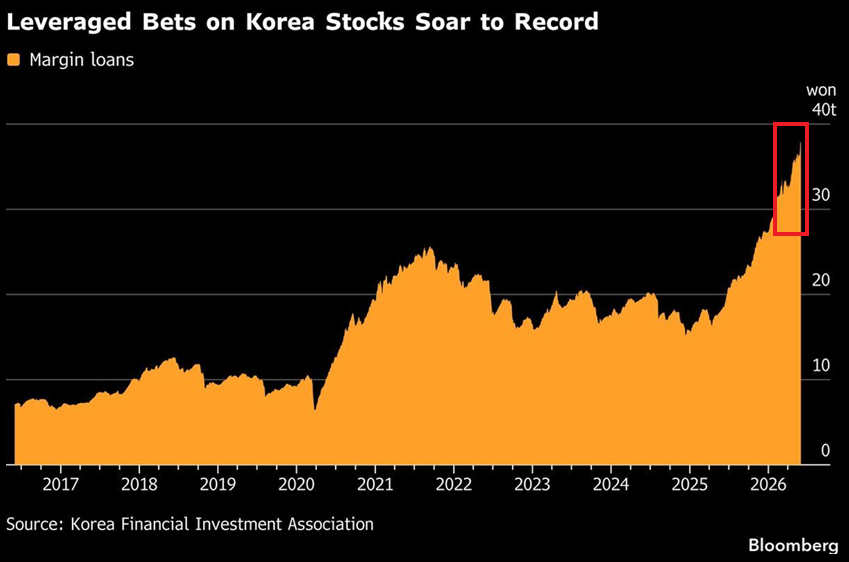
Figure: Korean stock market financing balances have risen to historical highs
ON THE ONE HAND, AI REMAINS THE BEST-ESTABLISHED INVESTMENT NEXUS. ALMOST ALL CORE ASSETS, FROM CHIPS, STORAGE, CLOUD COMPUTING TO LARGE MODEL COMPANIES, HAVE BEEN RE-INCORPORATED INTO THE "AI INFRASTRUCTURE" VALUATION FRAMEWORK。
As long as capacity demand continues to grow, today ' s capital expenditures, supply chain price increases and high valuations can be interpreted as pre-investments for future growth。
On the other side, suspicion is also accumulating。
AI IS BECOMING INCREASINGLY EXPENSIVE. CAPITAL EXPENDITURE OF THE GIANTS CONTINUES TO RISE, THE VALUATION OF THE LARGE MODEL COMPANIES CONTINUES TO RISE, AND AI IS QUEUING TOWARDS IPO。
GENERATING AI FOR THREE AND A HALF YEARS, THERE HAVE BEEN THREE ROUNDS OF SERIOUS DISCUSSIONS ABOUT FOAM. EACH ROUND HAS A CLEAR TRIGGER, A CLEAR LOGICAL CHAIN AND SEEMINGLY FATAL QUESTIONS, AND EACH MARKET HAS FOUND NEW HOPE IN THE CRACKS AND CONTINUES TO BET。
This time, from the reaction of the market, we have been at the centre of the fourth round of disagreements。
According to several investors, “it is far from time to talk about bubbles, even though the cash flow of the giants has begun to be eaten, the giants are still committed and should be vigilant when it accelerates and when you see it slowing down”
“THIS WAVE OF AI IS BETTER THAN THAT OF THE INTERNET IN 1993-2000. IN THE FLOOD OF THE TIME OF AI, THERE WAS NO HIGH AND LOW, BUT PROLIFERATION."
THIS IS THE CENTRAL CONTRADICTION OF THE CURRENT AI MARKET: EVERYONE KNOWS THAT PRICES ARE GETTING MORE EXPENSIVE, EVERYONE BELIEVES THAT GROWTH WILL LEVEL THE VALUATION BUBBLE AND NO ONE DARES TO GET OUT OF THE CAR FIRST。
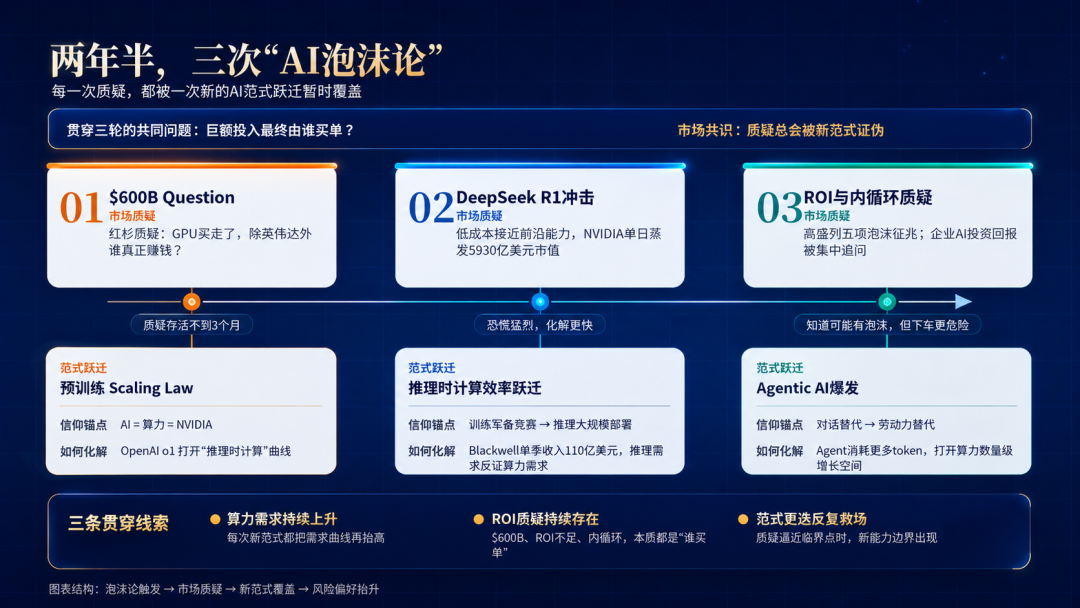
Two and a half years, three bubbles and a dangerous consensus
THE AI BUBBLE THEORY LASTED FOR TWO YEARS, AND EACH "FOAM THEORY" CORRESPONDED TO A PARADIGM SHIFT IN THE AI INDUSTRY, AND TO A WAVE OF TRIUMPHS AND A WAVE OF FAITH SURROUNDING THIS LEAP IN CAPITAL。
The first was June 2024. Sequoia Capital published the famous " AI's $600B Question " , which for the first time questioned large capital expenditures. Redwood's question is that the AI industry needs about $60 billion in annual revenue to support this round of infrastructure inputs, based on the data centre income at the time and total GPU ownership costs。
The alternative AI paradigm is pre-trained Scaling Law: the bigger the model, the better the data, the better the GPU。
From the beginning of 2024 to the time of the Redwood questioning, Super Micro rose by 217 per cent and Yvette by 150 per cent. The faith anchor of the whole market is a simple equation: AI = calculus = Inverda。
Redwood questions, the life cycle lasted just under three months。
In September 2024, OpenAI published o1, which calculates the emergence of a paradigm, not based on a larger model, on longer thinking, and using later training + RL to lift the model's capabilities. A new AI capacity-development curve has opened and markets have seen a second pole of growth in computing demand。
But the new paradigm itself quickly developed a new crack — DeepSeek R1 released — that brought to its extreme the efficiency of calculating this path at the time of reasoning: with less than $6 million in training costs, the ability to reason near the frontier model was achieved。
On January 27, 2025, the market value of the one-day evaporation of Yvette was $59.3 billion. The second bubble theory began to emerge。
At the heart of the market challenge is: does it really take so much credit to achieve the same AI capacity? The cycle of panic came intense, but faster. One month later, Britain released a financial paper, Blackwell single-season revenue $11 billion ahead of expectations, and the market proved with performance that the new reasoning paradigm would create more demand for reasoning, and that the total demand did not rise。
OpenAI, which drives the reasoning paradigm, becomes the absolute center of this wave, and whoever contracts it goes up. CoreWeave completed IPO on a $1.19 billion five-year contract, Oracle on the $300 billion agreement of the Stargate project, and Chase got a $10 billion chip bill。
The confidence in the market was the shortest, with OpenAI creating a "concept unit" in bulk, shifting the faith anchor from "training the arms race" to "drive deployments of reasoning."。
The third was October to November 2025。
Goldman Sachs released a report listing five bubble signs for AI: CapEx: top, slow growth in corporate profits, rising debt for science and technology firms, start-up of the Federal Reserve interest-rate cycle, extended credit spreads, and clear analogy for the night before the Internet bubble in 1997. For the first time in 20 years, the “overinvested” judgment appeared in a survey by the fund manager. The same week, Connect and Atlantic Monthly published an in-depth survey pointing to the same finding: 95 per cent of businesses AI investments did not yield real returns。
LARGE AI INVESTMENTS CYCLING WITHIN THE AI INDUSTRIAL CHAIN HAVE CULMINATED IN NARRATIVES THAT GENERATED INCOME FROM CLOUD MANUFACTURERS, CLOUD PRODUCERS' AI REVENUE GROWTH FROM MODEL COMPANIES, MODEL COMPANIES' VALUATIONS FROM THE CAPITAL SIDE, AND CAPITAL RETURNS FROM THE MODEL COMPANY'S PAPER REVALUATION。
BUT WHO'S PAYING FOR AI UPSTREAM
The giants of America responded to the analysts' questions almost in the same sentence at the Q3 Press conference in 2025, and also countered Goldman Sachs' judgment that Capex was at the top: "We would rather cast more than lose the future." Goldman Sachs also left a small tail in his report, which is now more like 1997 than 1999, meaning that the bubble signs are there, but still far from breaking。
In November 2025, the Fed again reduced interest rates by 25 basis points, and liquidity continued to be at the bottom of the valuation. The navigator is very innovative in questioning. The market consensus became: I knew there might be foam, but now it's more dangerous to get off than to stay in the car。
But what really resolves this round of questioning is the coming of a new paradigm。
In the second half of 2025, Agenic AI was concentrated, and AI was transformed from a dialogue to a digital workforce capable of autonomous planning, implementation and iterative. AI directly replaces work streams, and income ceilings leap from "search substitution" to "labour substitution". More importantly, Agent naturally consumes dozens of times the amount of token to talk, and calculating demand, instead of declining, opens up room for quantitative growth。
Look back at the first three waves of "foam theory" that run through three clues。
HOW LONG WILL THE COMPUTING NEEDS LAST; WHO WILL BEAR THE HUGE AI EXPENDITURES AND THEIR INPUT OUTPUT RATIO; AND WHETHER THE BIG MODEL WILL USHER IN A NEW PARADIGM BREAKTHROUGH。
The market has come down with a dangerous consensus that "challenges are always quickly perjured."
Experience in behavioural finance shows that investors re-entering after panic tend to have a higher risk preference than before, because they have "validated" the panic。
02 AI FOURTH FOAM AND TRIPLE CRACK
In the past few trading days, the market was shaken。
For the first time, cracks appear between the "profit" and "cash flow" of the technology giant。
IN 2026, THE Q1 FINANCIAL SEASON, THE GIANTS HAD A HIGH LEVEL OF PROFITS AND ZERO CASH FLOWS. THE AMAZON FREE CASH FLOW ALSO FELL 95 PER CENT AND THE FOUR GIANTS BURNED $2 BILLION A DAY. SOME OF THE GIANTS' "NET PROFIT GROWTH" HAS BEEN INTERPRETED AS A PAPER REVALUATION OF AI'S INVESTMENT, USING AI'S RETURN TO JUSTIFY THE AI'S INVESTMENT, A CIRCULAR ARGUMENT。
GOLDMAN SACHS GAVE A FIGURE IN APRIL: ABOUT 40 PER CENT OF THE EXPECTED PROFIT GROWTH OF THE 2026 STANDARD 500 IS THE CHAIN TRANSFER EFFECT OF AI-RELATED CAPITAL INPUTS. SEVERAL INVESTMENT BANKS AND MEDIA ESTIMATES INDICATE THAT IN 2026, SEVERAL LARGE AND LARGE CLOUD MANUFACTURERS AI HAD REACHED A SCALE OF $60 BILLION TO $700 BILLION。
According to the media, the Silicon Valley technology giants are poor only for profit. This also means that the overall growth of United States-listed companies is expected to be built on the same building block, and AI CapEx can only increase, not diminish, and move around。
Morgan Stanley points out that the ratio of capEx to revenue from mega-enterprises will reach 34 per cent in 2026 and 37 per cent in 2028, officially exceeding the historical peak of 32 per cent during the Internet bubble in 2000. In the three years between 2026 and 2028, total AI expenditures of the five giants alone will reach $2 trillion。
Even more subtle, five companies have almost $1 trillion in off-the-shelf lease commitments, a long-standing agreement for an undeveloped data centre, which does not appear on any balance sheet。
Global AI calls are booming, and many companies have called "tokenmaxing." Fomo's emotions are spreading, and the CEOs are afraid of being dumped by AI and fighting for their employees' cards "token"。
It's just that in the Tokenmaxing campaign, a large amount of consumption comes from systemic redundancies within the Agent architecture, over-designed Harness, creating a huge bubble in large models token calls. No agency has broken down the ratio of "effective calculation" and "structure emptiness"。
According to foreign media reports, Uber burned the entire year budget four months before 2026。
Engineers, at the initiative of tokenmaxing, began to use tools such as Claude Code as a parallel workforce: multiple missions running simultaneously, multiple worktrees running simultaneously, Agent searching, generating, reporting errors and repairing for long periods of time. AI appears to be using up, but it is difficult for the financial sector to immediately determine how many quantifiable outputs these tokens eventually lead to。
The mobilization is the core indicator of model company valuations, but how reliable is the trillions of valuations built on it if the indicator itself is fat
Whether the Agenic paradigm is truly effective in the narrative of an enterprise ' s productivity increase is the second crack in the market。
The carnival also continued in the capital market, with Anthropic reporting that the valuation was close to $965 billion and had submitted an IPO application in secret; OpenAI had also submitted an IPO in secret, with an updated financing post-valuation estimate of $85.2 billion。
It is clear that the market is paying the full price for an unfulfilled future. This does not necessarily mean a collapse, but it may mean a very narrow margin of error。
"All great technological changes create bubbles. No one can judge exactly. Either you invest a lot of money to take market shares, not worry about spending too much; or you lose market shares. On June 3, Ray Dalio, founder of the Bridge Water Foundation, said in an interview:。
DARIO ARGUED THAT THE BUBBLE BURST OCCURRED IN THE COURSE OF INVESTORS TRYING TO TURN BOOK WEALTH INTO CASH, AND THAT THE CURRENT AI-DRIVEN MARKET IS "GOING ALONG THIS PATH " , ALTHOUGH AI ITSELF IS "A REMARKABLE TECHNOLOGY."。
In this perspective, the long-term value of technology can coexist with the short-term valuation bubble, just as the Internet itself has profoundly reshaped the global economy following the collapse of the Internet bubble。
IT'S NOT AN "EFFECTIVE ISSUE" FOR INVESTORS。
ACCORDING TO PETER TYRE, "AI TECHNOLOGY IS REAL, BUT THE MARKET HAS OVERSTRETCHED THE PRICE FOR THE NEXT 15-20 YEARS." IN 2025, Q3 CLEARED ALL OF THE BRITISH WEDDA HOLDARS, $100 MILLION, 40% OF THE FUND'S HOLD, CUTTING 76% OF TESLA, REDUCING THE TOTAL HOLD BY 65%. DID HE MAKE AN ACCURATE PREDICTION OF THE INTERNET BUBBLE IN 1999, THIS TIME DIFFERENT? THERE IS NO ANSWER AT THIS TIME。
But certainly, Peter Tyre has emptied the new Agent-style carnival that began at the end of 2025。
Not just Tyre. Birkhel Khazawe's 2026 quarterly newspaper shows that Buffet's cash holdings have expanded to $39.74 billion — a record high of 59 per cent of total assets。
The long-term trend of technological evolution is positive and does not mean that investors will not act in the short term to stop or reduce their time. The contradiction between long-term trends and short-term investment strategies is the third crack in the market。
THE NERVOUS ASPECT OF THE MARKET HAS BEGUN TO BECOME SENSITIVE. WHEN US INTEREST RATES ARE EXPECTED TO RISE, AND THE MARKET STARTS TO QUESTION WHETHER AI CAPITAL SPENDING IS OVERHEATING, SOUTH KOREA, AS ONE OF THE "PRETENTIOUS" MARKETS IN THIS WAVE OF AI, STARTS TO EXPERIENCE LARGE FLUCTUATIONS. IT RISES FROM THE FAITH OF THE AI, COLLAPSES FROM THE RELAXATION OF THE FAITH OF THE AI。
Investment transactions are thus entering an extremely difficult zone。
MANY EXPERIENCED INVESTORS STILL BELIEVE THAT THE "AI BUBBLE" IS NOT HERE. BUT JUDGING WHETHER AI IS A BUBBLE OR AN UNDERESTIMATION, AND WHETHER AN EFFECTIVE INVESTMENT SYSTEM CAN BE ESTABLISHED, IS COMPLETELY DIFFERENT. THE FORMER IS A DIRECTIONAL JUDGEMENT, WHILE THE LATTER IS A COMBINED TEST OF RHYTHM, POSITION, VALUATION, CASH FLOW AND EXIT WINDOWS。
In a market where faiths are still present and volatility is increasing, looking at long-term trends does not mean that the majority of the population can afford a short-term retreat。
THE FOURTH GENERATION OF AI FOAM MAY NOT HAVE COME, BUT THE TIME HAS COME FOR VIGILANCE. EXPERIENCED AND RESILIENT CAPTAINS ARE ABLE TO FIND TREASURES THROUGH WAVES, BUT ORDINARY SAILORS MAY BE BURIED IN WAVES。
Original Link
