
L2 "SWIPE CARDS" : WHEN THE STORY OF AMPLIFICATION IS FINISHED, PAYMENT BECOMES THE WAY TO SURVIVE

Photo by Eric Foresight News
Recently, Solana had a Starknet joke about an eight-day user, 10 transactions per day and a $15 billion FDV in L2。
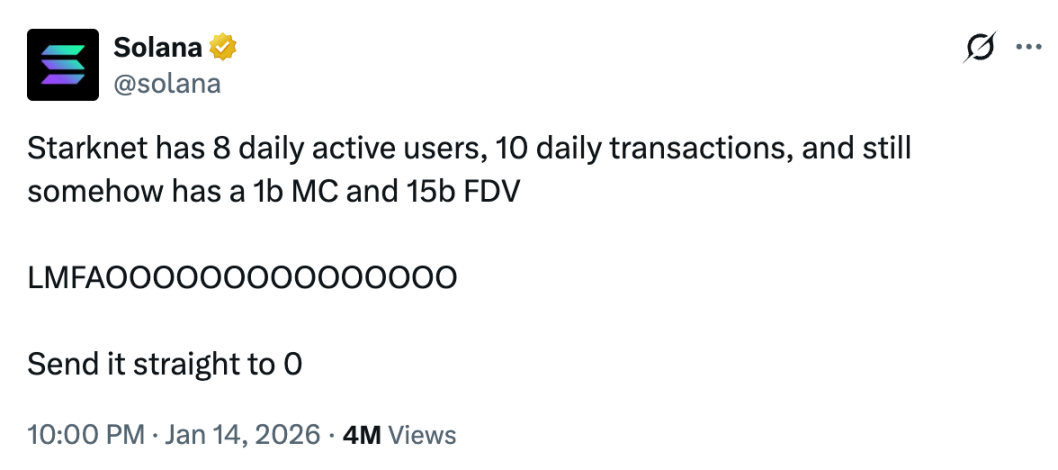
Although later on, the saline joke of the wound was to attract the eyeball, and thus elicit the Starknet token STRK through the NEAR Intents online in Solana. But Solana's chute was not empty, and for the last two years, the springing L2 did encounter a flow crisis。
The most convincing example in recent times is that on January 8, Web3 Wallet Company Zerion's hatching L2 network, Zero Network, was exposed to stopping blocks for more than three weeks without any impact. The official response was even more subtle, with Zero Network stopping on December 19, 2025, but it was only on December 23 that the official announced that the problem would be repaired, while Zero Network pushed the original release in May of the same year。
Despite this, only 8 users carried out 10 transactions in one day were actually exaggerated. According to L2BEAT statistics, Starknet yesterday's TPS was 2.64, meaning that there were more than 200,000 transactions on the Internet a day. But this number is still too low, and even the one-day volume of the ETA is 10 times that of Starnet。
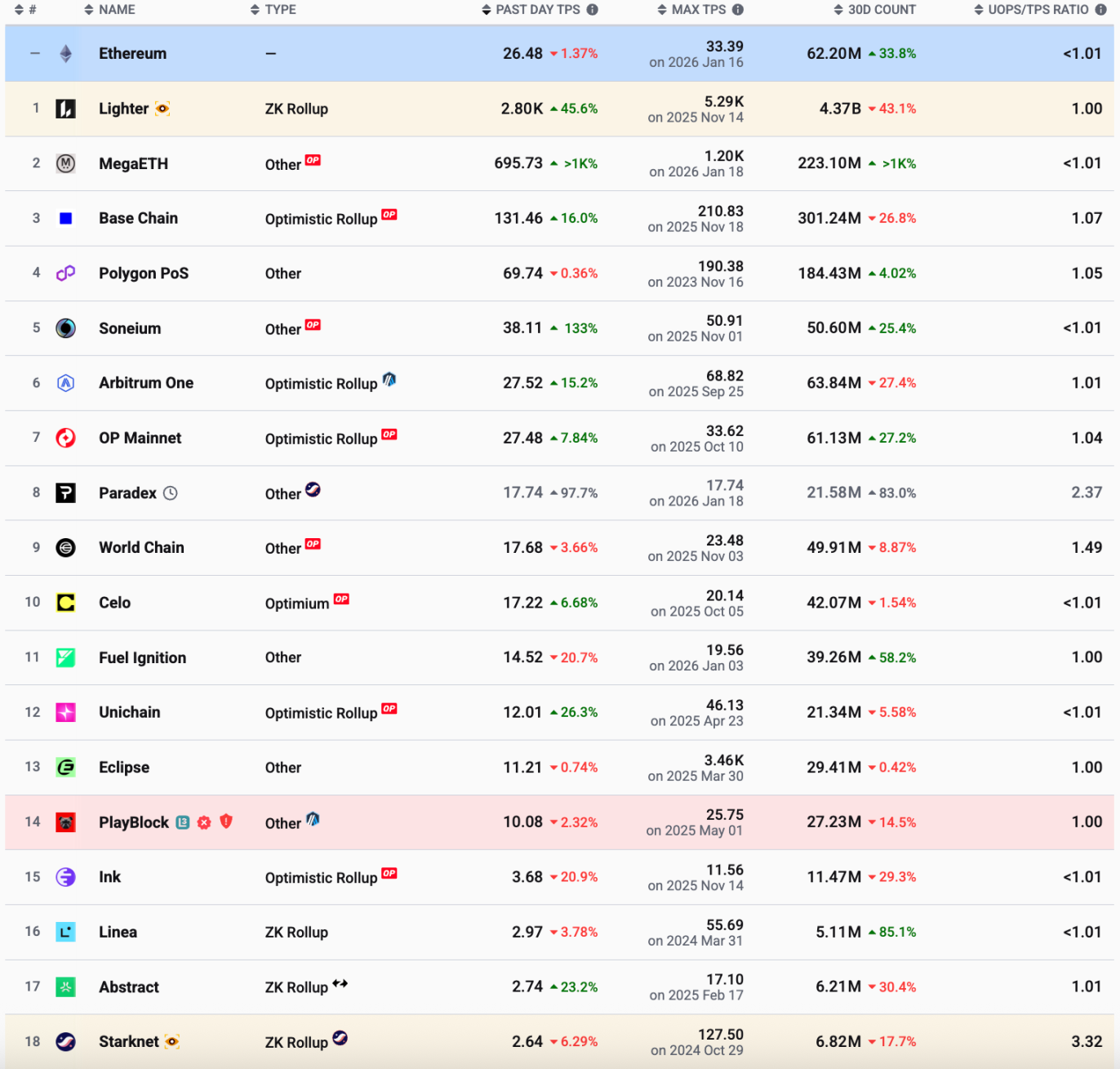
Data show that even Arbitrum and OP Mainet's TPS do not significantly exceed the Ether Workshop except for Base, Polygon. Linea, Starknet's TPS are less than 3 and the unreached parts include Scroll with TPS slightly above 1 and ZKsync, Blast with less than 1。
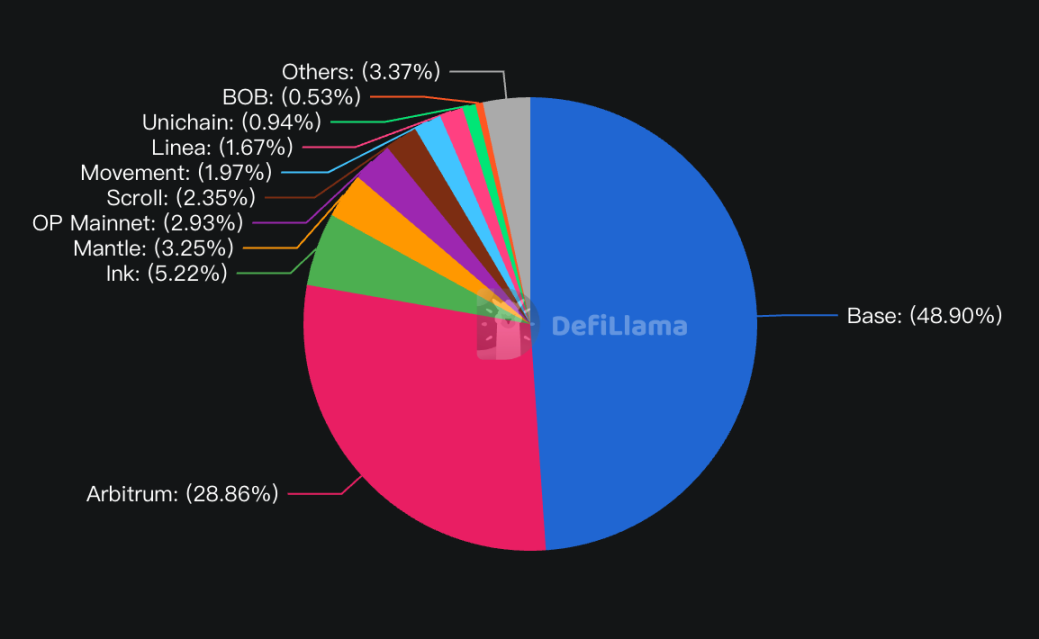
According to TVL data from DefiLala, Base and Arbitrum together account for nearly 80 per cent of all L2 TVLs, while L2 which is not a Orthers category has a conservative total of close to US$ 10 billion at the private fundraising stage, but only US$ 2 billion combined。
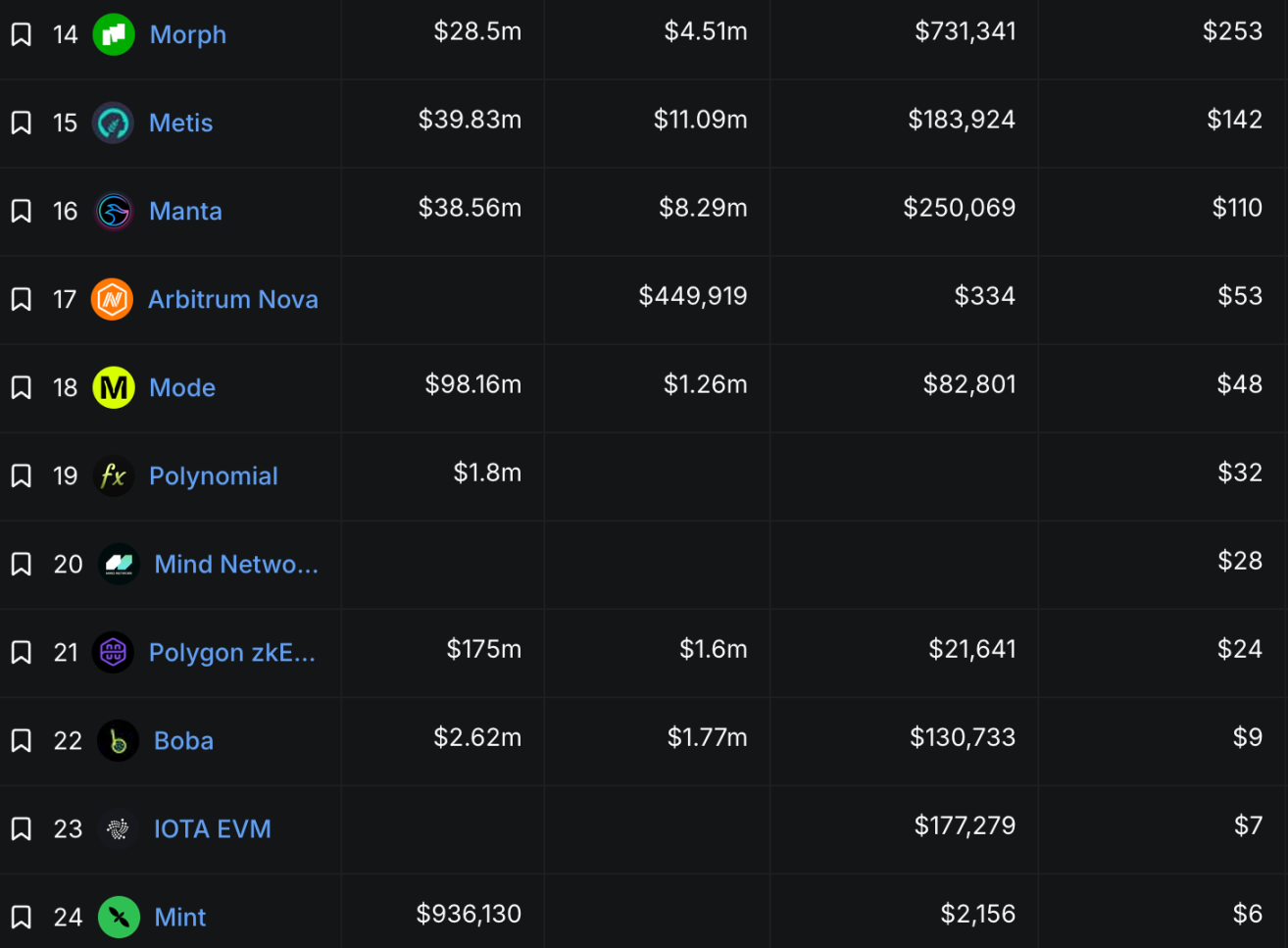
In terms of the income from the agreement, the top seven agreements over the past 24 hours are above $1,000, and the three-digit or even two-digit income from the agreement may not be as high as the interest that some large households receive on the exchange every day。
THESE DATA PROVIDE A VERY INTUITIVE PICTURE OF THE CURRENT L2 DILEMMA: IN THE LARGER CONTEXT OF THE SCARCITY OF NARRATIVE APPLICATIONS, IT IS A LUXURY TO EXPECT A KILLER-SIZE APPLICATION THAT IS WILLING TO OPERATE ON UNIVERSAL L2. L2 FOUND THE SAME ANSWER TO THE QUESTION OF HOW TO FIND AN APPLICATION THAT COULD PROVIDE STABLE TRANSACTION DATA: ENCRYPTED CURRENCY CARDS。
Pavel Paramonov, founder of the Encoded Currency Research Institute (Hazeflow), has criticized the fact that encrypted currency cards are not essentially "encrypted currency payments" but are still French currency payments, and do not really promote encrypted currency. However, it was also mentioned that the introduction of encryption cards by many projects or public chains was impracticable, with the sole aim of keeping users in the environment。
The encrypted currency cards currently issued by many exchanges are “host” cards in which the user’s assets are held in an exchange or institutional hosting account and are settled at the time of consumption by the exchange and off-ramp company and the issuer. And the clearing chain of these cards is usually Tron or Solana or even the slightly more expensive Etherwood, which, on the one hand, is that the stable currency asset stock on these chains is large enough, and, on the other hand, some of the cards reduce costs by bulk rather than by word. Liquidity and stability may be more important for institutions than L2 ' s low cost。
L2 sees encryption cards as “non-trust cards” in various forms, and before they are used to pay, the assets are in the user's own wallet, and each payment is settled separately, effectively increasing chain activity. Typical examples include Scroll (Etherfi card settlement chain), Gnosis and Linea (MetaMask settlement chain)。
In September 2024, Etherfi announced that under the flag the payment card would use Scroll as a clearing layer, and that Scroll could help Etherfi to "no Gas trading" and provide a higher percentage of the return through SCR token subsidies. The Etherfi card, in addition to the traditional direct use of Scroll for asset consumption, has a special mechanism: the user borrows interest-bearing assets on Scroll as collateral for payment in French currency, supported by eETH, weETH, WeTH, eBTC, etc。
Gnosis, as a side chain with no sense of presence for a long time, is a successful return to a city on a payment card with a roll-out card that operates mainly in the European region. Users can connect to non-custodial wallets such as MetaMask, Gnosis Safe in Gnosis Pay to convert the assets (partial euro, pound sterling and dollar stability currency) supported in the user's wallet to EuroStabilized Euro EURE issued by Monerium and to pay in euros by 1:1。
The encryption card issued by MetaMask uses ConsenSys under the banner of L2 Linea as the main clearing network, in addition to supporting Solana and Base. Users are required to deposit assets in their MetaMask wallet to support payment (all types of United States dollar or euro stable currency) before consumption, and at the time of payment, the user ' s assets are transferred to off-ramp service providers and then paid to businesses in French currency。
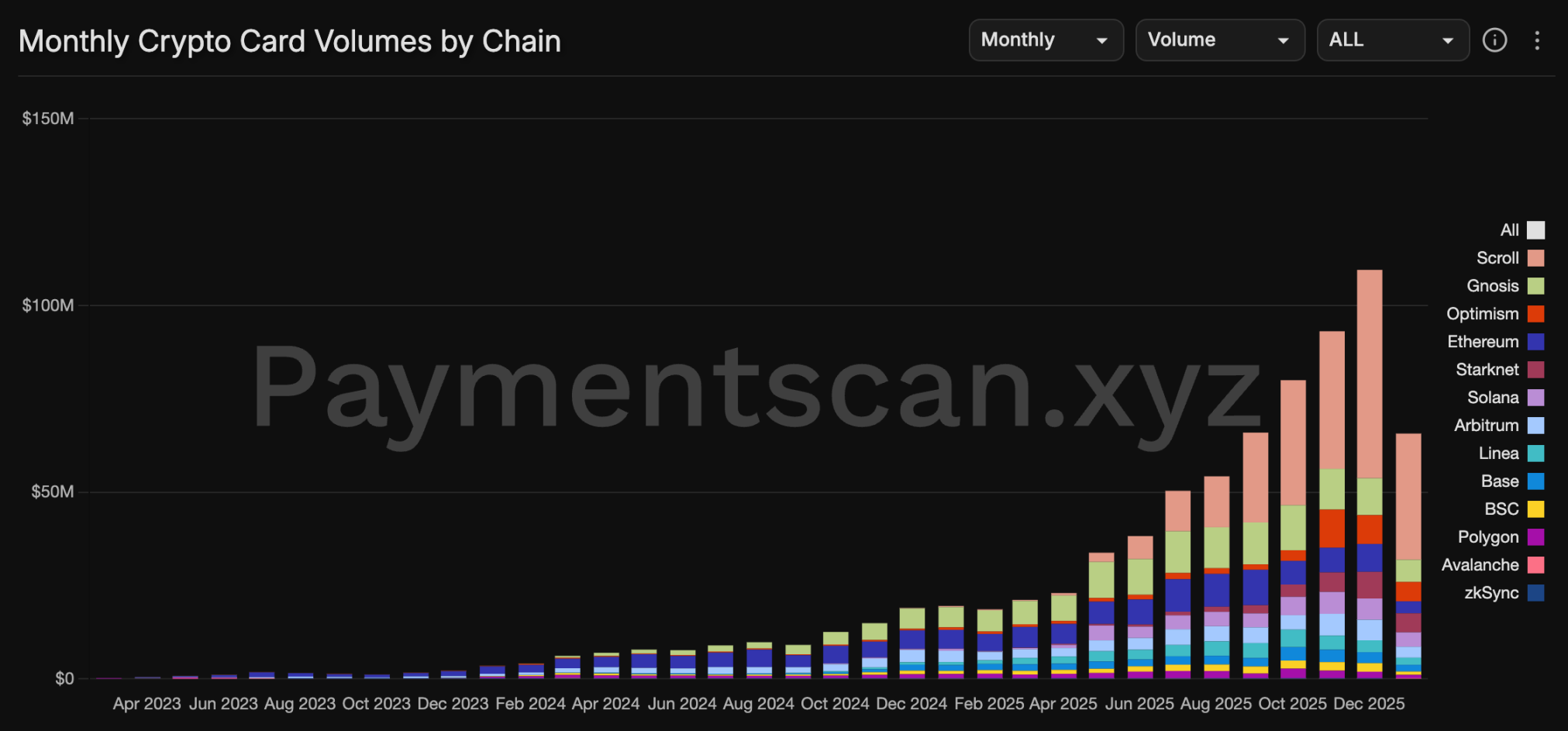
Because of the nature of the non-trust card countdowns, each consumption by the user corresponds to an activation contract to verify the amount of surplus assets and the chain of asset transfers. So L2 can rely on paying for this absolutely high frequency and sustainable scene to ensure a certain level of dynamism on the chain. According to Paymentscan data, Scroll, through its cooperation with Etherfi and SCR subsidies, holds a significant market share in card payments. However, this data is not entirely accurate, because many of the cards may not be wired at the time of payment, but are settled within the institution, but the fact that L2 found the actual application by paying is not contested。
Not only is the emerging L2 in anxiety, but Polygon, which cannot be considered a strictly L2, has shifted the strategic focus to payment in the earlier period. At the end of 2025, Polygon ' s non-United States dollar stable currency transfers exceeded $11.1 billion, XSDD transactions amounted to $2.24 billion, and AUDDF transactions amounted to $2.46 billion. In addition, Polygon became one of the main chains used for Stripe ' s stabilization currency payments; on January 13, it announced that it would purchase the encrypted currency payment infrastructure Coinme at a value of $250 million, and Sequence, a block chain development platform, would put "all in payments."。
AFTER HAVING EXPERIENCED A CONFLAGRATION OF CONCEPTS, L2 RECOGNIZED THE REALITY AND, WHILE STILL LOOKING FOR INNOVATIVE APPLICATIONS, IT WAS IMPERATIVE TO SURVIVE THROUGH THEIR OWN LOW-COST AND EFFICIENT CHARACTERISTICS。
RECOMMENDED READING:
RootData 2025 Web3 Industry Annual Report
The change of power in the currency: the dilemma of a 300 million-dollar empire
After Farcaster's transition, Lens Protocol welcomed the change, Web3 social dreams, even scum
