
Six years ago, 220,000 people went into a 38-fold increase in American stock
Perhaps the most important lesson for every investor is not to choose sides, but to learn to be vigilant in a carnival. 。
Original author: Forest Night, Watching
19 January 2026, Martin Luther King Memorial Day, United States share。
A 35-page empty report is on the line. The title is shocking: "Nazdak Laundromat" of the Southeast Asia Money Laundering Group。
The central conclusion of the report is only one sentence: “AppLovin is the final milestone of the new type of transnational financial crime of the twenty-first century. I don't know
The publisher, Capitalwatch, is an investigative agency that focuses on stock-taking in the United States. Given that their previous allegations of financial fraud against the Nouveau for good health eventually led to the latter's discharge in 2025, investors have reason to take the report seriously。
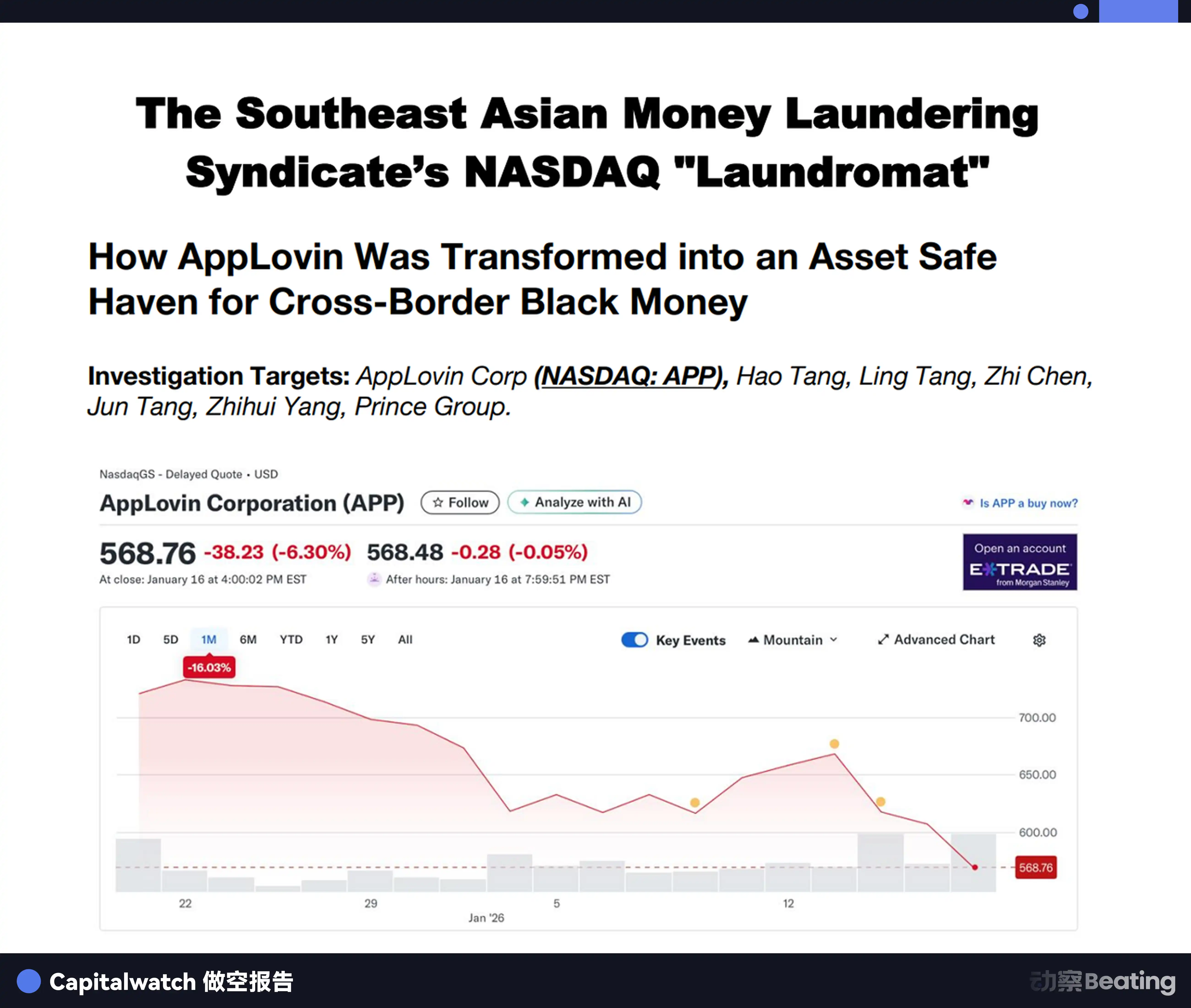
Upon opening the following day, AppLovin fell 4.8 per cent in front of its equity. Three trading days ago, the stock had dropped by 15 per cent。
But what's interesting is that three days later, AppLovin's buy-in continues to grow, and it's still high。
This is a typical Roman: the empty agency says it's a "false empire" and the family says it's a "show again"。
Who's telling the truth
Allegations: Advertising as money laundering
Capitalwatch reports lock three core figures。
The first is Hao Tang, one of the main shareholders in Applovin。
The report alleges that its wealth includes approximately $957 million in illicit proceeds associated with the collapse of the Chinese P2P platform network and about $2.15 billion in gambling-related funds. Capitalwatch describes it as "a fugitive from justice" and claims that "every dollar of his equity is covered by the tears of the victims of illegal fund-raising"。
The second is Ling Tang, who owns some 20.49 million AppLovin shares through Angel Pride Holdings, representing 7.7 per cent of the company and one of the largest individual shareholders. The report states that she is Hao Tang's sister and that her share is "a key component of the Down family money-laundering network"。
The third figure is most critical: Chen Zhi, founder of the Cambodian Princes Group. In October 2025, the United States Department of Justice indicted him for running a forced labour fraud camp, which was used to carry out a "pork-killer" encrypted currency fraud. On the same day, the Department of Justice announced the confiscation of approximately $15 billion bitcoin, the largest asset confiscation operation in the history of the United States. On 7 January 2026, 12 days before the publication of the report, Chen Zhi was arrested in Cambodia and deported。
The report attempts to prove that these three individuals constitute a money-laundering network across China, Cambodia and the United States. And AppLovin is the end exit that lets the black money finally bleach。
The central charge is a system known as the Mobius Ring: criminal groups pay billings to AppLovin through intermediaries to convert dirty money into legal income。
This is how it works: Cambodia's super-application of WOWINOW's advertising expenditure on AppLovin is grossly out of proportion to its market volume, and these excessive advertising expenditures are essentially money laundering's “fees”。
The Princes Group, through shell companies, maintains the main advertising account, paying hundreds of millions of dollars in purchase flows. AppLovin recognizes these revenues as legal income to be recorded in the financial statements and then settles overseas accounts under the control of the Princes Group in the form of a "developer's share of income". Thus, fraudulent funds have been converted into legal remittances from companies listed in NASDAQ。
The report also alleges that AppLovin technology has become a criminal tool. The "quiet installation" mechanism is said to permit the application of implantation without the consent of the user. AXON algorithms are accused of helping to distribute gambling and fraud applications and of precisely targeting vulnerable users。
These allegations, if true, represent an alarming increase in AppLovin's performance over the past few years, with a significant portion coming from the “unsustainable criminal group money-laundering budget”。
But the question is: how amazing is the company's performance
II. MYTHS: THE AI PETS THAT GROW 700% A YEAR
To understand the lethality of this empty report, first of all, the myth of the capital market that Applovin has created over the past three years。
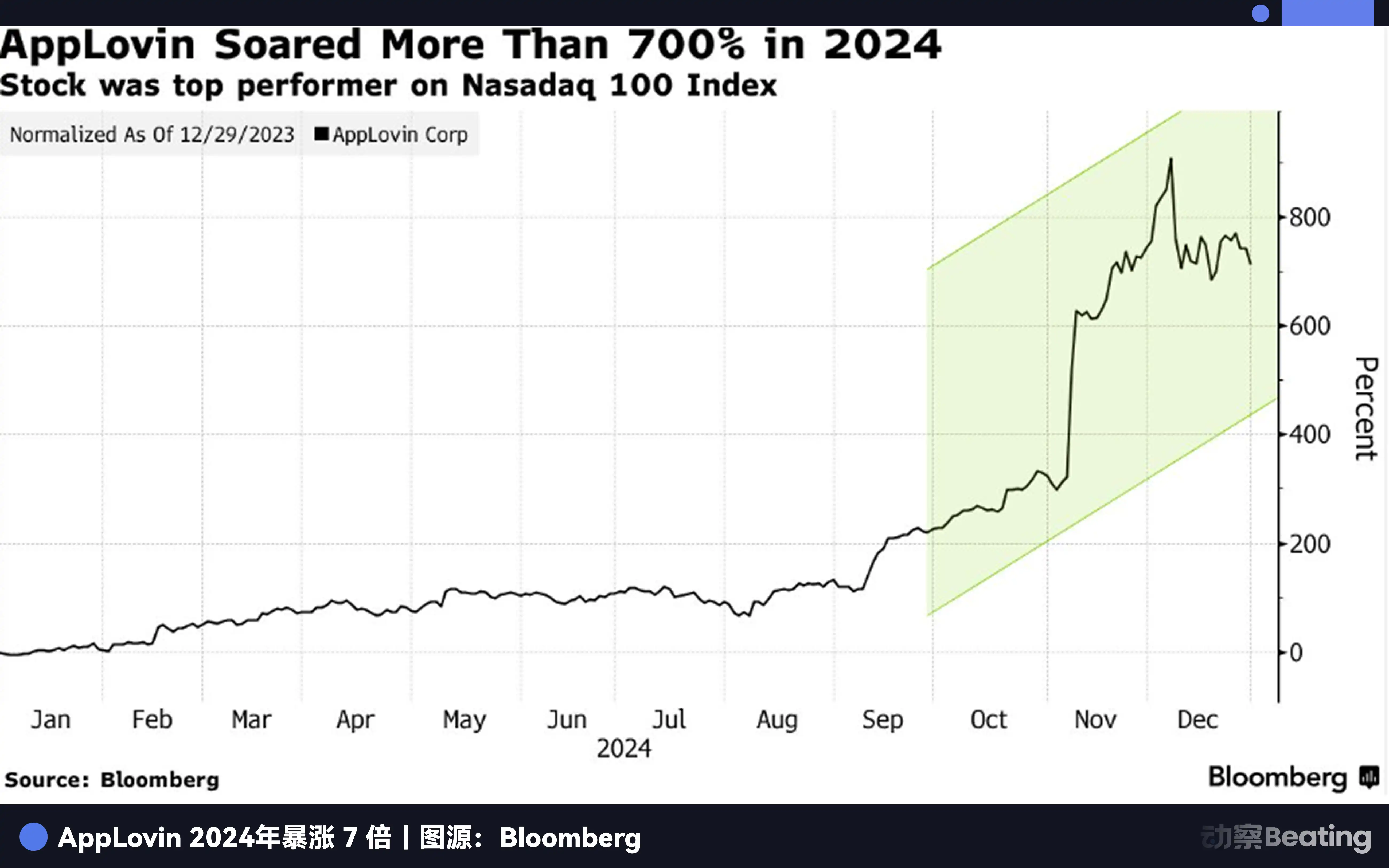
Throughout 2025, AppLovin stock prices rose 108 per cent. In 2024, the figure was even more exaggerated, exceeding 700 per cent, and the market value had once exceeded $140 billion。
From the lowest point in 2022, AppLovin increased 38 times. During the same period, Britain was 10 times greater, 6 times more than TTco, and less than 1 times more than gold。
THE COMPANY WAS ESTABLISHED IN 2011 IN SILICON VALLEY, INITIALLY AS A PLATFORM TO HELP MOBILE DEVELOPERS GAIN ACCESS TO USERS AND CASH. THE AD AGENCY PLATFORM MAX WAS ACQUIRED IN 2018 AND THE AI-DRIVEN ADVERTISING OPTIMIZATION ENGINE AXON WAS LAUNCHED IN 2020. IN 2021, HE WAS LISTED IN NASDAQ, BUT IN THE FIRST TWO YEARS HIS PERFORMANCE WAS FLAT。
The turning point occurred in 2023. After the AXON upgrade to version 2.0, the effect jumps. At a time when Apple iOS 14's New Deal for Privacy has hit the entire mobile advertising industry, Meta's market value has evaporated hundreds of billions of dollars, but Applovin has risen backwards. Wall Street began to rediscover the company and label it as "AI Beneficiaries"。
By the third quarter of 2025, corporate income had increased by 68 per cent to $1.4 billion each year, the second highest quarterly growth in the past four years; net profits had increased by 92 per cent to $836 million。
In July 2024, the company sold the games studio Tripledot Studios for $800 million, completely transforming it into a purely advertising technology company. One month later, the equity buy-back plan was increased by $3.2 billion and the index 500 was added。
From an anonymous mobile advertising company, to the Top 500 Component Unit, the AI concept pet, AppLovin took less than two years。
But the questioning never stopped. In February 2025, Fuzzy Panda and Culper Research announced that they were empty, accusing Applovin of "systematic abuse of authority". In March 2025, he joined the war, claiming that 52 per cent of the electricity suppliers were converted from re-directed users, with an incremental value of only 25 to 35 per cent。
Each time it was empty, the stock price fell short and continued to rise。
Until Capitalwatch's report. It no longer dwells on technical details or financial indicators, but points directly to a more lethal question: where does this company come from
To answer that question, it was necessary to return to China seven years ago。
Source: The collapse of the solidarity network and the "sister" 5.3 million
March 27, 2019, East China。
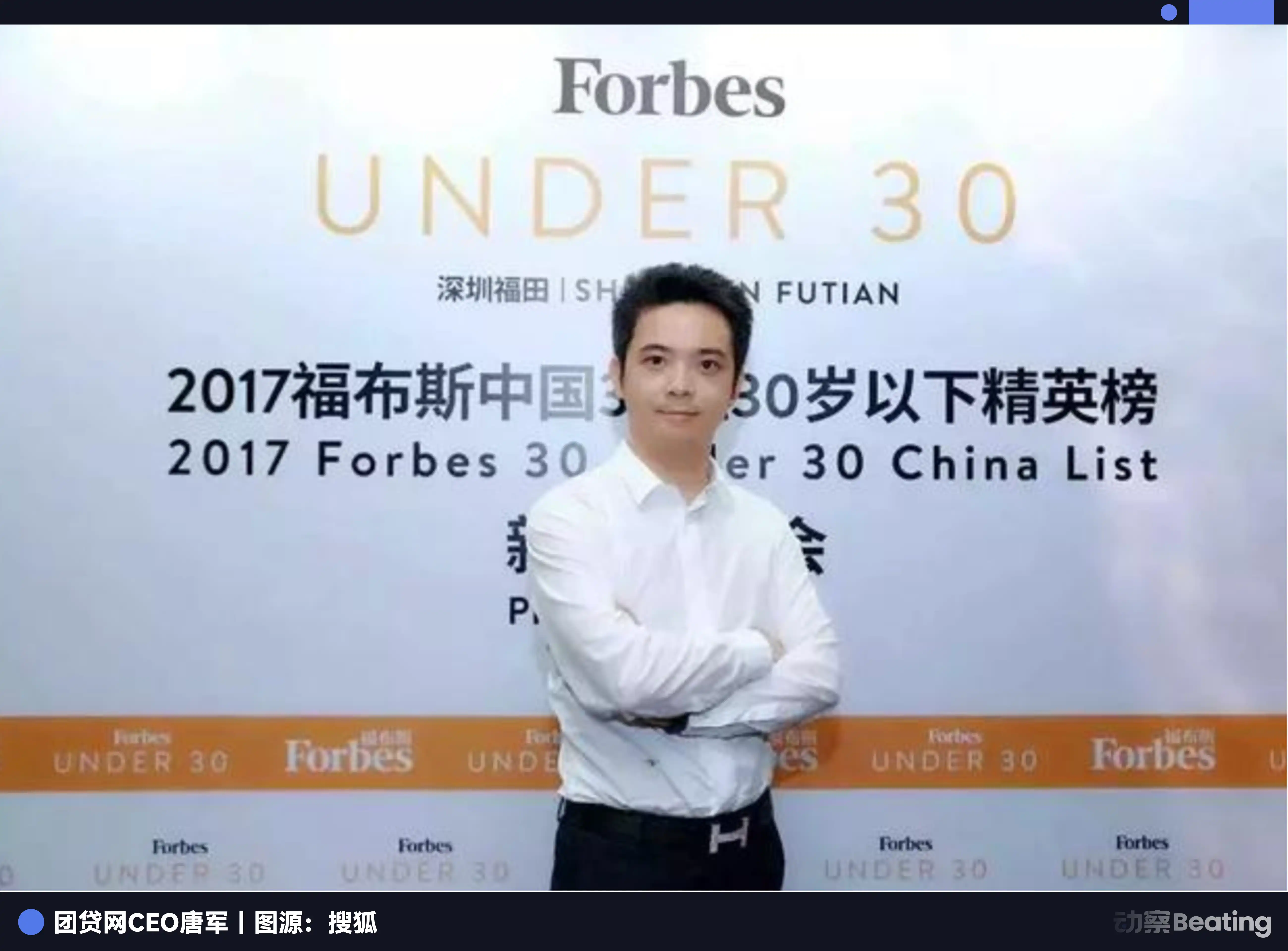
THE FOUNDERS OF THE NETWORK, TANG JUN, AND THE CO-FOUNDER, ZHANG LIN, SURRENDERED TO THE POLICE. THIS COMPANY, WHICH USED TO BE CHINA'S TOP P2P PLATFORM, COLLAPSED OVERNIGHT。
Founded in 2012, the consortium has accumulated over RMB 13,7 billion in online lending. The Tang Jun himself is an entrepreneurial star who is a mentor to a business incubator in Dong-hwan and often teaches young people how to start and finance a company. His controlled spin-off technology was on the market at a time of over 20 billion yuan。
THEN, IN THE SUMMER OF 2018, CHINA'S P2P INDUSTRY CAME UP WITH THE "THUNDER THUNDER." CONTROLS WERE TIGHT, LIQUIDITY WAS DEPLETED AND CROWDING SPREAD, WITH HUNDREDS OF PLATFORMS CLOSING IN A FEW MONTHS。
The police acted quickly, arresting 41 persons involved and freezing RMB 3.1 billion bank accounts, 35 properties, an aircraft and 40 cars. The investigation found that Tang Jun and Zhang Lin attempted to transfer and conceal assets prior to the crime and subsequently recovered more than 880 million yuan in hidden funds。
At the time of the collapse, there were approximately 220,000 active borrowers in the network, involving a total loan of 14.5 billion yuan. Most of these people are ordinary families lured by high-interests, and their savings are lost overnight。
In 2022, the court ruled that Tang Jun was sentenced to 20 years ' imprisonment and a fine of 51.5 million yuan。
The case is closed, but where's the money? There is a huge gap between recovered assets and investor losses。
The report of Capitalwatch claims that part of the answer was hidden at an extradition hearing in Bordeaux, France, in 2021。
That year, a man named Hao Tang was arrested at the airport on a private plane arriving from Iceland to France. An extradition request was subsequently filed. However, the Bordeaux Court of Appeal eventually refused extradition under the "political exception" clause, finding that the extradition request, although ostensibly based on money-laundering charges, was in fact politically motivated, and that Hao Tang ' s defence team advocated his involvement in a high-level political case。
Hao Tang regains his freedom. However, the court judgement unexpectedly disclosed the chain of evidence for money-laundering。
According to the judgement, Hao Tang assisted the Tung Army in the transfer of 632.89 million yuan yuan in illicit money by using the shell company network between February 2018 and March 2019, the critical window period before the collapse of the loan network. Money-laundering techniques include the introduction of funds disguised as “airship charges”, 27 maze-style cross-border transfers and the circumvention of foreign exchange controls through “knock-down” in the underground money house。
The Court did not deny that the funds had been transferred。
The judgement also revealed a key detail: the judicial audit found that approximately 5.3 million yuan had been transferred to a company account controlled by Hao Tang 's "sister"。
This clue led to Capitalwatch leading to AppLovin's list of shareholders。
The report cross-referenced the SEC file found that Ling Tang held an AppLovin 7.7% share through Angel Price Holdings. The SEC document indicates that her correspondence address is located on Yongkang Street, Kowloon Long, Hong Kong, and the address declared by Hao Tang is located in the same block, and there is a physical overlap between the addresses of the two in the early business register。
The report concludes that " there is good reason to conclude that Ling Tang is Hao Tang ' s sister and that Angel Price Holdings holds billions of dollars as a key component of the Down family money-laundering network. I don't know
But the network is just a "primitive accumulation" of funds. Another key point is needed to complete the whole chain of money-laundering。
This node is in Phnom Penh, Cambodia。
IV. Undercurrents: Industrialization of pigboard killing and $15 billion confiscation
Chen Ji, a mysterious rich man born in Fujian and subsequently naturalized Cambodia. Over the past decade, he has created Cambodia ' s largest commercial empire, operating across banks, aviation and real estate。
But according to the United States Department of Justice's court documents, there is another world hidden under this shining commercial chart. Since 2015, Chen Zhi and his senior team have "hiddenly developed the Crown Prince's group into one of the largest transnational criminal organizations in Asia"。
The indictment paints an alarming picture of the Princes' Group operating a number of forced labour fraud camps in Cambodia, “in large dormitories surrounded by walls and barbed wire, operating as violent forced labour camps”。
Most of the labour force in the camps is foreign nationals lured by highly paid work, and once they enter, their passports are confiscated, and they are forced to work for 10 hours a day under the surveillance of armed guards for the purpose of fraud in the form of “hog-killers”. Chen Zhi himself was directly involved in the use of violence against camp personnel and had photographs depicting beatings and other forms of torture。
By 2018, the Princely Group had benefited more than $30 million per day from such fraudulent activities。
In October 2025, the United States Department of Justice announced the confiscation of approximately $15 billion bitcoin, the largest asset confiscation operation in the history of the United States. On the same day, the Ministry of Finance characterized the Crown Order as a transnational criminal organization, imposing sanctions on Chen Yu and more than 100 related individuals and entities。
On 7 January 2026, Chen Zhi was arrested in Cambodia and subsequently deported for investigation. The Ministry of the Interior confirmed that his Cambodian nationality had been withdrawn。
The report of Capitalwatch attempts to establish a link between Hao Tang and Chen. The report notes that in late 2018, immediately before the crisis of the consortium network, the Hong Kong listed company Geotech Holdings had a change of control and that the sole shareholder of the BVI company that initiated the acquisition was Chen. The report considers that the overlap of operations within this time window is evidence of the collaboration between the two in money-laundering networks。
And the key link between the two and AppLovin is Cambodia's super-application WOWNOW。
In May 2022, Prince Bank established payment cooperation with WHONOW to fully integrate the bottom payment system. WOWNOW claims to have served more than 800,000 users and accessed more than 13,000 businesses。
But in a country with a population of only 16 million people, why would such a local life application require a huge budget on an American advertising platform
The answer to the report is that these advertising expenses are essentially money-laundering channels。
V. ROSIONMAN: Who is telling the truth
The charges are serious, but AppLovin is not without defence space。
CEO Adam Foroughi has initiated an independent investigation into the activities of the space agencies, insisting that the allegations are “false and misleading” and “for the personal economic benefit of profit”。
There is also another question of rationality: "Anything is possible." But if I assume I want to launder a lot of money, I probably wouldn’t try to operate through a listed entity registered in the United States and subject to more regulatory scrutiny than ordinary global companies. I don't know
THIS IS A THOUGHT-PROVOKING QUESTION. NASDAQ LISTED COMPANIES ARE SUBJECT TO SEC REGULATION, FOUR MAJOR AUDITS, INSTITUTIONAL INVESTORS, AND AERIAL SNIPERS. LARGE-SCALE MONEY LAUNDERING IN SUCH A TRANSPARENT ENVIRONMENT REQUIRES NOT ONLY BOLDNESS, BUT ALSO AN EXTREMELY SOPHISTICATED SYSTEM。
There are also different interpretations of the decisions of the French courts. The refusal of the court to extradite Hao Tang was based on the "political exception" clause and not on the denial of money-laundering. Is that proof of his innocence, or is it just an indication that he managed to drill a legal loophole
As of 21 January 2026, several key issues remained outstanding。
WOWNOW on AppLovin how much is the advertising expenditure? This is the central and verifiable point of the entire "advertisement is money laundering" charge. Since October 2025, the SEC has been investigating the collection of data by AppLovin, and is there an intersection between this investigation and Capitalwatch's allegations? Would it trigger a further review of the AppLovin shareholder structure by United States regulators if he confessed to financial transactions with Hao Tang after his deportation
At present, AppLovin has a flat interest of about 5 per cent, indicating that investors are cautious. The company will publish performance for the fourth quarter in February。
The final conclusion of the Capitalwatch report is that it is an "imperiality built on the sands" based on "the tears of the victims of the solidarity network and the sweat of the South-East Asian garden workers."。
Time will give the answer to whether this judgement is correct. The issues raised in the report, however, with respect to shareholder background, funding sources, compliance reviews, do merit serious consideration by the market and regulatory bodies。
Capital markets never lack myths. Every few years, a company rises at an alarming rate, with stock prices running out of hand, and valuations go beyond imagination, with analysts fighting for their endorsement with the most elegant words. In the process, challengers are often seen as “ununderstanders” of the new paradigm until one day the tide recedes。
Will AppLovin be the next perjured myth, or will he return once again to be an empty institution? No one knows. But one thing is certain: in a market where everyone shouts "AI Revolution", there are still people who are willing to ask "where money comes from." This in itself is a scarce awakening。
And perhaps the most important thing for every investor is not to stand side by side, but to learn to be vigilant in a carnival. When a stock rises by 700 per cent a year, when everyone is talking about how technologically advanced it is and how amazing the algorithm is, perhaps the simplest question should be asked: Who are the major shareholders in this company? Where did their money come from? Is this money clean
After all, in the world of capital, the most expensive cost is never to miss a tenfold share, but to forget in fanaticism that the dealer is always sitting across the table。
