
Writing after SpaceX premiere: Is $2.1 trillion worth of market value worth pursuing
In the future, these two big time nodes will determine how much more to sell for Mars Dream。
Original Odaily Daily@OdailyChinaI'm not sure
Author |Golem@web3 golemI'm not sure

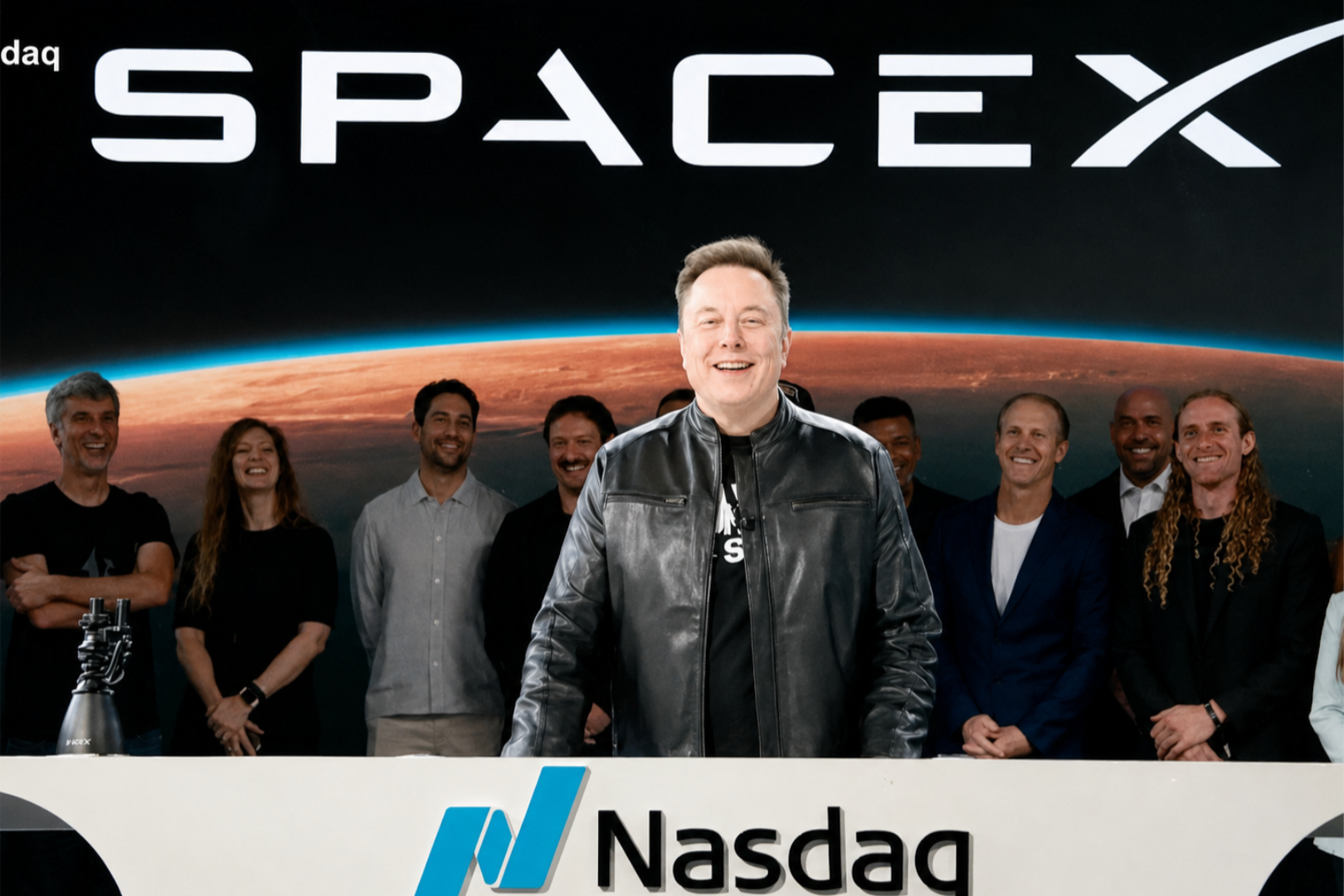
On June 12th, American local time, Musk didn't go to New York. Before he officially landed in NASDAQ, SpaceX stock (Nasdaq: SPCX) chose to remain at the company's Texas headquarters, standing among a group of employees, and completed a remote clock。
At this ceremony, Mask once again told the story of SpaceX further away. He stated that the company ' s goal was to send humans to the Moon, Mars and even more distant stars. At the end of the bell, the NASDAQ live channel played Elton John's Rocketman, adding a romantic note to the IPO, the most prominent space commercialist in history。
But that is the end of the sensory link, and the game of capital markets begins. SpaceX IPO priced $135, which jumped on the first day of the market at $150, with a break of $176 and a final charge of $160.95, with a temporary market value of $2.1 trillion。
Jump 150 dollars, market value fixed on the first day of the market, 2.1 trillion dollars
This time, the IPO has gained world visibility since the submission of IPO declarations to the United States SEC, and the company has finally set a fixed price of about $555.6 billion in A-class shares, valued at $1.77 trillion。
In terms of the distribution of shares, the shares of Mask individuals are about 42 per cent, of Valor Equity about 7.3 per cent, of Google about 5 per cent, of other early wind agencies together 10-12 per cent, and of employees and former employees between 10 and 15 per cent, while the shares of IPO in public distribution are only 4.2 per cent. Although Mask and its immediate interests hold the main SpaceX shares, none of their holdings can be sold after the day they are listed, the stake locks for core investors, such as Mask and Valor Equity, reach a fixed level of 366 days, and ordinary IPO shareholders (institutions and employees) experience 180 days of base locking, that is, at least until the end of 2026。
As a result, on June 12th, the initial roll-out was only about 550.6 million shares of IPO ' s public distribution, and SpaceX is a typical “low-flow, high-level FDV” project, which according to its valuation model had a market value of approximately $75 billion on the first day of circulation, just close to the amount originally planned for SpaceX。
Investors who often play the money ring project may be familiar with high-control models. As a result, during the subscription phase, market sentiment quickly plunged into FOMO, with SpaceX reportedly receiving more than four times over-subscription, and agency-to-scrambled aggregate requisitioning requirements exceeding $250 billion. The bulk investor's subscription alone exceeded $100 billion, well above the $7.5 billion distribution scale, and the money-ring player, of course, participated in the feast, but unfortunately most of them “basket-to-basket empty”。(Refer to:A new dream break on the SpaceX chain: trillions of dollars of IPO dinner, I only get four sharesI'm not sure
It is noteworthy that SpaceX ' s rare scheme, which allocates up to 30 per cent of IPO shares to bulk investors, has significantly lowered the threshold for participation in this scientific and technological event, and usually this large IPO project will allocate only 5 to 10 per cent to bulk investors, although SpaceX will end up with only about 20 per cent, but it is two times the standard IPO。
The reason for this is that, according to SpaceX management, scattered investors will hold their shares for a long time, just as Tesla’s today’s core group of investors is also a large group of diaspora investors, in essence believing that the bulk will pay for the dream described by Mask, but this is much more rational than they thought. (Detailed below)
Prior to the formal opening of the transactions in NASDAQ, the forward offer on Hyperliquid had fluctuated before US$ 170-175 and the counterpart company ' s valuation exceeded US$ 2.2 trillion. Prior to the formal opening, at NASDAQ, the SPCX opening price was initially reported at $172, which was about 29 per cent higher than the IPO price, largely in line with pre-open market expectations, but one hour later, the SPCX opening price fell quickly, eventually at $150, an increase of only 11 per cent over the IPO price。
According to Gate's United States stock exchange, SPCX eventually rose in the disk near US$ 176, eventually closing at US$ 160.95, increasing by about 19 per cent over IPO, but only 7.3 per cent over opening prices, setting the market value on the first day of the market at US$ 2.1 trillion. As a result, SpaceX’s first day was definitely a success, with Mask becoming the world’s first trillion-dollar rich man, but the result was not surprising, or even satisfying all market expectations。
Not only did Pre-IPO platforms roll over in advance pricing for SpaceX, but forecast market results also deviated considerably。
A few hours before SpaceX IPO came on the market, the market generally felt that its market value could hit over $2.2 trillion, and the probability of “SpaceX IPO closing market value above $2.2 trillion” on Polymarket was still above 65 per cent and at one point up to 70 per cent。
However, with the SPCX price “relatively low”, the probability of the event also began to fluctuate sharply, and eventually SpaceX the IPO closing market value was set near $2.1 trillion, and the event was closed。
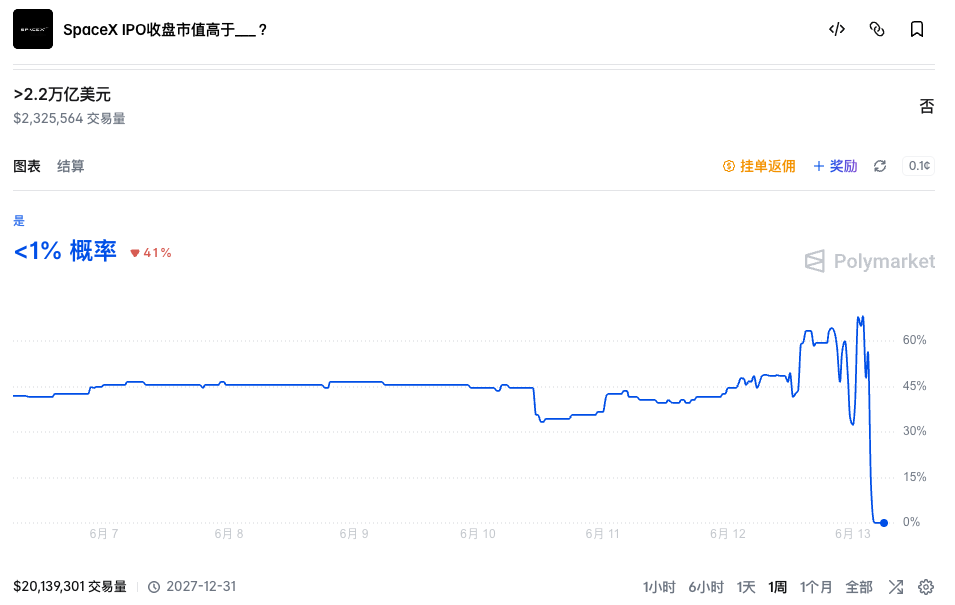
Discrepancies affect volatility rather than increase
The reasons are not complex, and the market still believes in SpaceX and is willing to pay a premium for Mask, but faith is not priceless. SpaceX valuation is too expensive, and once a good exit window is given, a firmer Mars dream becomes a bill。
SpaceX is the first mega-bots in human history to drop capital markets directly at a trillions of dollars, and the market value on the first day of the market goes beyond the technology giants Meta and Samsung to become the ninth-largest company in the world. But even the craziest bulk investors know that the current phase of SpaceX's collection cannot afford its huge valuation. SpaceX is still not profitable, with a net loss of $4.9 billion in 2025 and a net loss of about $4.28 billion in 2026。
Starlink is currently the only profitable business for SpaceX, with equity book data showing that in 2025 the chain business earned $11.387 billion, accounting for 61 per cent of SpaceX's total, operating profits of $44.23 billion, global users of over 10.3 million, or more than 9600 satellites in orbit, or $3.257 billion and operating profits of $1,188 million in 2026. But this "cash cow" business is just a side business of SpaceX。
Space launch is the main sign of SpaceX. As disclosed in the equity book, the Falcon series has accumulated over 650 launches, with a high success rate of 99 per cent, and its rocket booster recoverable technology has generated significant cost advantages and technological leadership within the industry. However, the largest external customer for SpaceX launch operations was the United States Government and was in a state of loss, with a loss of $657 million, a loss of 16.1 per cent, and a loss of $662 million, a loss of 107 per cent, in 2026。
The reason for this huge loss is that SpaceX has increased the input associated with the ship, but based on current technology and use scenario bottlenecks, the ship is still a distance from real commercial production。
In addition to these two operations, SpaceX's space power operation, which is still painting cake, is also in its valuation system. Mask's cattle in space computing are a little bit bigger than the two mature operations of the chain and space launch。
SpaceX's plan is simply to put GPU in a near-Earth orbit, using solar power to provide cloud computing for the global AI computing cluster. According to the SpaceX book, the goal of SpaceX is to deploy 100 GW ' s AI calculator capacity to orbit each year, and the current global demand for electricity in the AI industry is about 15-25 GW sizes per year, which means that the orbital power system in SpaceX ' s plan is theoretically enough to support today ' s expansion of the AI industry globally by about five times。
IN CASE THE READER DOESN'T KNOW WHAT THE CONCEPT OF 100 GW IS? THE CURRENT INSTALLED CAPACITY OF THE THREE CANYON HYDROELECTRIC PLANTS IS APPROXIMATELY 22.5 GW, WHICH IS EQUIVALENT TO 4.4 FULL CAPACITY GENERATION OF THREE CANYONS BY A SPACE COMPUTING CENTRE UNDER THE MASK PLAN。
In addition, SpaceX has clearly identified in its equity statement the potential market for the future (mainly AI-related operations) of $28.5 trillion. You know, China, the world's second largest economy, had a nominal GDP of about $19.4 trillion in 2025. SpaceX suggests this figure is already equal to 1.47 Chinese nominal GDP in 2025。
If you read it, you'll wonder if it's a listed equity book or a science fiction book, and the investors in FOMO will have to cool down. The research institute CFRA gave a “sale” rating of $115 after SpaceX was listed。
IN ADDITION TO THE DISCREPANCY BETWEEN ACTUAL OPERATIONS AND VALUATIONS, THE EXCESSIVE IPO RATIO IN THE BULK FAMILY MAY ALSO HAVE CONTRIBUTED TO THE STIFLING OF SAPX STOCK PRICES。
Mask released 20-30% of the IPO share to the bulk, and the larger the share, the greater the volatility, the more the bulk can be sold for the cost-neutral buy-in of FOMO. The real effect of the dispersion is therefore volatility rather than the final increase。
Next important game time
Of course, the following two time nodes are of particular importance for investors interested in SpaceX, whether you are in a hurry or have already left。
ABOUT 15 TRADING DAYS AFTER IPO (EXPECTED 6 JULY - AROUND 7 JULY)
This is the most important time point because SpaceX is expected to enter the NASDAQ 100 index in 15 trading days. In March, NASDAQ changed its rules specifically so that the new listed companies would wait three months before being eligible for inclusion in the index, but now only 15 trading days after the conditions have been met could be quickly included in the index, and at least 10 per cent of the turnover limit was removed. These new rules look like they're made for SpaceX and the next generation of AI technology giants。
The successful inclusion of SpaceX means that over billions of dollars globally will be passively bought into SpaceX ' s shares, which will underpin its stock prices。So if it is known in July that SpaceX has a great chance of being included in the finger, that the top fund will buy the stock, will you, as an investor, choose to buy it in advance and sell it to them at a high price
At the other end of the spectrum, however, protests have been made against some United States pension funds and long-term insurance funds. In May 2026, three of America's largest public pension administrations (managing assets of more than $1 trillion) sent a joint letter to Mask expressing concern about the risk of passive funding that might result from the rapid integration of IPOs into the index; and in the same month, the President of the American Teachers' Union (representing about 1.8 million teachers, health care and public sector employees) Randi Weingarten sent a direct letter to SEC requesting a special review of SpaceX IPO。
SpaceX Q2 Disclosure (early August)
The second important point is August, when SpaceX 2026 Q2 was released, which will be the first report card that will be handed over after SpaceX's listing, and its share price could be further pressurized if business is not moving forward compared to the present (too much progress actually and not realistic)。At the same time, the SpaceX book also provides that two days after the publication of the company ' s Q2 financial statements in 2026, eligible internal shareholders (employees, former employees, some early investors) may sell a portion of their locked shares, up to 20 per cent of the locked shares, and an additional 10 per cent may be unlocked if the stock price increases by 30 per cent over the IPO issue price and 5 out of 10 trading days meet the standard。
This means that the market in August will not only be able to cope with the financial volatility of SpaceX, but will also face enormous challenges in the face of the first large-scale unlocking of stocks on the market。
Whether or not we are “sufficient” for Mask’s dream, at least on the first day of the market, the market has chosen to believe in the story, but it has not completely lost its mind. The next thing that determines SpaceX's fate is its own real expression。
RECOMMENDED READING:
A new dream break on the SpaceX chain: trillions of dollars of IPO dinner, I only get four shares
