
SUPPLY CHAIN, ENERGY AND CAMPING: CENTRAL BACKBONE OF INVESTMENTS IN 2026 AI
Geopolitics becomes macroeconomic itself
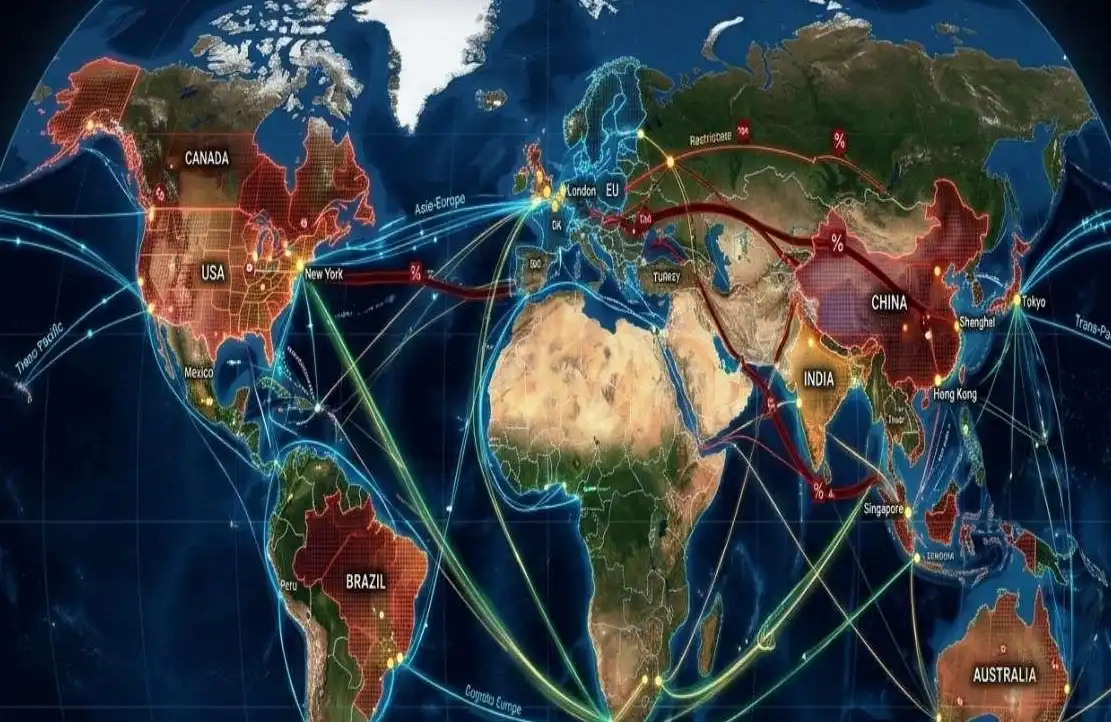
Original title: My 2026 Outlook: The Year Geopolitics Becomes the Macro
This post is part of our special coverage Syria Protests 2011
Photo by Peggy
THE EDITOR FOLLOWS THE MACRO-LINE OF 2026, WHICH MAY NO LONGER BE A CONVENTIONAL CYCLE TRANSITION, BUT A GEOPOLITICAL RESTRUCTURING INTO A PRICING PHASE. OVER THE PAST FEW DECADES, THE UNITED STATES HAS MAINTAINED ITS GLOBAL SYSTEM AS A GUARANTOR OF THE TRADE, SECURITY AND FINANCIAL ORDER; TODAY, AS AMERICA’S SHARE OF GLOBAL GDP DECLINES AND DOMESTIC POLITICAL CONSTRAINTS INCREASE, THIS MODEL IS SHIFTING FROM A “GLOBAL COVERAGE” TO A MORE BORDER-BASED “CAMPUS SYSTEM”。
THE CORE JUDGEMENT OF THIS PAPER IS THAT THE INVESTMENT FRAMEWORK FOR THE COMING YEAR SHOULD SHIFT FROM A TRADITIONAL “GROWTH-INFLATION” CYCLE ANALYSIS TO A JUDGEMENT ABOUT STRATEGIC BLOCS, SUPPLY CHAIN RE-ENGINEERING, AND THE DIRECTION OF CAPITAL SPENDING. WHOEVER HAS A CREDIBLE SYSTEM, INDUSTRIAL CAPACITY AND ENERGY CAPACITY WITHIN THE PREFERRED SUPPLY CHAIN IN THE UNITED STATES MAY BE THE BENEFICIARY OF A NEW ROUND OF GLOBAL ASSET REVALUATION. JAPAN, KOREA, LATIN AMERICA, EUROPE'S INDUSTRIAL CHAMPIONS, AS WELL AS ELECTRICITY GRIDS, STORAGE, AUTOMATION, ROBOTICS AND AI INFRASTRUCTURE, ARE INCLUDED IN THIS LOGICAL CHAIN。
IN PARTICULAR, THE ARTICLE EMPHASIZES THAT THE RETURN OF MANUFACTURING FLOWS IS NOT A POLITICAL SLOGAN, BUT A SYSTEMATIC REDISTRIBUTION OF LABOUR, ENERGY, ELECTRICITY GRIDS AND SAFE BORDERS. THE UNITED STATES CANNOT FULLY INTERNALIZE PRODUCTION ON ITS OWN, AND THUS THE IMPORTANCE OF ALLY ECONOMIES HAS RISEN; ENERGY AND ELECTRICITY GRIDS HAVE BECOME A HARD-ON FOR INDUSTRIAL POLICY; AND AI, AS THE CENTRAL BATTLEGROUND FOR COMPETITION BETWEEN CHINA AND AMERICA, WILL CONTINUE TO DRIVE HIGH-INTENSITY INVESTMENTS IN COMPUTING, ELECTRICITY, NETWORKS, AND MANUFACTURING STACKS。
For investors, this means that the opportunity in 2026 may not be in a crowded, large-scale US-based trade in science and technology power, but in a global search for a “seller” for this reorganization: electrification equipment, industrial automation, storage, grid infrastructure, defense bottlenecks, and non-United States markets that benefit from supply chain re-engineering. This paper provides not a single asset recommendation, but a geopolitical framework for understanding global macro and asset rotation in 2026。
The following is the original text:
THE DECISIVE FEATURE OF 2026 WAS NOT A STANDARD BUSINESS CYCLE CUT-OFF, BUT RATHER A WATERSHED IN A MAJOR GEOPOLITICAL RESTRUCTURING THAT HAD ALREADY TAKEN PLACE. FOR DECADES, THE UNITED STATES HAS PLAYED AN EXPANSIONARY ROLE IN THE GLOBAL ECONOMY: ANCHORING GLOBAL TRADE FLOWS, PROVIDING GUARANTEES FOR SECURITY ORDER, AND SERVING AS A TACIT GUARANTOR OF POST-WAR ORDER. BUT THIS PATTERN IS CHANGING, BECAUSE STRUCTURAL ARITHMETIC HAS CHANGED: AMERICA’S SHARE OF GLOBAL GDP IS NO LONGER ENOUGH TO UNDERPIN A GLOBAL COMMITMENT OF EQUAL BREADTH, AND ITS DOMESTIC POLITICAL CONSTRAINTS ARE INCREASINGLY POINTING TO A STRATEGIC CONTRACTION。
This does not mean that the influence of the United States is disappearing, but rather that it is being reconfigured. The United States is moving from a broad-based global posture to a clearer “campus” model: preferred supply chains, credible investment corridors, and more selective, regionalized security commitments. This is the core catalyst behind a series of major correct judgments over the past two years and will remain the main framework for understanding 2026。
Under this new pattern, the most important question for investors becomes: who is excluded from this system of preferences and which assets will benefit from this redesign
1) New camp system: Winners are United States-aligned, productive economies Body
High-performing emerging markets are not just countries with a favourable demographic structure, but are economies with strategic coherence, stability and productive capacity within the United States-led system. Countries with civil liberties, institutional resilience and democratic governance will become important because the United States camp needs trust: trust in contracts, trust in political continuity, trust in intellectual property protection, and trust in supply chain security。
BUT MORE IMPORTANTLY, THE US CAMP IS NOT LIMITED TO DEVELOPING COUNTRIES. IT WOULD ALSO INCLUDE DEVELOPED ECONOMIES WITH STRATEGIC INDUSTRIAL CAPABILITIES AND TECHNOLOGICAL DEPTH. JAPAN AND THE REPUBLIC OF KOREA, FOR EXAMPLE, ARE THE NATURAL BENEFICIARIES OF RENEWED INVESTMENT FROM CHINA AND THE BRICS CAMP (EXCEPT INDIA). THEY ARE KEY NODES IN THE FIELD OF SEMICONDUCTORS, ADVANCED MANUFACTURING AND INDUSTRIAL ROBOTICS, WHICH ARE THE SKELETONS OF THE AMERICAN CAMP SUPPLY CHAIN。
At the same time, the United States itself faces a paradox. Politically, the United States wants a return to manufacturing; strategically, it needs supply chain independence; but economically, the United States does not have enough labour to fully internalize the production base required. In short, the United States does not have enough cheap, young labour to fully build its new supply chain. It is this restriction that makes the area of ally and quasi-alignment even more crucial。
2) Defence restructuring: from "big tent" to "regional fortress"
If the first level of change occurs in the economic sphere, then the second level of change occurs in the security sphere. As the United States moves from a “large and open tent” to a smaller and more defensive regional fortress, the meaning of “defence” will change markedly. The emerging strategy is more of a modern Monroeism: focusing on the protection of adjacent regions and critical corridors, rather than maintaining the maximum global reach。
This shift has put Latin America at the centre. This is America's home, and it's America's home. Its geopolitical logic is very direct: the supply chain cannot be secure if adjacent areas are unstable. This means that changes at the political and institutional levels will be increasingly encouraged — whether implicit or visible — in order for the region to be suitable for large-scale capital deployment and integration into the United States supply chain。
One important impact is that, over time, China ' s influence in Latin America will gradually be squeezed out. With the region ' s political top-right and closer alliance with the United States, inflation and interest rates may decline and growth may rise. Its mechanisms were not mysterious: FDI increased capital spending, expanded productive capacity, strengthened external balances and improved monetary credit。
This could lead to a virtuous cycle: trade growth, industrial upgrading, and economic growth, which is no longer dependent on bulk commodity exports, is becoming broader. Large commodities will remain at the centre, but their spillover effects will increasingly manifest themselves in the areas of finance and alternative consumption, as domestic credit systems deepen and middle-class consumption becomes more resilient。
3) Energy: hard constraints on returning manufacturing flows
Supply chain reshaping faces a hard constraint in the developed world: energy and grid capacity。
When the United States, Europe and allied economies try to bring back production and ensure its safety, they are finding that their energy systems are far from adequate: grid ageing, underinvestment, and strategically exposed to unreliable sources of energy. This led to a clear theme for 2026: energy shortages will be a constraint on industrial policy。
This will drive a range of investment impulses:
:: Increasing energy imports from allies
Accelerated renewable energy construction
Re-emphasizing nuclear energy
:: Large-scale upgrading of the grid
Expanding logistics and raw material demand
Solar and wind energy are already gaining kinetic energy, as they expand faster than traditional base-charge infrastructure. Nuclear power cannot be built quickly through a “progressive” approach; nor can natural gas increase rapidly without expensive pipeline construction and approval. In contrast, renewable energy can be modularly deployed, faster, more widely distributed and more politically expanded。
Of course, the missing link is reliability. That's the role of storage. Batteries are becoming a key tool for peak load management and grid stabilization, and continuing advances in battery technology, coupled with increasing investment, are making the storage value chain increasingly strategic. The three main lines of return of manufacturing, energy and security converge here: the grid is becoming a national security asset。
4) Europe: within the same camp, subject to growth constraints, but with the highest quality "seller" assets
Europe may be one of the most vulnerable areas in 2026. Europe ' s growth ceiling remains low due to a weaker population structure, higher energy costs, more regulatory and less risky capital than the United States. In other words, Europe is unlikely to be an engine for the next cycle。
But the importance of Europe lies not in macro-dynamicity, but in its industrial composition. In a fragmented world, Europe is within the United States camp. Moreover, Europe still has some of the highest-quality global enterprises in those areas where the new pattern will overinvest: electrical equipment, electrification, grid infrastructure and industrial automation。
This is why the European stock market is likely to perform well even if Europe’s economy is relatively backward: the European index is not just a reflection of “European demand”. They consist to a large extent of global exporters and transnational suppliers, which serve capital expenditure cycles that are occurring around the globe。
Defence: a valuation step up instead of a simple kinetic transaction
european defence spending has shifted structurally, and the political consensus on the counterpart of stronger military capabilities is sustainable. but since the beginning of the russian-uu war, markets have re-evaluated much of the readily available rise in space, and the conflict itself may be moving into a low-intensity phase. this means that european defence opportunities will no longer be widespread beta exposure, but should focus more on selective bottlenecks: ammunition, secure electronic equipment, aerospace components, and maintenance and logistics。
Electricity equipment: European electrification skeleton as a new capital expenditure cycle
THE REAL OPPORTUNITIES FOR INCREMENTALITY ARE ELECTRIFICATION AND GRIDS. THE ELECTRICITY SYSTEM OF THE DEVELOPED WORLD IS THE BOTTOM CONSTRAINT BEHIND THE RETURN OF MANUFACTURING AND AI. THE PROBLEM IS NOT JUST ELECTRICITY GENERATION, BUT TRANSMISSION AND DISTRIBUTION EQUIPMENT THAT CANNOT EXPAND FAST ENOUGH: TRANSFORMERS, SWITCHES, GRID AUTOMATION, ELECTRICAL ELECTRONICS, EFFICIENT POWER UNITS AND SYSTEMS INTEGRATION。
THE EUROPEAN INDUSTRIAL BASE INCLUDES THE WORLD'S LEADING FIRMS IN THE CATEGORY OF SHOVELS. BECAUSE THEY SERVE GLOBAL CAPITAL SPENDING, NOT EUROPEAN CONSUMPTION, THEIR PROFITS CAN GROW EVEN IF GDP GROWTH IN EUROPE IS FLAT。
Industrial automation: Europe as an enabler of productivity growth
The return of manufacturing and offshore outsourcing are ultimately constrained by labour scarcity and cost. The only way to keep highly wage advanced economies competitive with global manufacturing is to increase productivity and promote automation. Europe remains a leading supplier of plant automation systems, robotics, industrial sensors, control software and precision tools。
Thus, the right way to place Europe in 2026 is not to treat it as a macro-level “European recovery” deal, but rather as a structural trade: holding the leading industrial and infrastructure players that are export-driven and that benefit from the upgrading of global capital spending, while maintaining a more cautious approach to European home-grown demand segments。
5) AI: CENTRAL BATTLEGROUND OF CENTRAL AMERICAN COMPETITION
IF ENERGY IS THE PHYSICAL CONSTRAINT OF THE RETURN OF MANUFACTURING, THEN AI IS THE STRATEGIC CONSTRAINT OF THIS CENTURY. IT IS THE MOST IMPORTANT BATTLEGROUND IN THE COMPETITION BETWEEN CHINA AND THE UNITED STATES, BECAUSE BOTH LEADERSHIPS INCREASINGLY VIEW THE RACE TO SUPER INTELLIGENCE AS A DECISIVE ISSUE。
CHINA IS CATCHING UP LATER, TAKING LONGER – STARTING LATE AND FACING A CHIP EMBARGO – BUT THE KEY IS THAT CHINA IS ALREADY CATCHING UP TO THE POINT OF IMPACT AND IS STEPPING DOWN ON THE GAS. DOMESTIC AI CAPITAL SPENDING IN CHINA HAD PREVIOUSLY LAGGED BEHIND THAT IN THE UNITED STATES, BUT THE GAP WAS NARROWING. THIS ENSURES THAT AI WILL CONTINUE TO BE THE TARGET OF LARGE INVESTMENTS, REGARDLESS OF SHORT-TERM COMMERCIAL RETURNS, AS IT IS INCREASINGLY SEEN AS A STRATEGIC INFRASTRUCTURE RATHER THAN AS AN ORDINARY INDUSTRY。
The impact on 2026 was direct:
AI CAPITAL SPENDING AND COORDINATION AT THE NATIONAL LEVEL WILL CONTINUE TO ACCELERATE。
State support and intervention in both camps increased。
AI THE VALUE CHAIN WILL BE STRUCTURALLY DIVIDED: THE UNITED STATES AND CHINA ARE EACH FORMING。
Duplicate construction means that total investment is larger, and this will result in double efficiency, electricity, networks and manufacturing stacks。
WITHIN THIS FRAMEWORK, AI SHOULD BE UNDERSTOOD IN BROAD TERMS — NOT ONLY AS A GENERATOR MODEL, BUT ALSO AS A SMART, AUTOMATED AND ROBOTIC. THE YEAR 2026 IS LIKELY TO BE AN ACCELERATED YEAR FOR ROBOTS, AND HUMAN ROBOTS WILL BECOME IMPORTANT NARRATIVES AND CAPITAL EXPENDITURE DESTINATIONS。
Ultimately, the economic performance at the application level may be disappointing — until the inevitable comes to light — compared to infrastructure inputs. But that's more likely a 2027-2028 story. For the year 2026, the determining characteristic remains the intensity of investment rather than the maturity of the realization。
6) Combination Meaning: Rotation from crowded U.S. large technology units
This macroeconomic pattern also explains the importance of the global attributes of our value chain index. The United States stock market, particularly its large technology unit, has become bubbled and stymied. Both domestic and international investors in the United States have a considerable concentration of ownership of the block. Even when the United States is still structurally strong, conditions for sustained momentum become less attractive when silos become extremely crowded。
This has created an opportunity for international and non-scientific stocks to be the most logical expression of this prospect. Especially if 2026 is a year of rotation... - It may be similar to the conversion after 2000, although the basics are not identical。
IN OTHER WORDS, IF GEOPOLITICS ARE RESHAPING THE SUPPLY CHAIN, IF ENERGY BECOMES HARD-PRESSED, IF DEFENSE BECOMES REGIONAL, AND IF AI CAPITAL SPENDING REMAINS OVERWHELMING, THEN THE LEAST RESISTANCE IS TO HOLD THE BENEFICIARIES OF THIS RESTRUCTURING GLOBALLY, RATHER THAN TO CONTINUE TO PURSUE THE MOMENTUM OF A HANDFUL OF LARGE US TECHNOLOGY UNITS。
Conclusion: a catalyst, multiple expressions
The inherent consistency of the vision for 2026 is that everything goes back to the same source: a geopolitical change that redefines trade, security, energy and technology competition. The right framework is not "growth versus inflation" or "population versus productivity". The right framework is that the world is being restructured into a different strategic camp, and that re-engineering the supply chain will force higher capital spending, drive re-evaluation of risks and reshape winners and losers across regions and industries。
This is the core catalyst behind every major structural judgement of the past two years. It will also remain the understanding of the most important macro perspective in 2026。
[ Chuckles ]Original Link]
