
From charades to "Temporary Rules": Ten-year charades of encryption
Values must come from the programmed operation of well-functioning systems, not from the commitment of someone. 。
Thejaswini M A
Original language: Black Unicorn
ON 17 MARCH, THE UNITED STATES SECURITIES AND EXCHANGE COMMISSION (SEC) AND THE COMMODITY FUTURES TRADING COMMISSION (CFTC) ISSUED A RULEBOOK TO THE ENCRYPTED MONEY INDUSTRY THAT HAD BEEN EXPECTED SINCE 2013. I AM PLEASED WITH THAT AND AM WORKING TO DO SO。
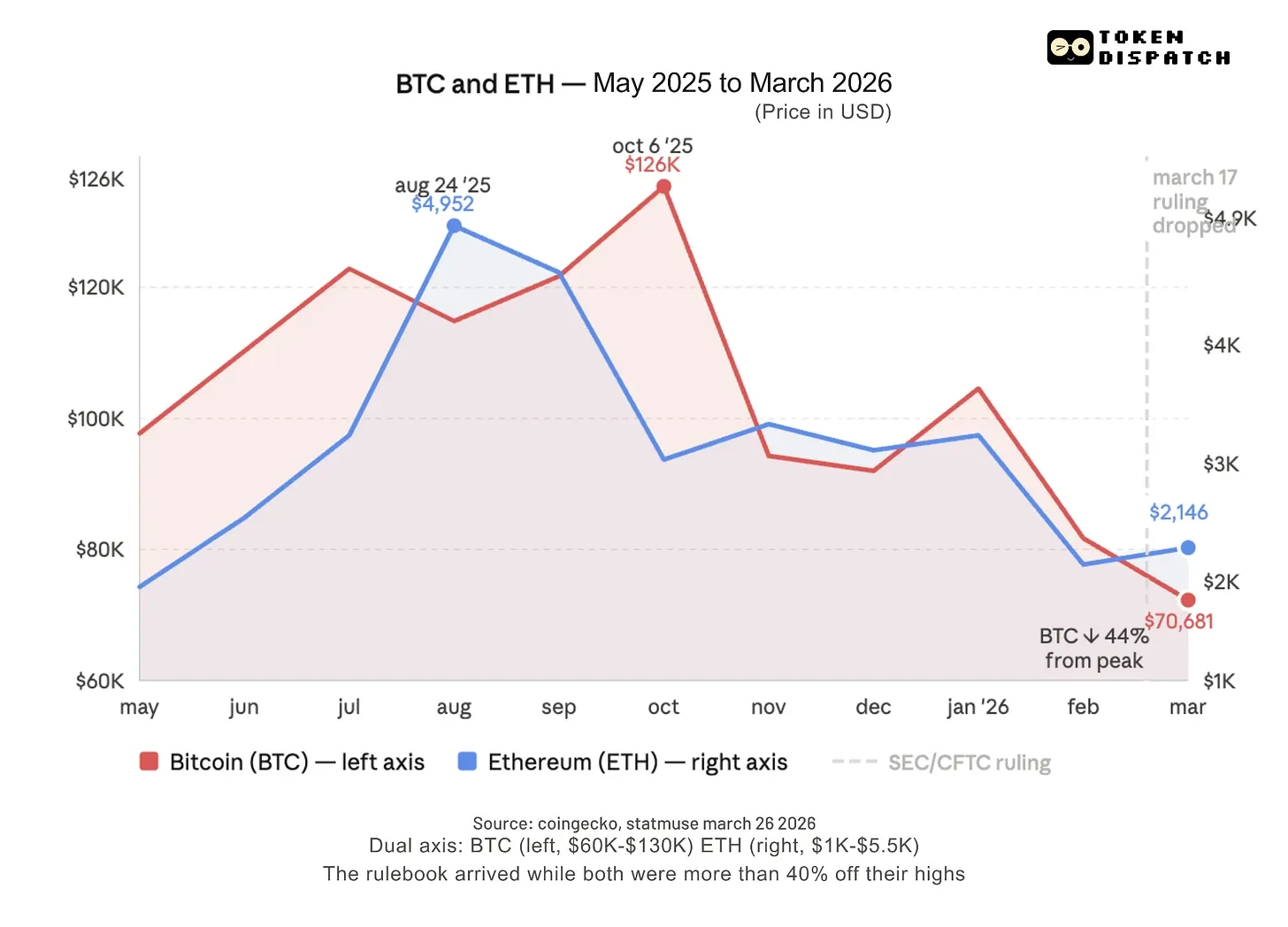
Bitcoin dropped 44% above the high point of October. The fare price was about US$ 2,000, less than half the price seven months ago. The total market value of the mountain currency has evaporated by US$ 47 billion since its peak. The panic and greed index reached 11. It's not a bad 11 in a week, it's an 11 out of 100. This means that people no longer dispute where the bottom is, but begin to sell the remaining encrypted currency。
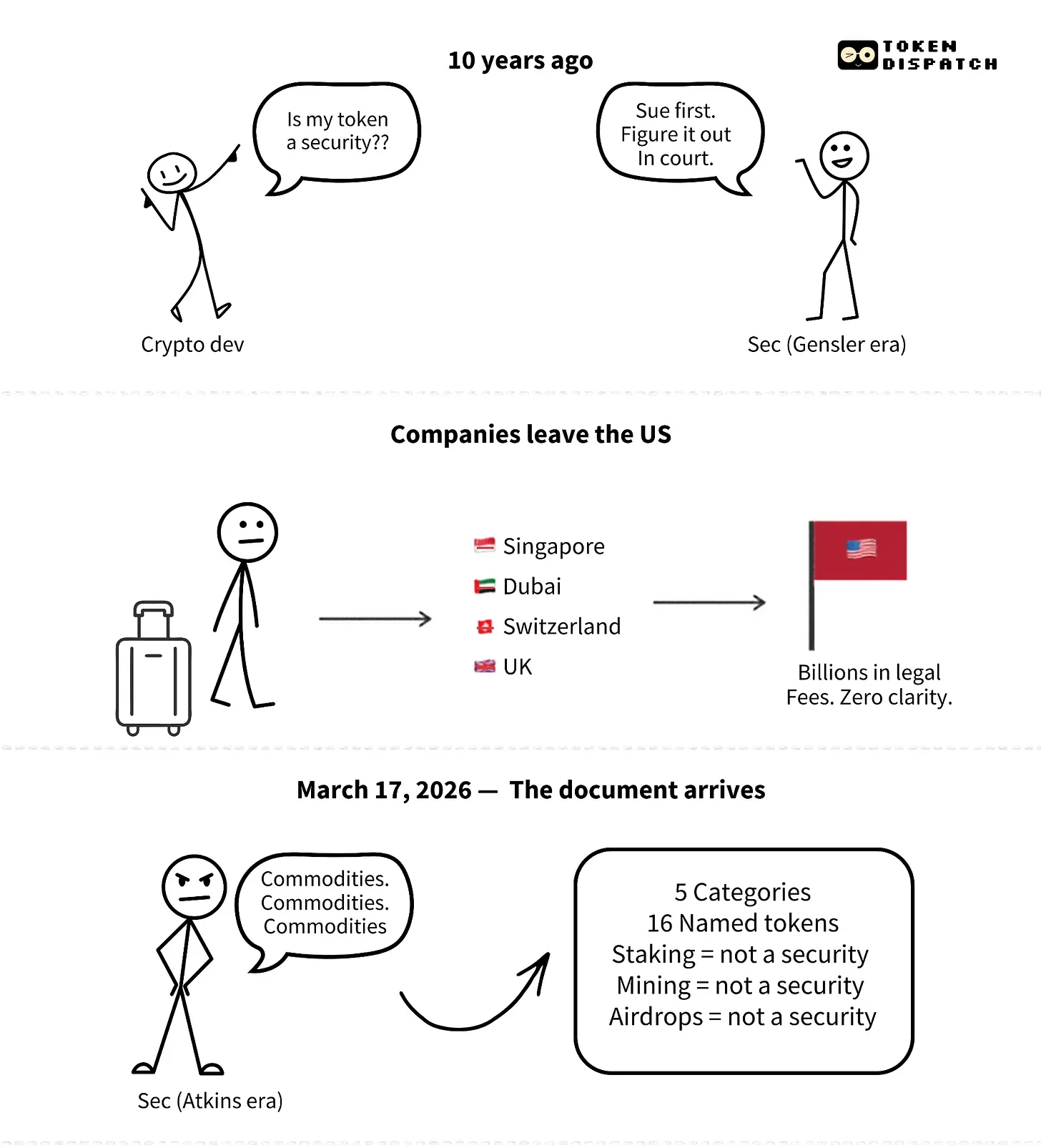
And then, on March 17, the United States Securities and Exchange Commission (SEC) and the Commodity Futures Trading Commission (CFTC) issued a document that finally revealed what the tokens you held were. Prior to that, the parties had gone through a decade of litigation, hundreds of enforcement actions and billions of dollars in legal fees. Some companies have even opted to move to Singapore instead of continuing to play the puzzle game with Gary Gensler. And in the week of falling $1,900 in taffle prices, the answer was finally revealed。
But the key is that, despite the damage done to the currency economy itself, everything at its bottom flourishes. Stabilized currency flows have exceeded $31.6 billion, and real world assets (RWAs) in the chain have reached $26.5 billion and are growing steadily. That is why Morgan Stanley is building an encrypted trust bank. Meta gave up the meta-cosm project, but is introducing stabilization coins into whatsapp. Stripe is processing a fixed currency transaction worth $40 billion. NASDAQ is building a monetized stock exchange platform. Encrypted currency is becoming the backbone of global finance, and in most cases it does not depend on tokens。
Encryption money is no longer merely a speculative asset class. The regulatory policy introduced on March 17 was originally designed for the first generation of encrypted currency, but it was formally implemented after the second generation of encrypted currency。
But that does not mean that it is meaningless。
Paul Atkins, the Chairman of the United States Securities and Exchange Commission, once said, "We are no longer the Securities and Everything Commission."
For the first time, United States regulators have harmonized definitions of encrypted currency. Each of the five categories falls into one category. And I'm going to come up with these definitions, and read them with ideas you've never heard of。
DIGITAL GOODS ARE A BIG PLAY. DIGITAL GOODS ARE AN ENCRYPTED ASSET WHOSE VALUE DERIVES FROM THE PROGRAMMED OPERATION OF A FULLY FUNCTIONAL ENCRYPTION SYSTEM AND THE DYNAMICS OF SUPPLY AND DEMAND. ITS VALUE DOES NOT DEPEND ON THE MANAGEMENT OF CENTRAL ISSUERS. IF THE NETWORK IS TRULY DECENTRALISED AND FUNCTIONING, AND NO SINGLE COMPANY SUPPORTS IT, THE ASSET IS A COMMODITY. THIS IS GOVERNED BY THE UNITED STATES COMMODITY FUTURES TRADING COMMISSION (CFTC), NOT THE UNITED STATES SECURITIES AND EXCHANGE COMMISSION (SEC)。
Sixteen mainstream coins, including Bitcoin, ETA, Solana, XRP, Cardano, Avalanche, Polkadot, Chainlink, Dogcoin and Chay canine, were officially recognized as digital commodities. Dog coins and canine coins meet this definition because they are not driven by sponsors or institutions. Their lack of commitment, road maps and the continued work of their teams are critical to the value of tokens. That is why they are considered commodities rather than securities. The test is whether there is a commitment to deliver returns based on the results of its work。
DIGITAL SECURITIES REFER TO TOKENIZED STOCKS, BONDS AND NATIONAL DEBT. IN SHORT, THESE ASSETS ARE SECURITIES BEFORE THEY ARE PLACED ON THE BLOCK CHAIN AND REMAIN SECURITIES THEREAFTER. THE UNITED STATES SECURITIES AND EXCHANGE COMMISSION (SEC) REGULATES THESE ASSETS. THAT'S IT。
DIGITAL COLLECTIONS ARE NFTS BOUND TO SPECIFIC ARTICLES OR EXPERIENCES. DIGITAL TOOLS ARE ASSETS USED TO ACCESS SOFTWARE OR SERVICES AND DO NOT EXPECT RETURN ON INVESTMENT. THE STABILIZATION CURRENCY HAS ITS EXCLUSIVE CATEGORY WITHIN THE FRAMEWORK OF THE GENIUS ACT。

Pledges, mining and air drops have been granted. The decision made it clear that receiving an incentive to dig, participating in a chain pledge or receiving a drop in a digital commodity was not a securities transaction. This eliminates one of the greatest legal risks facing the network since Gensler. The packaging of non-securities coins has also been approved。
These 16 named tokens are the base infrastructure behind which there are years of decentrization and development. DeFi protocol tokens — such as JUP, POL, METEOR and the vast majority of those introduced over the past two years — are not named and are clearly not eligible. A well-functioning encryption system with no centralized agency to oversee participation is at a very high threshold. Most of the active development agreements fall short of this standard. The grey areas, which should have been addressed by such an interpretation, remain ambiguous with regard to the tokens actually held by the majority。
Values must come from the programmed operation of well-functioning systems, not from the commitment of someone. This test translates a decade-long ambiguity into something that compliance officials can really address。
There's something else
The proclamation does not constitute a formal rule-making procedure under the Administrative Procedure Act, nor is it binding on the law or officially promulgated legislation。
YOU BETTER READ THAT AGAIN. THE 68-PAGE DOCUMENT THAT WE HAVE BEEN WAITING FOR IS ONLY AN EXPLANATORY ANNOUNCEMENT, NOT A LAW OR REGULATION, BUT ONLY AN INSTITUTIONAL POSITION STATEMENT ISSUED BY THE CURRENT PRESIDENTS OF THE UNITED STATES SECURITIES AND EXCHANGE COMMISSION (SEC) AND THE COMMODITY FUTURES TRADING COMMISSION (CFTC), WHICH THEY CAN WITHDRAW AT ANY TIME。
THIS INTERPRETATION IS BINDING ON THE OFFICIAL BODIES OF THE UNITED STATES SECURITIES AND EXCHANGE COMMISSION (SEC) AND THE COMMODITY FUTURES TRADING COMMISSION (CFTC). HOWEVER, IN THE ABSENCE OF RELEVANT LEGISLATION, FUTURE GOVERNMENTS COULD MODIFY IT. THE DOCUMENT ITSELF RESERVED THE RIGHT OF INSTITUTIONS TO REFINE OR EXPAND THEIR VIEWS. A FUTURE SEC PRESIDENT WITH A DIFFERENT POLITICAL POSITION COULD OVERTURN THIS INTERPRETATION WITHOUT CONGRESSIONAL APPROVAL. THE NEXT GOVERNMENT DOES NOT NEED EVEN NEW LAWS, BUT NEW LEADERSHIP。
Atkins knows this very well. He expressed this view on the day of the launch, calling for action by Congress to provide more sustained clarity. He sees this interpretation as a transitional measure, pending parliamentary action on comprehensive market structure legislation. This legislation is the Market Structure Transparency Act. The Market Structure Transparency Bill is currently before the Senate。
THE CLARITY BILL
THE HOUSE OF REPRESENTATIVES PASSED THE CLARITY BILL BY 294 VOTES IN JULY 2025. THE TWO-PARTY COOPERATION HAS ACHIEVED SUCH A HIGH LEVEL OF SUPPORT, INDICATING A GENUINE CONSENSUS BETWEEN THE PARTIES。
It then entered the Senate and stalled。
THE KEY TO PREVENTING THE PASSAGE OF THE BILL IS TO STABILIZE THE RATE OF RETURN ON THE CURRENCY. BANKS BELIEVE THAT ALLOWING ENCRYPTION PLATFORMS TO PAY INTEREST ON STABLE CURRENCY BALANCES COULD TRIGGER AN OUTFLOW OF DEPOSITS. PEOPLE WOULD TAKE OUT THE MONEY FROM SAVINGS ACCOUNTS AND DEPOSIT IT IN USDC TO GET HIGHER RETURNS. THE BANKING LOBBY THEN LOBBIED. THE SENATE BANKING COMMISSION CANCELLED THE REVIEW SCHEDULED FOR JANUARY 2026. THE BILL HAS NOT MADE ANY PROGRESS IN THE NEXT TWO MONTHS。
On 20 March, Senator Tom Tilis and Angela Alsobrooks confirmed a principled agreement on the incentive to stabilize the currency, which was supported by the White House. The terms of the agreement are: the passive proceeds of the stable currency are prohibited; incentives for activities linked to payments and platform use are still allowed. Both sides were dissatisfied, and compromises usually resulted from that。
BUT THE RATE OF RETURN AGREEMENT IS ONLY ONE OF FIVE THINGS TO BE DONE BEFORE THE CLARITY ACT COMES INTO FORCE. THE REMAINING FOUR LEGISLATIVE STEPS WERE COMPLETED AT THE HEIGHT OF THE YEAR。
- Senate Banking Commission; and Senate plenary voting (60 votes required)
- Coordination with the Committee on Agriculture
- Coordination with the Chamber of Deputies version
- Signed by the President
The deliberations of the Banking Commission are scheduled for the second half of April, after the Easter recess. Senator Bernie Moreno warned that if the bill was not submitted to the Senate plenary by May, digital asset legislation might not make progress in the coming years。
In addition, the war in Iran took up a great deal of discussion in the Senate. There is also a bill on voter identification, which Trump has expressed the wish to adopt first. The Decentralisation of Finance (DeFi) provisions remain unresolved, and Senate Democrats are concerned that there is an illegal financial risk. Nor has the provisions of ethical norms been finalized, particularly whether high-ranking government officials should be prohibited from profiting from encrypted assets — an issue that is clearly politically sensitive given the encrypted currency held by the current Government. The Senate Republicans are currently discussing the addition of community banking deregulation provisions to the bill as political leverage, which will trigger a whole new series of negotiations。
The Financial Services Commission of the United States House of Representatives recently held a hearing entitled "Designation and the Future of Securities: Modernization of Capital Markets". Witnesses to the hearing included Kenneth Bentsen of the United States Securities Industry and Financial Markets Association (SIFMA), Summer Mersinger of the Area Chain Association, Christian Sabella of the United States Securities Exchange Clearing House (DTCC) and John Zecca of NASDAQ. NASDAQ and the New York Stock Exchange are building a monetized stock exchange platform. DTCC is responsible for the current settlement. If the DTCC recognizes the efficiency of the block chain, the debate is actually over。
Thus, infrastructure construction is based on a set of rules manuals that may not exist after two years. This is the dilemma facing the industry. Corporations are making billions of dollars in decisions to build hosting systems, monetization platforms and pledge infrastructure, all based on a convincing but legally invalid explanatory document。
What's eternal, what's not
FOR READERS WHO HOLD THE ABOVE-MENTIONED 16 TOKENS (E.G. ETH, SOL, XRP), THESE ARE NOW OFFICIALLY RECOGNIZED AS DIGITAL GOODS UNDER UNITED STATES LAW, THANKS TO THE STATEMENTS OF THE HEADS OF THE TWO REGULATORS. THE CLASSIFICATION WILL CONTINUE TO BE VALID AS LONG AS THE TWO PRINCIPALS OR THEIR SUCCESSORS CONTINUE TO MAINTAIN THIS DETERMINATION。
IF THE CARITY BILL IS PASSED, IT BECOMES LAW. NO FUTURE PRESIDENT HAS THE RIGHT TO OVERTURN IT WITHOUT CONGRESSIONAL APPROVAL. THE ASSETS LISTED WOULD BE PERMANENTLY DEFINED AND THE CLASSIFICATION CRITERIA WOULD BE BINDING。
If it had not been adopted by May, the current classification system would depend only on the views of a single government department. Currently, 16 named assets are temporarily secure, but not all have been named. Most of the decentralised finance (DeFi), most of the new tokens, as well as any assets that do not require permission and that do not have a clear issuer, remain in the grey zone, an issue that has not been explicitly addressed in previous interpretations。
The most desirable sentence is as if it were a draft written in pencils。
Someone needs to pick up a pen to officially implement this. Everything depends on the next six weeks of the Senate. Will these rules last long enough to make all this meaningful
