The original Odaily Daily Planet@OdailyChinaI'm not sure
By Azuma@azuma_ethI'm not sure
On 2 December, BlackRock, the world ' s largest asset management company, released its 2026 investment outlook report. Although the report does not have much direct connection to the encrypted money market (only one page of the PDF on page 18 refers to stabilization currency), it is “the King of Global Governance” that is the most important source of information in the worldIn his report, Belet provided an overview of the current environment and variables in the global economy, which may be of some relevance to users who wish to expand the scope of their investments, in the immediate context of the growing convergence of encrypted money markets with mainstream financial markets, or in the context of macro-market changes in the latter。
The entire report is longer, and the Daily Daily Daily Planet will attempt to streamline this 2026 operational secret that outlines Belet。

Superpower is reshaping the world
Bérédé said at the beginning:The world today is in an era of structural change driven by geopolitical fragmentation, the evolution of the financial system (Odaily note: this is mainly about the currency of stability), energy transformation, etc., of which the most prominent force for change is undoubtedly artificial intelligence (AI) - The development of AI is advancing at an unprecedented pace and on a scale, and the shift of the industry from a “light capital” to a “heavy capital” model is profoundly changing the investment climate。
In the current market structureIt is difficult for investors to avoid judging the direction of the post-market - which means that there is no absolute neutrality, and even a broad index investment is not a neutral option。
Leading forces: AI
AI is now the dominant superpower that drives the US stock up this year. In recent months, investors have become increasingly concerned about whether AI bubbles are emerging – Sheller market earnings data indicate that US stock valuations have reached the peak levels since the Internet bubble and the Great Depression of 1929。
Historically, market bubbles have emerged in several major transition periods and may be repeated this time, but bubbles often show clear signs only when they break apart. This is why I have to goIN HIS REPORT, BELET WILL FOCUS ON THE QUESTION OF MATCHING THE SIZE OF AI INVESTMENTS WITH THE LEVEL OF POTENTIAL RETURNS - THIS IS BOTH THE MAIN THREAD BEHIND THE AI TECHNOLOGY REVOLUTION AND THE CORE QUESTION THAT THE REPORT SEEKS TO ANSWER。
Belet thinksAI THE THEME REMAINS THE MAIN DRIVING FORCE OF THE UNITED STATES STOCK MARKET, SO THE AGENCY WILL INSIST ON RISK PREFERENCES, BUT THE CURRENT MARKET ENVIRONMENT DEMANDS MORE FOR PROACTIVE INVESTMENTI DON'T KNOW. WHETHER IT IS THE SCREENING OF WINNERS IN THE AI COMPETITION AT THIS STAGE OR THE CAPTURING OF OPPORTUNITIES IN THE FUTURE AS AI GAINS BEGIN TO SPREAD, THE CHOICE OF INITIATIVE IS CRUCIAL。
The market core question: Does “pre-expenditure” match “replacement gains”
AT PRESENT, THE CORE QUESTION FOR MARKET INVESTORS IS HOW TO ASSESS THE MAGNITUDE OF THE HUGE CAPITAL EXPENDITURE ON AI AND ITS POTENTIAL INCOME
AI DEVELOPMENT REQUIRES PRE-INVESTMENT IN THE AREAS OF COMPUTING, DATA CENTRES AND ENERGY INFRASTRUCTURE, BUT THE FINAL RETURN ON THESE INVESTMENTS IS LAGGING。THE TIME LAG BETWEEN CAPITAL EXPENDITURE AND FINAL GAINS HAS PROMPTED AI BUILDERS TO BEGIN TO USE DEBT TO CROSS FINANCING BARRIERS. THIS PRE-ENCUMBRANCE OF EXPENDITURE IS NECESSARY TO ACHIEVE FINAL GAINS, BUT IT ALSO CREATES A VERY DIFFERENT INVESTMENT CLIMATE - ITS CORE FEATURES INCLUDE:
- higher leverage: substantial increase in the distribution of credit in public and private markets;
- Better capital costs: large borrowing pushes interest rates
- (A) FOCUS ON OPPORTUNITIES: UNTIL AI GAINS SPREAD TO THE ECONOMY AS A WHOLE, MARKET INCREASES REMAINED HIGHLY CONCENTRATED ON THE SCIENCE AND TECHNOLOGY SECTOR
- Increased active investment space: The space for active management and stock selection will increase significantly when revenues actually spread to industries other than science and technology。
The question of the matching of expenditure with income is not conclusive。Beled believes that the final answer depends on whether America's economic growth will break the long-term 2 per cent trend。
Bérédé predicts that:CAPITAL SPENDING ON AI WILL CONTINUE TO SUPPORT ECONOMIC GROWTH IN 2026, AND THIS YEAR THE CONTRIBUTION OF INVESTMENT TO GROWTH IN THE UNITED STATES HAS TRIPLED TO ITS HISTORICAL AVERAGE. THE GROWTH DYNAMICS OF THIS “HEAVY CAPITAL” MODEL ARE LIKELY TO CONTINUE INTO THE NEXT YEAR, ALLOWING ECONOMIC GROWTH TO REMAIN RESILIENT EVEN IF LABOUR MARKETS CONTINUE TO COOL。
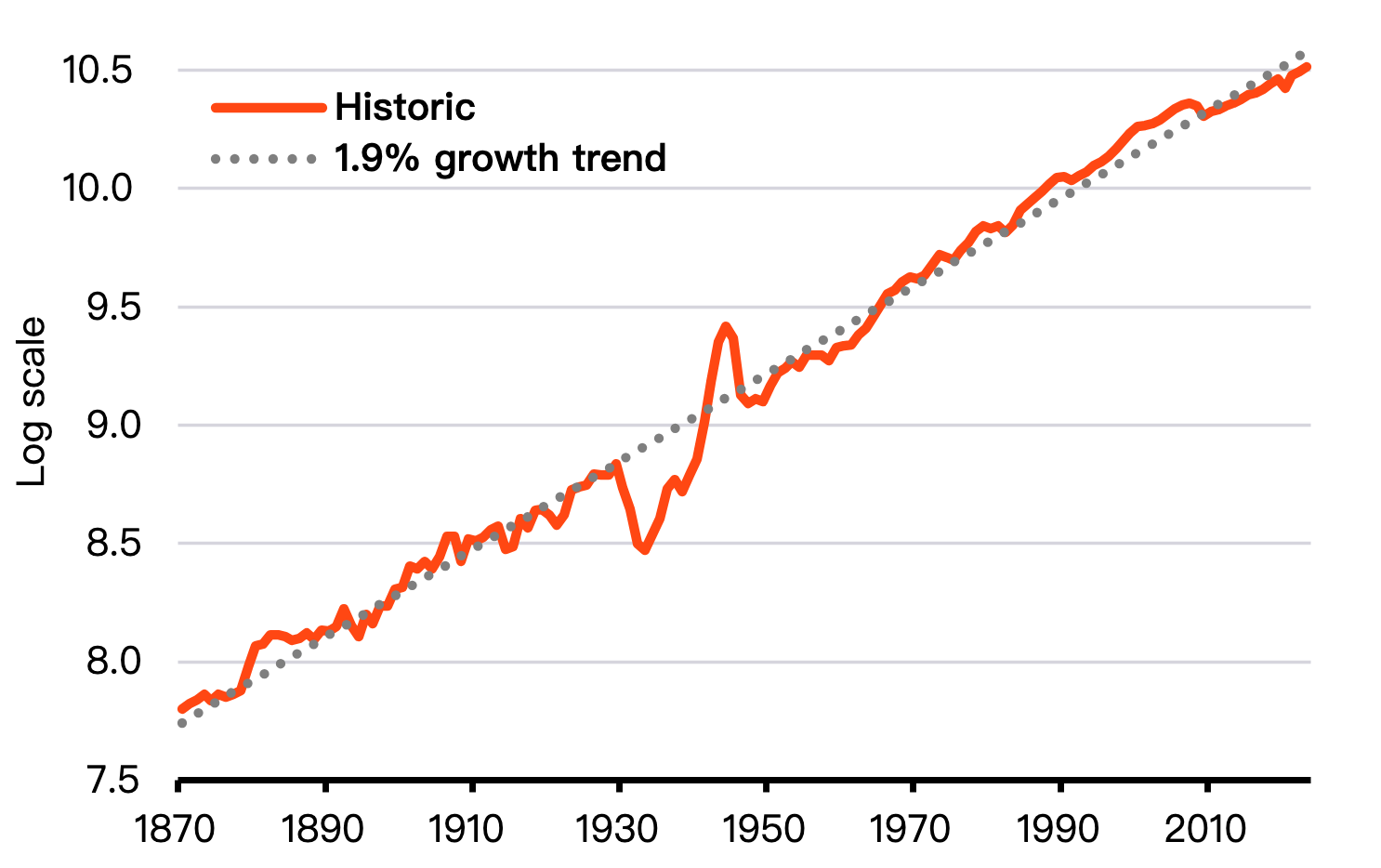
BUT IS THAT ENOUGH TO PUSH THE US ECONOMY PAST THE LONG-TERM 2% TREND? ALL THE MAJOR INNOVATIONS OF THE PAST 150 YEARS -- INCLUDING STEAM ENGINES, ELECTRICITY AND THE DIGITAL REVOLUTION -- HAVE FAILED TO ACHIEVE THIS BREAKTHROUGH. HOWEVER, AI MAY MAKE IT POSSIBLE FOR THE FIRST TIME. THE REASON ISAI IS NOT JUST AN INNOVATION IN ITSELF, BUT HAS THE POTENTIAL TO ACCELERATE OTHER INNOVATIONS。It goes beyond automating tasks and can accelerate creativity and scientific breakthroughs through self-learning and iterative improvements。
Three core themes
Micro-macro
INFRASTRUCTURE DEVELOPMENT IN AI IS CURRENTLY DOMINATED BY A SMALL NUMBER OF COMPANIES, WHOSE EXPENDITURES ARE LARGE ENOUGH TO HAVE A MACRO-LEVEL IMPACT。THE OVERALL REVENUE GENERATED THROUGH AI IN THE FUTURE MAY SUPPORT THIS EXPENDITURE, BUT IT IS NOT CLEAR WHAT SHARE THE LEADING TECHNOLOGY COMPANIES WILL RECEIVE。
BELET WILL MAINTAIN A RISK PREFERENCE AND MATCH THE EQUITY WITH THE AI THEME (WHICH IS UNDERPINNED BY STRONG PROFIT EXPECTATIONS). EVEN IF INDIVIDUAL COMPANIES ARE UNABLE TO FULLY RECOVER THEIR INVESTMENTS, OVERALL CAPITAL EXPENDITURE IS EXPECTED TO YIELD RETURNS), WHILE CONSIDERING THE CURRENT TIMING FOR PROACTIVE INVESTMENT。
Leverage up
LONG-TERM FINANCIAL SUPPORT IS REQUIRED TO MOVE BEYOND AI TO DEVELOP A “INVESTMENT-FOR-INVESTMENT-RECEIVING” FINANCE BOOM, AND LEVERAGE IS INEVITABLE. THIS PROCESS HAS BEGUN, AS EVIDENCED BY RECENT LARGE-SCALE DEBT PAYMENTS BY LARGE TECHNOLOGY COMPANIES。
Belet expects that businesses will continue to use open and private credit markets on a large scale. The expansion of public and private sector lending may continue to place upward pressure on interest rates. The high cost of debt servicing is one of the reasons why we believe that the term premium (i.e. the compensation required for investors to hold long-term bonds) will rise and push up the rate of return。On this basis, we have turned to low-cost long-term United States national debt。
The Fault of Diversification
Portfolio decision-making in the name of “diversification” has become more proactive than ever, with the aim of circumventing the few forces currently driving the market. The Belet analysis shows that the growing share of the United States stock market returns is reflecting a single, common driver after removing the common drivers of return for equities such as value and momentum。Market concentration increased and the breadth narrowed。ATTEMPTS TO SPREAD THE RISK EXPOSURE TO THE UNITED STATES OR AI, INCLUDING THROUGH A SHIFT TO OTHER REGIONS OR EQUIVALENT WEIGHT INDICES, IN ESSENCE CONSTITUTE MORE PROACTIVE DECISION-MAKING THAN EVER BEFORE。
IN BELET ' S VIEW, GENUINE DIVERSIFICATION IMPLIES A SHIFT FROM A BROAD CLASS OF ASSETS OR A REGIONAL PERSPECTIVE TO A MORE PRECISE, FLEXIBLE CONFIGURATION AND THEME THAT CAN WORK ACROSS SCENARIOS. THE PORTFOLIO NEEDS CLEAR PLAN B AND IS READY TO MOVE QUICKLY。In this environment, investors should reduce the blind spread of risk and place greater emphasis on the conscious assumption of risk。
Views on the stabilization currency
SUMMARIZING THE “SUPERPOWER” THAT IS CURRENTLY RESHAPING THE GLOBAL ECONOMY AND FINANCIAL MARKETS, BELET HIGHLIGHTED FIVE DIRECTIONS: AI, GEOPOLITICS, FINANCIAL SYSTEMS, PRIVATE LENDING, AND ENERGY INFRASTRUCTURE。
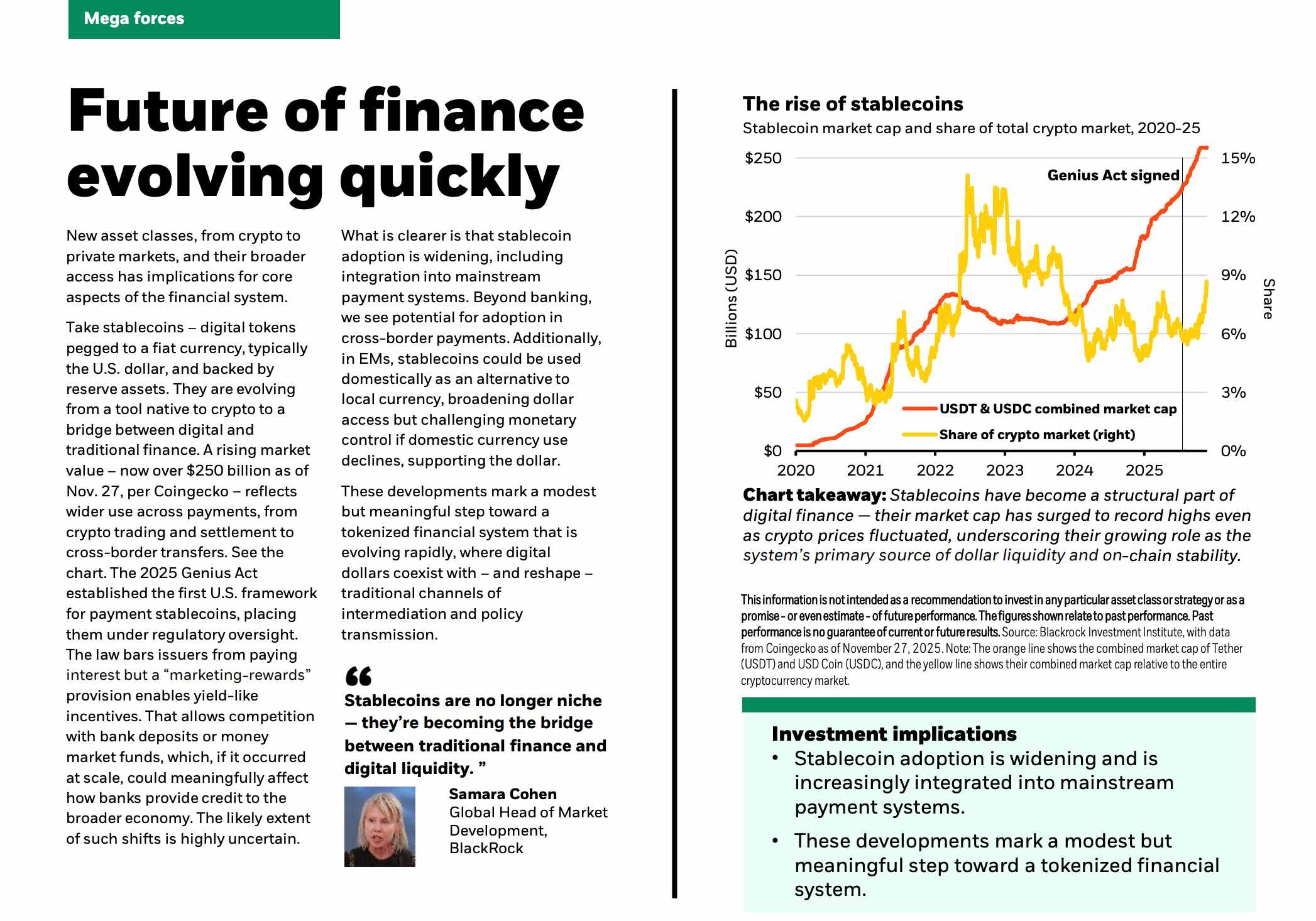
Among them, the only case in which the evolution of the financial system had been addressed was the development of a stable currency。Belet saw a trend towards increasing the use of stabilization currency and further integration into the mainstream payment system。
Stable currencies are expected to compete with bank deposits or money market funds and, if sufficiently large, may significantly affect the way banks provide credit to the wider economy. In addition to the banking sector, Belet noted the potential for currency stabilization in cross-border payments. In emerging markets, stabilization currencies can also be used as an alternative to local currencies for domestic payments, expanding the use of the dollar, while at the same time challenging the control of monetary policy and supporting the dollar to some extent if local currencies are used in decline。
these changes mark a modest but important step towards a monetized financial system. the system is rapidly evolving — & nbsp;The United States dollar coexists with traditional channels and reshapes intermediation and policy transfer。
Belet's configuration plan
Okay, here's the most important thingAt the end of the report, Belet gave the agency ' s allocation strategy for various types of assets and analysed its investment logic from both a tactical and a strategic perspective。If you don't want to think on your own, maybe you can copy your homework。
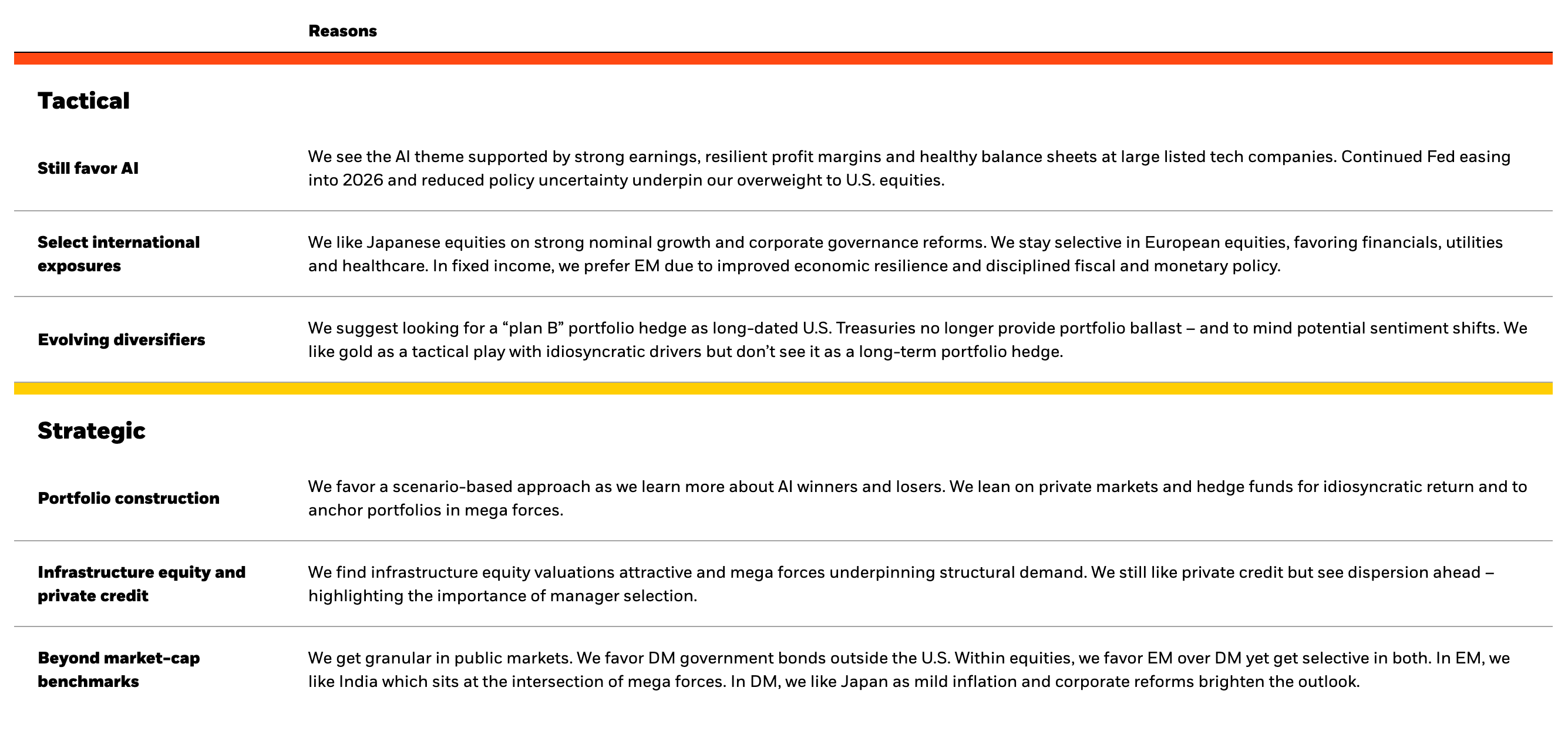
In a cycle of more than five years (strategy) and six-December (tactical), Belet ' s core configuration is as follows。
Strategic level:
- Group BuildAS THE AI WINNERS AND LOSERS BECOME CLEAR, WE PREFER SCENARIOS. THE ALLOCATION OF “SUPERPOWER” IS ANCHORED BY THE RELIANCE ON PRIVATE MARKETS AND HEDGE FUNDS FOR SPECIAL RETURNS。
- Infrastructure equity and private credit: We find infrastructure equity valuation attractive and superpowers supporting structural needs. We're still looking forward to private lending, but we're expecting a division of industries -- which highlights the importance of managing the recruitment of candidates。
- Excess of market value weighted benchmark: We will fine-tune in the open market. A preference for developed market government bonds outside the United States. In terms of equities, we look at emerging markets as a whole rather than developed markets, but select them internally. In emerging markets, we favour India, which is at the crossroads of massive forces; in developed markets, we appreciate Japan, whose prospects are being improved by moderate inflation and business reforms。
At the tactical level:
- KEEP LOOKING, AI: THE STRONG PROFITABILITY, ROBUST PROFITABILITY AND HEALTHY BALANCE SHEETS OF LARGE LISTED TECHNOLOGY ENTERPRISES WILL CONTINUE TO SUPPORT THE DEVELOPMENT OF AI. THE FEDERAL RESERVE’S LIBERAL POLICY AND THE REDUCTION OF POLICY UNCERTAINTY, WHICH CONTINUED INTO 2026, CONSOLIDATED OUR POSITION ON THE SUPER-AMERICAN EQUITY。
- Selected international exposures: We value the Japanese stock because of its strong nominal growth and the smooth progress of corporate governance reforms. We have maintained selective investments in European equities, favouring finance, utilities and health-care blocks; in the area of revenue sequestration, we have preferred emerging markets because of their increased economic resilience and stronger fiscal and monetary policies。
- Dispersive tool to keep up with the times: GIVEN THAT LONG-TERM UNITED STATES DEBT IS NO LONGER ABLE TO PROVIDE PORTFOLIO STABILIZATION, WE SUGGEST LOOKING FOR A “PLAN B” PORTFOLIO HEDGE TOOL AND FOCUSING ON POTENTIAL EMOTIONAL SHIFTS. GOLD, BECAUSE OF ITS UNIQUE DRIVERS, CAN BE USED AS A TACTICAL OPERATION, BUT WE DO NOT REGARD IT AS A LONG-TERM COMBINATION HEDGE TOOL。
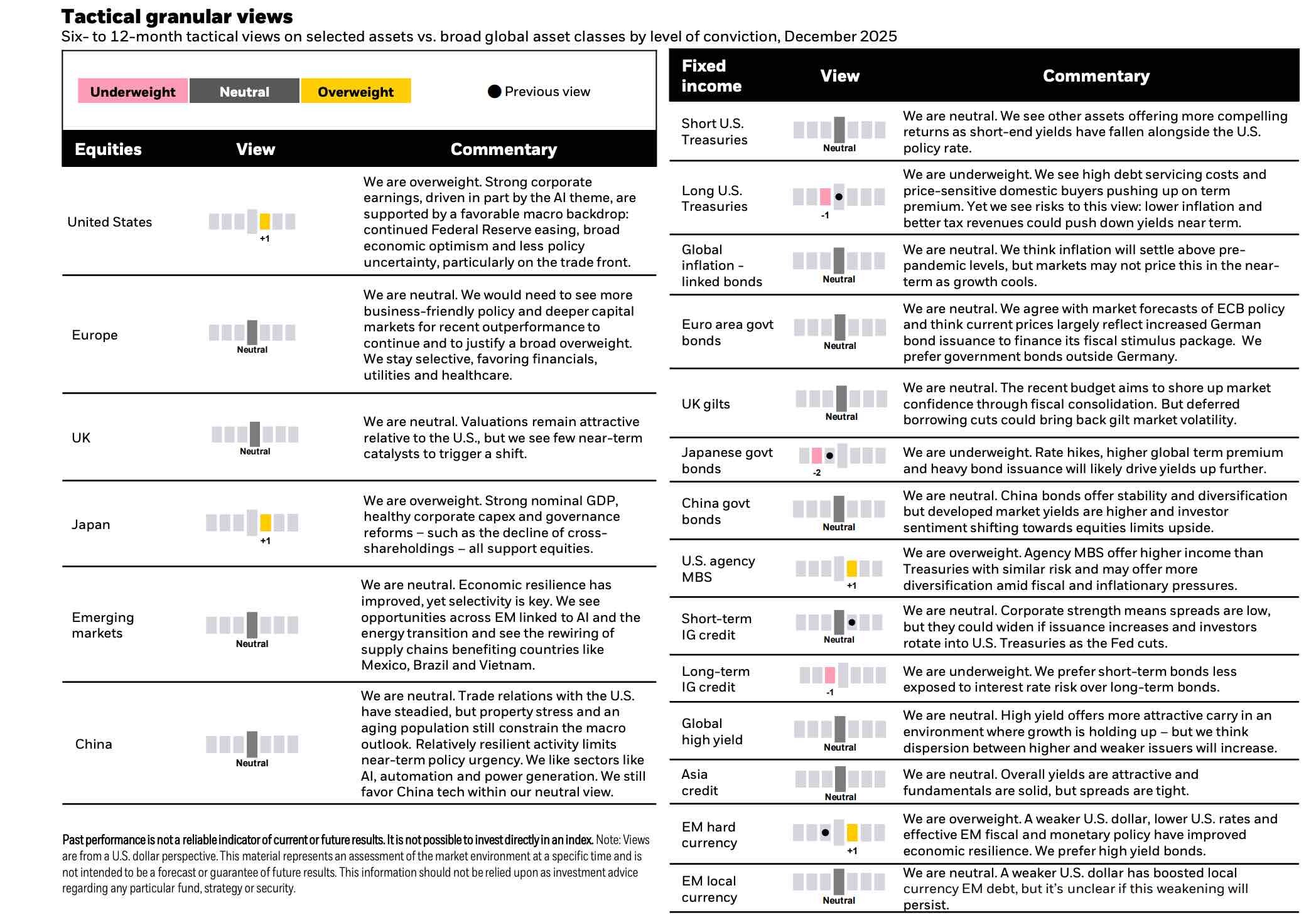
Belet explained the rationale and reasons for the distribution of stocks and fixed earnings in various markets。
- United States stock market (excessive): STRONG CORPORATE PROFITABILITY (PARTLY DRIVEN BY AI THEMES) WITH A STRONG MACRO BACKGROUND WILL SUPPORT US EQUITY PERFORMANCE
- European stock market (neutral)• Need to see more pro-business policies and deeper capital markets, with a temporary preference for finance, utilities and health care
- British stock market (neutral): Valuations remain attractive vis-à-vis the United States, but in the short term they remain neutral due to a lack of catalyst push-up。
- Japanese stock market (overrated)(B) STRONG NOMINAL GDP, HEALTHY CORPORATE CAPITAL SPENDING, GOVERNANCE REFORMS, ETC., ALL YIELD GOOD DAILY PERFORMANCE。
- Chinese stock market (neutral): Preference for technology units within neutral zones。
- Emerging markets (neutral):: ECONOMIC RESILIENCE HAS IMPROVED, BUT THERE IS STILL A CHOICE. OPPORTUNITIES RELATED TO AI, ENERGY TRANSFORMATION, SUPPLY CHAIN RESTRUCTURING, SUCH AS MEXICO, BRAZIL AND VIET NAM, WILL BE VALUED。
