
Circle released Arc Network's White Paper, could the new economic mechanism promote it as the “liquidation coordination layer” for institutional-level stabilization of currency payments
In-depth search and screening of current hotspot events and value reading, point assessment and rationale analysis。
Original by:Shirley Li, Web3Caf Research Fellow
How can we easily grasp the market hot spots, technological developments, ecological advances, governance dynamics that are taking place in the Web3 industry? The "Market Pulse Analysis" column, launched by Web3Caff Research, will explore and screen current hotspot events and provide value readings, points and rationale analysis. And through the phenomenon, it's going to follow us fast to capture Web3 on the market。
Compliance: Token is the currency of stability, and please be aware that the issue and participation in the investment of Token is subject to different stringent regulatory requirements and restrictions in different countries and regions, particularly in mainland China, where Token is suspected of “illegally issuing securities”, and where the provision of token transactions, such as those related to encrypted money transactions, is also an “illegal financial activity” (the readers of mainland China strongly recommend reading:In mainland China, laws and regulations relating to block chains and virtual currency are organized and highlightedIn this regard, please refrain from making decisions based on this information and from engaging in any illegal financial activity in strict compliance with the laws and regulations of your country or region。
Currency stabilization has been an important component of the chain-based financial economy. Recently, with the rapid development of scenarios such as & nbsp; RWA, cross-border payments, its role is evolving from a mere chain-to-trading medium to an important value vehicle linking traditional financial and chain economies in parts of the world, and stable currency payments have become a new form of financial infrastructure。
Last May, Circle announced the introduction of & nbsp, Layer 1 & nbsp, the public chain & nbsp, and Arc, which is designed to provide enterprises with high-performance, predictable and compliant access to corporate-level stabilization currency. And the emergence of Arc is also expected to make the primary stable currency of Circle USDC, from a single function of payment token to the utility of the public chain. Previously, Circle had published Arc Literpaper and described the logic of the sector chain at the product level, as well as a detailed reading by Web3Caff Research:
Arc, as a L1 link, has made the following innovations, mainly around enterprise-level users:
- USDC as a native: Arc introduced USDC as an original of the public chain, Gas Token, to eliminate the effects of price fluctuations in Token, and to make the prediction of interactive costs directly related to the base costs in Gas. To further reduce volatility, Arc dynamically adjusts the current base costs through the weighted average of the historical block utilization index (Exponently Weighted Moving Everage, EWMA) to avoid sudden and substantial increases in transaction costs due to sudden network congestion. In addition, when users use other stabilization currency for payment, Arc will automatically use its primary stabilization currency to advance the cost of interaction and deduct other stabilization currency of the same value from user accounts, which provides flexibility for multinational enterprises and users in non-United States dollar areas, giving Arc the prospect of becoming a global multi-currency financial clearing chain
- High Performance Consensus Design: In the chain context, because the finality of interaction takes time, an enterprise cannot immediately initiate the processing of an order because there is some automatic processing that may follow a series of financial/business systems that would need to be cancelled, and therefore the additional processing costs may be incurred by the enterprise for each transaction, which is unacceptable in the operation of the actual enterprise. To that end, Arc adopted the Malachite the Consensus Mechanism (a & nbsp; Tendermint Byzantine Mistake mechanism), under which a payment is immediately established and cannot be reversed once it has been confirmed and submitted by two thirds of the certifying officers. At the same time, Arc's certifiers are not anonymous pledge nodes, but a selection of well-established institutions capable of meeting the compliance needs of different regulatory systems globally. In the future, Arc will also introduce multiple proponents (Multi-proposer), which will allow multiple certifying officers to generate block proposals in parallel within the same time window and consolidate them into single blocks at the consensus stage, which will further increase the volume of throughput in payment systems and reduce delays in financial processing。
- Enterprise-level privacyIn order to ensure that the core business information of the enterprise is not leaked, Arc provides the enterprise with an optional privacy capability and is implemented in stages. In the future, as security techniques such as multi-party security calculations and homogenous encryption mature, Arc will introduce more sophisticated privacy settings along the chain, such as private order books, privacy finance strategies, etc., which operate automatically in private chain contracts。
If you want to know more about the logic of the Arc block chain, read it:Market Pulse Analysis: Circle goes into the public chain track, can its L1 network Arc become the first chain of compliance for the payment of stable coinsI don't know。
The time has come in May of this year, at a distance of half a year from Arc half a year has passed since the testing of the online line, and Circle once again released a white paper on the Arc block chain that further elaborates the design logic of ARC Token as the original coordination asset of Arc Network and discloses Arc the main network is expected to go online this summer。
As mentioned earlier, while the Arc Network currently uses the PoA (certification of authority) mechanism, whereby a selected and credible group of institutional nodes is responsible for the validation and commissioning of the network, there is a certain risk of centralization in this model, which is better suited to the early start-up phase of the project. As the network is scaled up, the Arc network is likely to transition to & nbsp; PoS the mechanism, while USDC, the stable currency, is not suitable for pledge. Thus, Circe is considering the introduction of a new Token system, ARC Token, as a primary coordinated asset of the Arc network, to coordinate the interests and behaviour of the various participants in the network (certifiers, developers, users, institutions, etc.)。
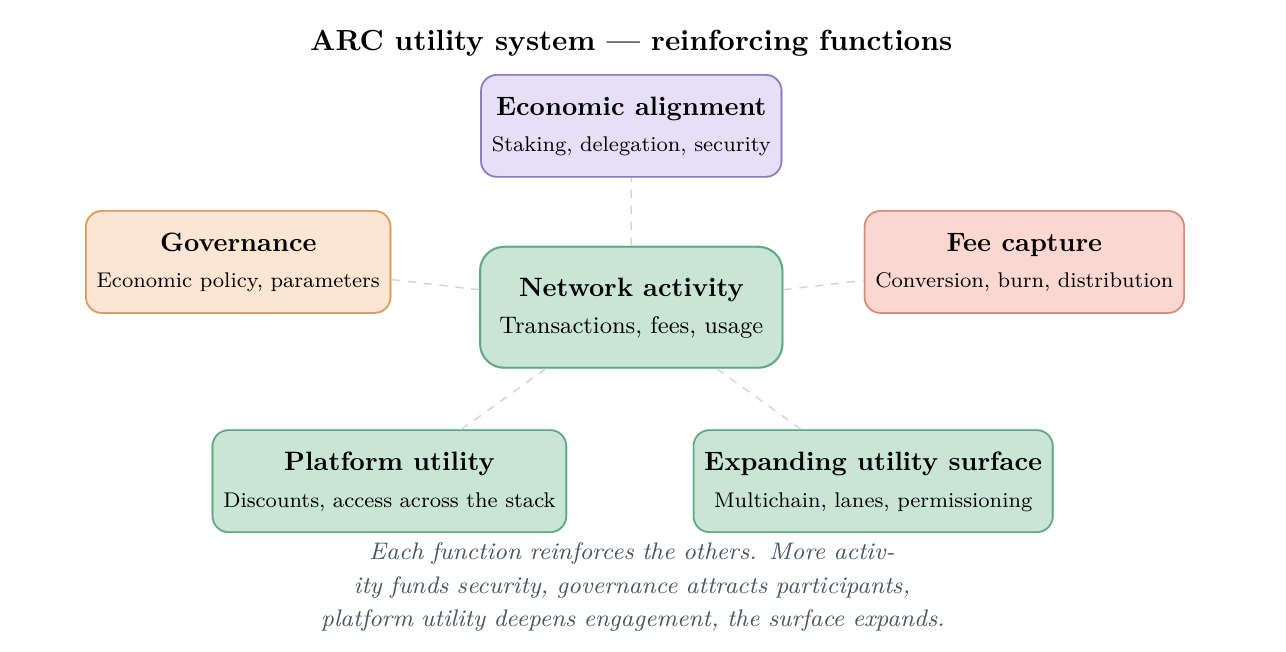
The White Paper was designed to allow ARC holders to participate in voting on network governance on the basis of the weight of their pledge, to decide collectively on network fees, inflation rates, destruction logic, etc., and to obtain benefits in the future in terms of protocol access and interaction. However, the White Paper also made it clear that the governance model of the Arc network was not entirely based on & nbsp; DAO the model would remain in place. In the early days of the network, the responsibility for sensitive matters such as security response, compliance, validation node access and upgrading of agreements will remain primarily with the Circe and the designated agency。
At the same time, the fees paid by users in stable currency on the Arc network are automatically converted to ARC Token, some of which are distributed as incentives to certifyers and pledgeors, while the other part is destroyed. This design may be closer to the usage habits of institutions and enterprises than the traditional public chain, which requires users to have direct possession of native Gas Token。
For the Arc network, the scope of ARC Token ' s application may be further expanded in the future, for example, by being used to construct dedicated trade routes; to coordinate and manage asset flows and data interoperability between different block chains; and to support the cross-assets Gas scene of Circle Paymaster to enable users to pay for the network in different stable currencies, etc。
Source:The Native Assembly of the Economic OS
It should be noted, however, that the ARC Token system is at the stage of discussion and design and may undergo significant changes in the future. Moreover, Circle has repeatedly emphasized that ARC itself is neither a securities nor an investment product, and does not represent any equity or right of return。
Large-scale economic activities tend to come from banks, payment agencies, business users and capital markets in the Arc Network, a dedicated block chain centred on stable currency payments. With the establishment and improvement of global laws and regulations relating to the stabilization of currency, chain assets and chain finance, the path to the participation of these institutions in the construction of the chain infrastructure is becoming clearer. This trend has also led to a change in the competitive logic of Web3 infrastructure. The public chain struggles over network performance and transaction costs are becoming the past, while network mobility, compliance, stability, sustainability and ecological scalability will become the new focus of competition。
Of course, this transition will not happen overnight, and the future development of the Arc network will still face many potential challenges。
For example, the current overall structure of the Arc network still has a strong central colour. Although Circe attempted to create a longer-term mechanism of economic coordination and governance for the network through the introduction of ARC Token, and gradually promoted its evolution towards POS, after all, the system is still in the discussion stage and has not yet been formally implemented, and its specific governance structure and economic models remain subject to greater uncertainty. At the same time, the ARC Token mechanism itself would introduce additional governance and security risks for the Arc network, such as whether the design of economic models matched real network needs. Will the concentration pledge of large nodes lead to a re-concentration of power over networks? These are subject to further official discussion and optimization。
In addition, while the regulatory regime for the stable currency is gradually being improved, there are significant differences in the specific regulatory framework between countries and regions, which means that Arc Network will still need to adapt continuously to changing compliance requirements in the future。
At present, traditional public chains such as Taifung, Base, Solana are actively expanding towards chain financial infrastructure, stable currency payments and institutional applications. This is enough to be seen as a sign of change in the current Web3 head agency, including Circle, but it remains to be seen who can truly build up the next generation of financial infrastructure in the global chain。
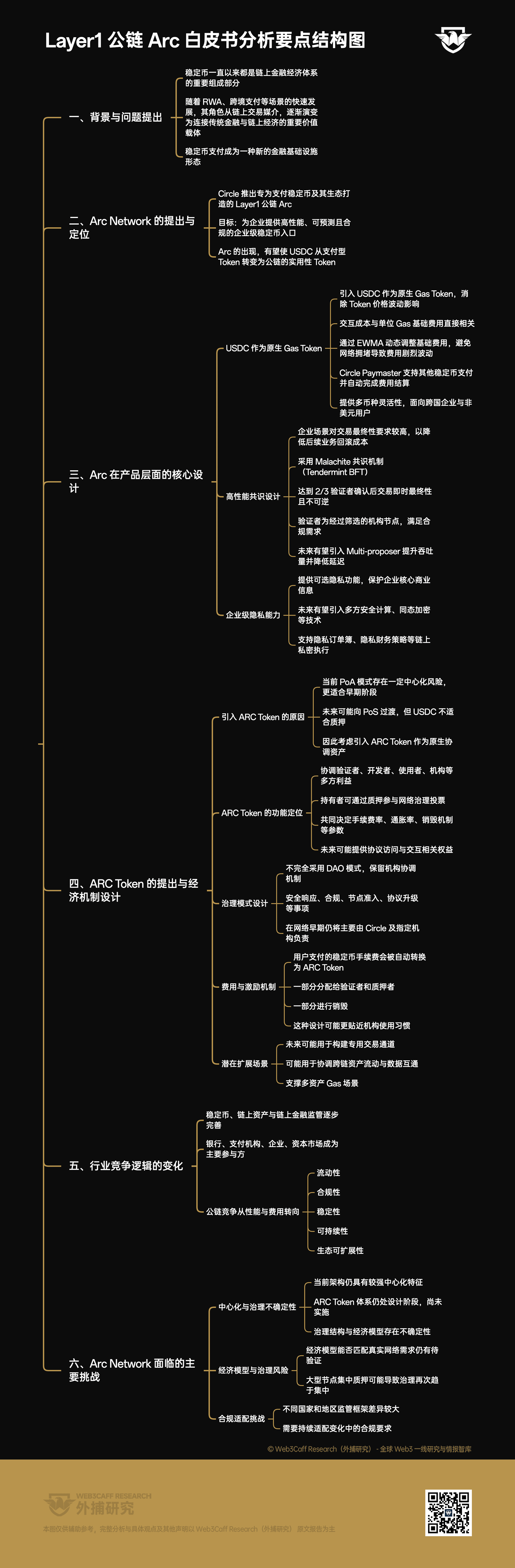
Elements structure:
References:
[1] & nbsp;Including the ARC Whitepaper:
Declaration of exemption:The report, prepared by the Extrapolation Study (Web3Cafff Research), contains information for reference purposes only and does not constitute any prognosis or investment proposal, offer or offer, and investors are requested not to rely on such information for the purchase, sale of any securities, encrypted currency or any investment strategy. The terminology used and the views expressed in the report are intended to help understand industry developments and to promote responsible development of the Web3 industry, including the block chain industry, and should not be interpreted as a clear legal perspective or the perspective of the Extrapolation Study (Web3Caff Research). The views expressed in the report reflect only the individual opinions of the author as of the said date and are not relevant to the position of the Extrapolation Study (Web3Caff Research) and may subsequently be renewed. The information and views contained in this report are derived from sources considered reliable by the Extrapolation Study (Web3Caff Research) as proprietary and non-exclusive, and do not necessarily cover all data or guarantee their accuracy. Thus, the Extrapolation Study (Web3Caff Research) does not provide any form of security for its accuracy and reliability, nor does it assume responsibility for errors and omissions in any other way (including those arising out of negligence). This report may contain “forward-looking” information, which may include forecasts and forecasts, and this does not constitute a guarantee against any prediction. It is entirely for the reader to decide whether to rely on the information contained in this report. This report is for information purposes only and does not constitute an investment proposal, proposal or offer for the purchase or sale of any securities, encrypted currency or any investment strategy。
