
Dialogue Bitwise consultant: No house, no bitcoin
Nothing is perfect -- neither is bitcoin, but it's progressing. 。
Collapse & Compiled: DeepwaterTechFlow
Guest:Jeff Park, Bitwise Adviser
Moderator: Kevin Follonier
Podcast source:When Shift Haps
Original title:Why is a House Is the World Investment You Can Make - Bitwise Advisor - Jeff Park
Date broadcast:16 April 2026
Summary of highlights
Jeff Park is a senior macro strategist and adviser to Bitwise. He was convinced that the current financial system had lost meaning for young people, especially in the context of high housing costs and the possibility of artificial intelligence replacing a generation of jobs. He noted that real estate was in fact a devalued asset, while Bitcoin was the ultimate financial haven. In addition, he predicted that the rapid development of artificial intelligence would trigger a wave of the largest bitcoin worldwide。
He suggested that the “occupation of AI” would be a critical turning point for the Z and Alpha generations. At this point, these two generations will discover the potential of bitcoin through a “dreaming moment” similar to that of the millennium generation during the financial crisis. Through this process, they will gain a deeper understanding of the nature of digital assets and investments。
Moreover, Jeff is very optimistic about the potential for real estate monetization. In his view, monetization had the capacity to revolutionize the existing financial system and provide more equitable investment opportunities for ordinary people。
This paragraph explores how these critical moments affect our understanding of digital assets and investments and the possible far-reaching implications for the future。
Summary of outstanding views
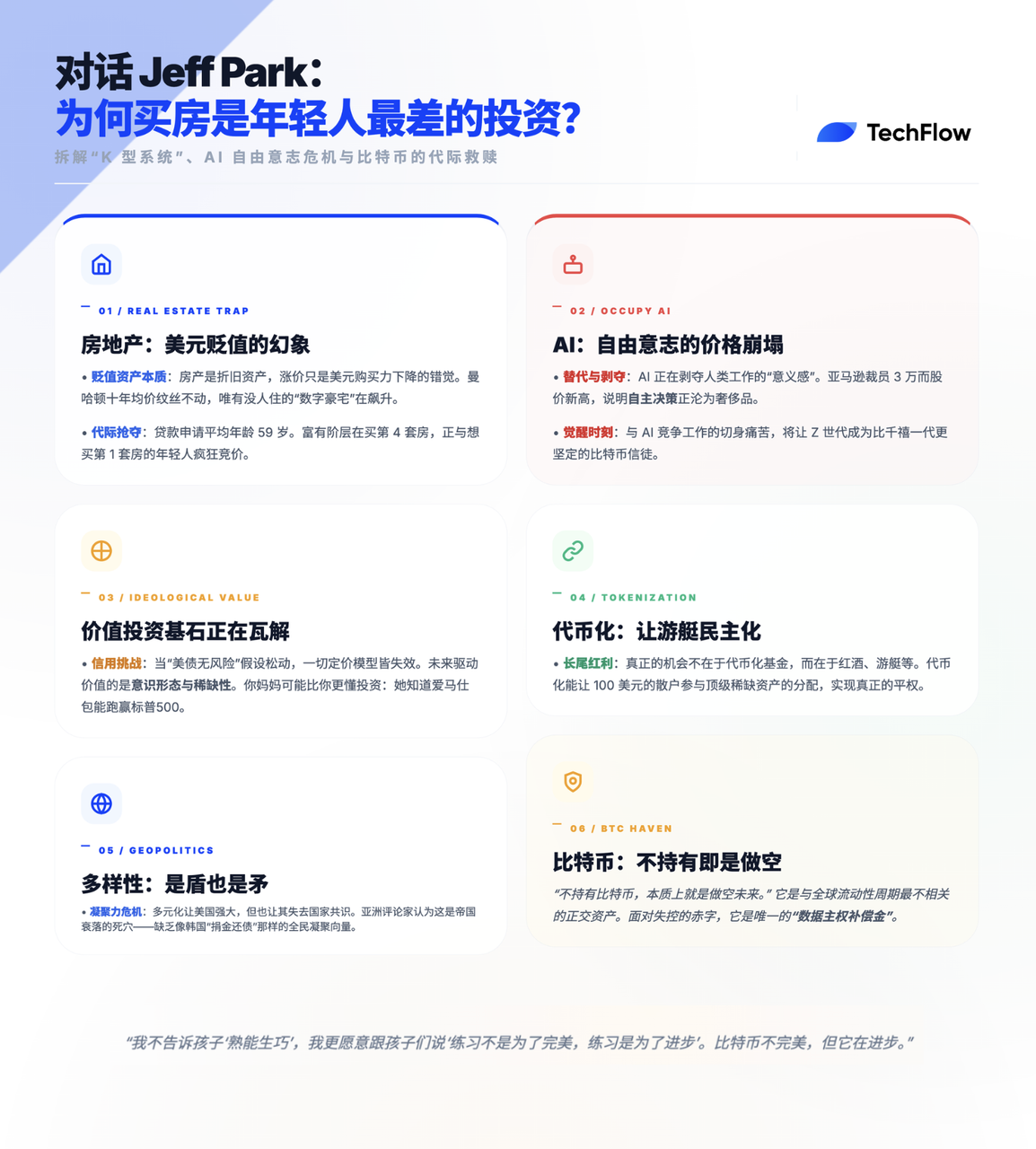
The truth about real estate and wealth
- “The rise in house prices is not due to the fact that the house itself has become more valuable, but to the fact that the dollar has been devalued. The house is a depreciated asset, and the tax code says in black and white that you can offset depreciation within 20 to 30 years — we actually knew that the house was a depreciated asset.”
- “The average house price in Manhattan has not actually risen over the past decade, and it has remained flat. What really rises is the penthouse houses that are used as a storage tool for wealth — no one lives at all, just a line on the balance sheets of rich people.”
- “The average age of people applying for housing loans in the United States this year is 59. This is not the first room -- this is the third and fourth. And these people, they're robbing the 25-year-old man who wants to buy his first apartment.”
- “In New York, renting is the right answer. When you have your own housing, you pay taxes, administrative fees, maintenance fees, mortgage insurance and property insurance, the net return is less than 2 per cent, and less than 1 per cent when you have bad luck. Why don't you just put the money in the money market fund."
- “There is now a better way to store wealth, which does not need to be maintained, which does not occupy physical space and is not taxed annually, and you do not have to worry about property being confiscated after being listed by the Government — that is, bitcoin.”
About AI and "Occupy AI"
- “WE HAVE NEVER SEEN A SUBVERSIVE TECHNOLOGY LIKE AI, WHICH HAS THE POTENTIAL TO COMPLETELY REPLACE THE WORKFORCE WHILE ALLOWING BUSINESSES TO ACHIEVE RECORD PROFITS. THE AMAZON LAY OFF 30,000 PEOPLE, AND THE STOCK MARKET IS AT AN ALL-TIME HIGH — THAT'S THE MOST STRAIGHTFORWARD NOTE OF THE “FALL OF FREE WILL”
- “AI IS DEPRIVING HUMAN BEINGS OF THE CAPACITY TO MAKE AUTONOMOUS DECISIONS. EVERY TECHNOLOGICAL REVOLUTION IN HISTORY — POWER, AIRPLANES, MAIL — IS MAGNIFYING HUMAN CAPABILITIES, AND AI IS LIKELY TO SIMPLY MAKE HUMAN `WORK ITSELF' DISAPPEAR.”
- "THE ESSENCE OF AI IS TO FINALLY CENTRALIZE ALL YOUR DATA, HARVEST IT, AND REPLACE YOU WITH IT. IF MY DATA ARE MAKING THE MODEL SMARTER, I NEED SOME FORM OF COMPENSATION — AND THIS COMPENSATION MECHANISM CAN ONLY THEORETICALLY BE ACHIEVED BY ENCRYPTED CURRENCY.”
- “Every generation needs a wake-up call to find bitcoin. The millennium awakening is the financial crisis, the Z generation and the Alpha generation awakening will be Occupy AI-- They'll find bitcoin in the pain of competing with AI."
- “AI AND BITCOIN HAVE A COMMON LOGICAL KERNEL: ENERGY CONSUMPTION. IF YOU DO NOT AGREE WITH THE NEGATIVE EXTERNALITIES THAT AI BRINGS, THEN THE OTHER SIDE OF THE SCARCE ASSETS THAT ARE EXCHANGED FOR THE SAME ENERGY IS BITCOIN. YOU CAN VOTE BY CHOOSING BITCOIN."
On investment framework and logic
- “The underlying assumptions of value investment — pricing everything at no-risk interest rates — are collapseing, as the credit quality of the United States itself is being challenged. When this hypothesis is removed, you will see the world more clearly: what really drives values is ideology, not cheapness.”
- "Your mom actually knows more about investment than you think. She knew that the most valuable thing sometimes existed in the physical world — a horse's bag, which had been running for 500 years.”
- “Diversity is not dead, but you have to broaden your horizons and look for assets that are truly unrelated to the global liquidity cycle — gold, art, wine... The logic of these assets has nothing to do with 6,800 points or 6,200 points of the marker.”
- “I'm really interested in the monetization, not the monetization of the Beled Monetary Market Fund, but those long tail assets — top wine, yachts — that ordinary people can hold for $100. This is the real opportunity for monetization.”
- “What kind of downside risk would you be exposed to without bitcoin? Not having bitcoin is essentially making empty bitcoin."
- “If I choose only two assets, Bitcoin must be one of them. It is the least relevant and most relevant asset to all other things in the global capital market. The other is an income-producing asset based on United States dollars.”
About society and the future
- “The greatest advantage of the United States, and at the same time its greatest weakness, is the diversity of its population. This is in fact a known attack vector from the east... diversity destroys this country.”
- “When you realize that upstairs, downstairs, street neighbors are all inspired by the same patriotism, unable to control their own destiny — a strange feeling.”
- "I don't tell the kids, "It's perfect." I told them, "It's not perfect, it's progress." Nothing is perfect -- neither is bitcoin, but it's progressing. Everything we do is in pursuit of that ideal direction."
Jeff, early exposure to currency devaluation
Moderator Kevin: You mentioned earlier that you had early contact with currency devaluations. Can you tell me
Jeff Park:
I grew up in the United States and Korea, and I spent part of my primary school time in Korea. I went through the Asian financial crisis in Korea in 1997, which shocked the entire world and left a deep mark on my heart. I was only a child in the second or third grade, but you can feel that the whole country is in a strange collective state — everyone, upstairs, downstairs, across the street, all of their neighbours, are congregated with the same patriotism, facing a fate that they cannot control. It's a strange feeling:When you realize the devaluation of a country ' s sovereign currency, you can bring everyone together to that extent。For most Americans, the closest analogy is probably 9/11 — a national trauma that brought together people on the right and on the left, thinking about what America is and what it stands for. Currency devaluations can produce the same cohesion。
This experience in 1997 struck me hard, but it also showed me the power of a nationWhen people are mobilized to face the crisis of sovereignty and defend their interests in a principled manner。AND ONE THING I REMEMBER VERY WELL: THE KOREAN GOVERNMENT ASKED ALL CITIZENS TO DONATE GOLD IN ORDER TO ENRICH THE TREASURY AND HELP REPAY THE IMF RELIEF LOAN. IN THE UNITED STATES, THE IMF MAY SOUND NEUTRAL, BUT IN MANY EMERGING MARKETS, THE IMF IS A HIGHLY POLITICAL TERM THAT IS SUSPECTED, DESPISED AND EVEN PERCEIVED AS HAVING A POLITICAL AGENDA. I'VE SEEN THIS BEFORE, AND SOMETIMES I THINK THAT THESE EXPERIENCES MAY BE, IN A WAY, THE PEN THAT I TOOK TO THE ENCRYPTED CURRENCY 20 YEARS LATER。
Who's Jeff Park
CA: So who are you
Jeff Park:
I'm Jeff Park, but I think I'm, in a way, a confluence of power. On the one hand, I grew up in the United States of Korea, with the background of the East mind, so I could act as a kind of bridge between East and West narratives -- Whether it is the prosperity brought about by globalization or the social tension that it creates. On the other hand, from an intergenerational point of view, I entered the workplace in 2008 — the first post-graduation job in Morgan Stanley, at the forefront of the global financial crisis。
But it also quickly made you realize that nothing in this world is truly indestructible and that much of what is taught you in school is not so solid. It's humble, but you can turn it into an engine to build your own way of thinking. This experience has also made me a microcosm of a generation — a millennium generation that entered society in the face of a financial crisis — which has created a deep mistrust of institutions and intermediaries and a desire for untrusted, autonomous solutions in social networks, in all kinds of causes and in all aspects of life。
How diversity in America is both a strength and a weakness
Moderator Kevin: When you were a child, you experienced a devaluation, and when you entered office in 2008, you saw the vision of the financial system shattered. Now we are in New York — the world's financial center — and prices are so high. I'm from Switzerland, living in Singapore, and neither of these places is cheap, but I still feel ridiculous to be here. I can't imagine how ordinary people can survive, all of which has to do with what you went through as a child, but it's more urgent now. What are we looking at? What do we do
Jeff Park:
The greatest strengths and weaknesses of the United States are the diversity of the population and its pervasiveness throughout the population structure and social fabric. You often hear Asian commentators predict the decline of the United States Empire, and they usually capture a central point: diversity kills the country. I used to hear that when I was a kid。This has been implicit in South Korea ' s geopolitical relations with China, South Korea and the United States, and these trends are now fully present in the political movement within the United States. At the heart of the problem is that when population structures are so diverse, it is difficult to develop a genuine national cohesion. It is much simpler in Korea, where we are all Koreans, with a common historical foundation and experience of colonial oppression, and where these shared sufferings give us a condensed vector. And in the United States, history is so rich and complex that it is difficult to find that obvious link that makes everyone feel "we sacrificed together." Korean military service is compulsory and all men, regardless of class or level of education, must serve - This has played a significant role in creating a sense of social homogeneity, as has Israel. And in America, you would ask:What's that American experience that everyone sharesThis question is difficult to answer. American politics usually divides between the right and the left, between the class, between the old and the old, but I think these dimensions are disruptions and escape。The real core is the lack of national cohesion among the younger generation, which is the most precious and difficult to build。
What did we see today from the broken financial system
Moderator Kevin: What's wrong with the financial system now
Jeff Park:
WE ARE SEEING THE MANIFESTATIONS OF A COMPLETELY OUT OF CONTROL AND A COMPLETELY COLLAPSED FINANCIAL SYSTEM. PEOPLE USE THE "K" ECONOMY TO EXPLAIN WHAT HAPPENS AT THE SOCIAL LEVEL. THE K-TYPE ECONOMY MEANS THAT ONE PART OF THE POPULATION IS EXPERIENCING A HUGE ECONOMIC BOOM AS A RESULT OF ASSET INFLATION, WHILE THE OTHER PART OF THE POPULATION IS IN A DOWNWARD ROUTE, WHICH FOR THEM IS A RECESSION. THEY DON'T HAVE A JOB, THEY CAN'T GET A JOB. THE GAP BETWEEN THE TWO IS WIDENING -- THAT'S WHAT THE K FONT MEANS: ONE LINE GOES UP, ONE LINE GOES DOWN。
HOW THE “K” SYSTEM IS REFLECTED IN THE REAL ESTATE MARKET
Jeff Park:
You can see it in New York through real estate. You might be surprised that the average price of New York City real estate for the last 10 years has not actually risen, but is even. You would be surprised because many narratives would give the impression that real estate in New York has experienced incredible prosperity, especially reports of amazing towers, skyscrapers and the entry of Chinese and Russian capital into residential development. But it's not wrong either。
AND WHAT WE SEE IN REAL ESTATE IS THE K-TYPE ECONOMY, WHERE THE SUPER-LUXURIOUS UNITS THAT ARE BEING PURSUED BY DEMAND AS A STORAGE TOOL ARE DOING WELL。They are not really inhabited, but assets, and people buy to keep wealth on balance sheets, which is a good part of it. If you had a 20 million dollar penthouse apartment, bought seven years ago, you could have changed to 30 million dollars。
But if you buy ordinary housing, which is a house where you really want to live, feed, make a productive economic contribution to the city, and the price is closer to what is called "affordable", those houses may actually be falling or evening。
manhattan has something called a mansion tax, which will be imposed if the apartment is sold for more than $1 million, but today in new york, $1 million might buy only one studio. this tax was set up about 30 or 40 years ago, when a $1 million apartment could really mean some luxury. because it is not linked to inflation, and the government certainly will not take the initiative to adjust an item that expands the tax base to inflation, almost all apartments traded in the second-tier market are now hit by this luxury tax。
Those housing units that contribute more to the economic life of cities have fallen or remained flat. New York itself is a paradox. It's a city where two life stories unfold in the same place. When you come here from Singapore or Switzerland, you see that everyone's experience may be completely different. All of this, in my view, is a symptom of a good asset shortage。
The real estate problem is not new. Many talk about the decline of capitalism, pointing to real estate, because land is by definition scarce. Land is scarce, as are communities built around physical space。Manhattan ' s properties are expensive because people want to work where there is commercial development and where people are close to each other。When you fold up these social components, the value of the land is higher than it was in the past because of the convergence of social power. This has happened over and over again in human civilization:As long as the core of the activity is released somewhere, the land will prosper。
The problem for the United States is that we have a huge prerogative to operate the global financial system. We often say that the dollar is the largest export to the United States, and that is true, but it has costs. The cost is that offshore funds eventually have to go back and invest in United States assets. This is the correspondence between the trade deficit and the capital account surplus. If the United States is to continue to maintain its trade deficit, by definition, we need sustained offshore capital flows to United States assets. That's how the dollar works。
You are essentially creating a manufactured market for American assets. Offshore investors need local parking balances, which creates a difficult environment. Because that market has nothing to do with me, whether you really live in New York, or the productivity that we live here and contribute to the economy. It is priced not around our cost structure as residents, but around United States assets as sovereign reserves. When there are different motives in a real estate market, pricing problems will inevitably arise。
What should new real estate investors think about
Moderator Kevin: What does he think about a 30- or 35-year-old who has some money saved and wants to make a reasonable investment? He might barely have enough down payment for a single apartment in New York, but you said that a single apartment already cost $1 million — theoretically, $1 million should be scarce, luxurious, but you said no, you'd have to buy 20 million top floors。
So, what do our parents say about buying a flat and real estate
Jeff Park:
Real estate is a good example of what we really want to think about, not that it's going upThe value of dollars is fallingI don't know. In essence, the house needs to be maintained. It is a capital expenditure — something bad, it needs to be repaired, it has mortgage taxes, property taxes and various maintenance costs. With the purchase of a house, there is a large amount of capital investment to continue。Instead of turning into gold over time, the house will be depreciated, and you will have to work on it, so the house is essentially a depreciated asset。In fact, the United States tax code stated in black and white that houses would depreciate for a considerable period of time and that real estate investors could declare depreciation deductions within 20 to 30 years. So we knew that real estate was a depreciated asset。
Then why is its price still risingFirst, because of the continued depreciation of the United States dollar. Second, people use real estate as their main way of savingBecause it anchors you in economic productivity — for example, you want to send your children to a good school, and public schools are usually divided by school district, and you have to pay a substantial property tax to qualify for admission. So..Home ownership is tied to many social functions that continue to drive home prices to follow inflation。
The problem arises from two dimensions: population structure and mobility transformation itself. From the United States market, the average age of Americans applying for housing loans this year is 59 — a figure that should be alarming. The 59-year-old is probably not buying the first house, but the second, third and fourth. And these people, the 25-year-old who wanted to buy his first apartment, are competing directly with you。
The problems we face in the area of housing are a very special intergenerational problem:The role of real estate as a storage tool for wealth and the social need to enable families to truly live and raise the next generation have become completely opposed。Many young people are trapped in their journey for their lives because the purchase of houses is far from possible. There's also the dimension of capital control: you hear more and more New Yorkers moving to Austin, Texas, because New York taxes are too high. But what happened? Austen’s natives are also dissatisfied, because their house prices have been anchored in New York’s economic benchmark rather than in their own local market – which has created a new crisis of affordability. This is a matter of capital control and of intergenerational liquidity conversion. Both dimensions are leverage that policymakers can adjust. The United States has offered a 50-year mortgage to experiment with liquidity conversion. But this is just the beginning of one of the biggest problems in society:YearLight people can't afford a house。
Moderator Kevin: I think from a rational, ordinary male perspective: having a girlfriend, getting married, having kids, probably needs a house for years. But I also want this to be a smart investment, because I put in many years' wages and lots of hard work. Now you tell me that most of these investments are not good investments, but bad investments. What if I'm 30 or 35 years old, with $100,000, $200,000, $500,000, and I can apply for a mortgage
Jeff Park:
That is the problem. I often tell people who move to New York that New York is essentially a tenant market and that rents are more cost-effective. Because when you have a flat, you pay taxes, public bills, maintenance fees, mortgage insurance, real estate insurance, all of which end up eating off so much that you may have less than 2 per cent capitalization, 2 per cent if you're lucky, and sometimes less than 1 per cent, which means you might have to put the money in the money market fund for 3.5 per cent。The only reason you still accept less than 1% of the return is because you want the house price to rise, so the whole path is a bet on the house price to rise。
For young people, at least in New York, renting is the right economic choiceI don't know. But my opinion will change when you have a family. Once a child is born, stability becomes more important - you need to determine which school the child can attend, and you need to plan for the next 15 years. This sense of security and certainty requires a premium, so you really need to make a commitment. But this is no longer an economic decision. You bought a house at that stage, not because it was going to increase, but because you were building a family and needed a stable social safety net. That's why I think young people are getting less and less interested in children: Economically, permanent rental is the best solution — until you have to have children. And if you have kids, you can't rent a house, and the whole cycle breaks. Either you don't want kids, or you want kids, but you're stressed out。
Another often heard option is to wait for the death of the last generation to inherit wealth. It's common in Asia, especially in Japan, and there are similar problems in Korea. – A great deal of wealth is concentrated in the hands of the baby boom generation, which will eventually pass, but with a time lag. They lived longer, and the millennium generation was growing, without the attendant decline in prices。This time gap creates a huge friction between young and old people。
How people respond to the current crisis of home purchase investment
Moderator Kevin: So I either wait until parents aged 60 or 70 die and leave the property, or I find another way out. Are there any alternatives for persons aged 25, 30 and 35
Jeff Park:
YesThere is indeed a better way to store wealth than real estate. This wealth does not require maintenance, does not require physical space, does not require maintenance, is not taxed annually and is not at risk of being confiscated by the Government for any reason - - That's bitcoinI don't know. Bitcoin is so important to me because it directly relieves the pressure on real estate. In other words, a guy who used to buy $40 million in top apartments in New York because he needed to save his wealth and move $50 million, and he never knew how to move $50 million easily. Now he can buy bitcoin directly, and you don't have to pay it taxes of an annual service nature or worry about expropriation. In theory, there are possibilities in the property rights of the United States that, if one day they think you should appear on a list, the assets may be confiscated, and bitcoin gives you no reason to worry about them。
This means that the money will no longer go to real estate. If the money is no longer flowing to real estate, the housing demand curve will be reset, housing prices may fall and young people will be able to buy. There is, of course, a huge political apparatus around the constant protection of rising housing prices, as home ownership brings wealth and is the underlying social contract of the American dream. Bitcoin is fundamentally challenging this。
I think it's the most popular test of Bitcoin: more people need to see Bitcoin as the main source of savings relative to other assets, such as real estate, and then come to the same conclusion: it's a win-win for society as a whole. Short-term suffering may be a decline in house prices, but as a form of storage, it is more efficient and much less discriminatory than today ' s property regime。
The reason for the rise in house prices is not that the house itself has become more valuable, but that the dollar has been devalued, while humans tend to gather in more productive places. - The natural rule of capitalism is the persistence of the strong. If there is no exit, the tension will eventually break。We have seen this in New York — the lighthouse of the capitalist world — with a left-wing mayor, no one can predict that day。
Smart Investor Frame Parsing
Moderator Kevin: Let's talk about the article you wrote: The Fall of Wise Investors and the Rise of Ideological Investors. What is a smart investor? Why did he fall
Jeff Park:
The Smart Investor is a framework that I have borrowed to describe investor practices like Warren Buffett and Benjamin Graham. When people talk about investment in value, there was a very specific meaning in the past:Buying stocks that are cheaper than cash flows and trading in shares that are less than the growth stock, focusing on dividends rather than profits。It's a word: CheapI don't know。
My assertion is that this time is over and it has been over for a long time — because if you look at today's best-performing assets globally, cheap does not pay off。It's the things that are scarceLike I said at the top house. The Smart Investor framework is based on assumptions taught in many schools, but I think they are now completely broken down。
One of the core assumptions is:All assets must be priced at no-risk ratesI DON'T KNOW. NO-RISK RATE IS THE INTEREST RATE ON THE NATIONAL DEBT - THIS IS THE BASIS FOR ALL PRICING MODELS AND IS THE CORNERSTONE OF CAPITAL ASSET PRICING MODELS (CAPM), DISCOUNT CASH FLOWS (DCFS) AND EQUITY RISK PREMIUMS. BUT ALL OUR PERCEPTIONS OF RISK-FREE INTEREST RATES ARE CHANGING, AND THAT IS WHY THE 60/40 PORTFOLIO IS BECOMING LESS EFFECTIVE — THE INCREASING CORRELATION BETWEEN US TREASURY DEBT AND STOCK MARKETS, BECAUSE THE FUNDAMENTAL CONCEPT OF “RISK-FREE” IS BEING CHALLENGED. WHY? BECAUSE THE CREDIT QUALITY OF THE UNITED STATES IS BEING CHALLENGED。
WITH THE ASSUMPTION THAT NO-RISK INTEREST RATES ARE THE ANCHOR OF ALL ASSET PRICING REMOVED, THE WORLD BECOMES EVEN CLEARER: WHAT IS REALLY BEING BOUGHT TODAY, WITH IDEOLOGICAL WEIGHT? WHAT'S THE VALUE DRIVE BEYOND CHEAP? THAT'S WHAT I CALL "IDEOLOGICAL INVESTORS". CULTURE, AI, HOW TO INFLUENCE PEOPLE'S INVESTMENT IDEOLOGY, GEOPOLITICS — THESE ARE REAL VALUE CREATION MECHANISMS, NOT THE NOISE THAT NEEDS TO BE WASHED AWAY。
What would ideological investors do
Moderator Kevin: What exactly do ideological investors do
Jeff Park:
Ideological investors spend a lot of time thinking about what happens in the futureAnd past models can't tell you that because the premise of those models is being rewritten, so you need to look out. How do you get advantage in a market like this? You need to think deeply about the flow of funds, about the shift in the mobility paradigm, about where the buyers of the various types of assets come from. You also have to consider the possibility of asset manipulation and how to keep yourself out of it. So you need to build an investment framework that allows you to exit certain dynamics in a way that most people have never told you。
A simple exampleMoms are worth something. They have a natural instinct。They know that the most valuable things sometimes exist in the physical world — like that unique jewel, or that horse bag, which has been winning 500 for over 20 years. Top art is another type of asset that does not belong to traditional equity investments but can serve as a means of dispersing wealth。Mothers' insights into this investment paradigm are far greater than those educated by traditional financial advisers。
Your financial adviser told you: 60/40, stock, bonds, private equity, private credit, venture capital. But it's the same thing. They are all linked to the same global arbitrage for risk-free interest rates and macrocycles. What you really want is another pool of assets that has nothing to do with this, and that's really diversity。
UNDER THIS FRAMEWORK, ENCRYPTED CURRENCIES AND BITCOIN ARE USEFUL AGENTS - BECAUSE, AT LEAST BEFORE THE INTRODUCTION OF BITCOIN ETF, THE INVESTORS WERE INDEPENDENT OF THE STOCK MARKET, AND THE PRICE MOVEMENTS OF BITCOIN WERE NOT RELATED TO THE STOCK MARKET BOOM AND FALL. I BELIEVE THAT THERE ARE STILL MANY OPPORTUNITIES FOR INDIVIDUAL INVESTORS TO EXPLORE AND BENEFIT FROM BEFORE MAINSTREAM ASSETS. ENCRYPTED CURRENCY, GOLD, HORSE BAG, DREAM CARDS, SHOES ... THESE ARE EXAMPLES。
The important role of data in wealth creation
Jeff Park:
There is also an important asset class that has not yet been identified for product market convergence points, namely data。Your data is really valuable, but most people are sending it out free because they don't know how to cash it. My generation, the millennium generation, is growing up on Facebook with the data being sent out in a way that doesn't realize the cost. But the younger generation is more conscious, and they know the economy of the creators and how to mediate and benefit from data flows. So I think..Data can become an asset class in the future, and each individual needs to be aware of what he owns and how to realize it。
Predicting markets is a good example — I think it is a huge asset class that is about to explode. No JP Morgan's financial advisor will sit down and tell you how to bet on the forecast market because they don't think it's professional. But I promise that someone will do so in 10 years. Because the data needed to forecast money in the market are highly privatized, unlike other financial markets, the gains are not related to other markets. More and more young people would go in that direction because they knew that all other markets were full of financial manipulation, and they did not want to play in that manipulated game. That's why the encrypted currency exists, why the bitcoin succeeds, why the DeFi exists, why people trade in the forecast market, why the sports lottery is the track where Draft Kings and Robinhod are both being held, why the two-fold leverage ETF is so popular. All of this is a trend towards greater freedom and greater autonomy for individuals, away from the world of manipulated assets governed by a global arbitrage deal。
Jeff, how do you view your portfolio diversification
Host Kevin: Raoul Pal said on this show that decentralization is dead — everything has to do with one thing: currency overhang and the devaluation of the French currency, so he encrypted it all. What do you think? How did you build your personal portfolio around this
Jeff Park:
I agree with him, not with him. I disagree because he does not see the world as large enough. When he says that there is no need for decentralization, if he looks at the different face of the same deal, which is common to global liquidity, he is absolutely right, and I fully agree. But if you can widen the horizon and imagine a pool of investable assets that are not manipulated by the same set of cross-border financial flows, decentralization has value。
So in the "radical portfolio theory" that I put forward last year, I listed 25 different types of assets that do not belong to the mix of stocks, bonds, private and public collections that we have traditionally understood。Gold is one of them, and I think it finally gave me an opportunity this year to see it。As Americans, we may laugh at the gold lovers, but back to my cultural perspective — in Asia, gold is a huge asset class. My family still gives me gold at a family gathering as an expression of love, rooted in the Asian cultural understanding of wealth storage。Gold is the most primitive non-replicable value stockpile in the true sense。
In addition to gold, top art is also an excellent means of dispersing — scarce, high-cultural assets that add value over time and have nothing to do with stock market location。In 2008 and 2009, some of the best transactions took place in the art market. Good wine is also a category — limited quantities that can be consumed and disappear, so there are people who trade wine to store wealth. But there's one thing I really like about tokenization. If the monetization works in the way I want, it is not the Apollo private equity fund or the Beled money market fund that is of interest to me — which has worked to some extent well, and which may have led to marginal improvements. The real opportunity lies in the assets of long tails — such as the top wine, or a small share of the yacht。
What's it bringing to the investment field
Moderator Kevin: So you can monetize a bottle of wine or a yacht so that those who don't have millions of dollars can buy a small sum of $100 or $1,000
Jeff Park:
Yes, these assets have historically not been reached because they are difficult to access, require a high degree of expertise and ability to develop, and do not have mature channels to serve them. But if you ask any billionaire, that's how they invest. There is a reason why the yachts continue to be admired because it is an excellent asset for wealth storage. The problem is that the threshold is too high for ordinary people to get inIt's a chance to democratize these alternative assetsI don't know. I want to see "radical portfolio" actually land in my lifetime -- you and I can sit down and talk about 40 percent of the unconventional configuration, and that's not what Robinwood and E-Trade recommended for you。
Are investments now out of reach for ordinary people
CA: What about ordinary people? My sister, 35 years old, has a regular job, wants to save money and invest, and she can't do these complicated things. What did she do
Jeff Park:
I saw an interesting figure the other day: in 2005, only about 5 to 10 per cent of Americans opened stock accounts after college. It's about half that now. In the last 20 years, this has been the caseYoung people have become more financially consciousOr at least there is a willingness to do so. Whether they succeed is another matter, but they have shown interest and have begun to understand finance earlier than our generation. That is certain, and I am optimistic — provided that they are provided with the right tools and choices。
I also see that many young people are trading in sneakers, and in koron cards. You might find it interesting and marginal, but in cultural terms, I think that's what young people do -- They're thinking about wealth diversity in a different way than just chasing Nvidia and PalantirI don't know. That kind of "numbers only rises" can certainly play, but young people can play their own game. If they can play very well in their own games, they have enormous power。
Why did Jeff propose Occupy AI
Moderator Kevin: We talked about the devaluation of the currency, the problems it brings to the world and to our generation, and how asset prices have become less reasonable and how difficult it is to buy a house. But now that AI is folding, it's itself amazing, but it also makes a lot of people lose their jobs. You wrote an article called Occupy AI. You entered the workplace in 2008 and experienced a financial crisis when there was Occupy Wall Street. Your article is called Occupy AI. Can you explain Occupy Wall Street before Occupy AI
Jeff Park:
I have a very vivid memory of Occupy Wall Street, because it's a very physical event in the heart of New York City. Many angry populists came together, camped and demanded justice. They demand justice because they feel deceived and exploited by Wall Street. It ultimately stems from the subprime crisis, as well as from the perception that banks are not truly responsible for their own mistakes, whether at the legal or moral level. So in the end, it was actually a moral movement:How can we allow banks to do this without being held accountable
Moderator Kevin: What exactly did they do
Jeff Park:
The subprime crisis, in short, is a mad adventure, an astronomical bonus, and when everything crashes, there is no cost — “privatization of gains, publicization of losses”。Taxpayers pay for distorted and misappropriated incentives. And it is not just banks — rating agencies — that are conspirators, because they take money from the issuer and, of course, tend to give high ratings; this, in turn, allows those who cannot afford it, those who have bad credit, to get a loan. Everyone closed their eyes, but the economy was ultimately unsustainable and the system collapsed。
THIS RELATES TO AI:IT'S A CLASS WAR. AI WILL BE A CLASS WARI DON'T KNOW. BECAUSE, IN MY VIEW, WE'VE NEVER SEEN A SUBVERSIVE TECHNOLOGY LIKE AI -- IT COULD COMPLETELY REPLACE THE LABOUR FORCE, WHILE ALLOWING BUSINESSES TO MAKE RECORD PROFITS. WE'LL SEE A MORE EXTREME K ECONOMYBusinesses continue to grow in profitability, not because income is growing, but because costs are falling — and so-called “costs are falling” — or because they are unemployed。
The collapse of free will
Moderator Kevin: In your article, you wrote: 30,000 Amazonians were laid off, and the stock market was at a record high — the most straightforward picture of the collapse of free will prices and the rise in self-determination values。
Jeff Park:
I think that when you ask most people why they work, they say it's for money, but we all have a higher desire — to be productive, to contribute to society, to set an example for children and to build something meaningful for communitiesThe target is far from just making moneyI don't know。
IT'S ESSENTIALLY PRODUCTIVE TO LIVE. IF THIS IS LOST, NOT JUST AT THE ECONOMIC LEVEL, THERE ARE DEEP PSYCHOLOGICAL PROBLEMS. AI, THE BIGGEST BLIND AREA UNDER DISCUSSION, IS THE TECHNOLOGICAL WAVE OF LARGE LANGUAGE MODELSDeprivation of human capacity for autonomous decision-making and of the ability of human beings to actively participate and contribute — a loss of free will SensorAND MANY PEOPLE DON'T REALIZE IT. WE TALKED ABOUT THE HISTORICAL TECHNOLOGICAL REVOLUTION — ELECTRICITY, CARS, TRAINS — WHICH AMPLIFIED HUMAN CAPABILITIES, YOU'RE STILL WORKING, TECHNOLOGY IS AMPLIFYING YOU, BUT PARTS OF AIIT'S LIKELY TO MAKE THE JOB ITSELF COMPLETELY DISAPPEAR, AND MOST PEOPLE CAN'T ALL JUMP TO "THE TOP MANAGERS OF AI."。We know that long ago — society needs people to do meaningful jobs, even if those jobs can, in principle, be automated, because that is what makes society work. This accelerated replacement is the real challenge。
EVEN MORE DISTURBING IS THE FACT THAT THE DISCUSSION AROUND THE FEDERATION FOR AI DATA CENTRE IS NOW FRAMED AS A "LIVE OR DIE" FRAMEWORK:If we don't do this, China will do it, so we have to vote anyway。When investment is framed in this way, one cannot price its value rationally. If the entire human labour force is worth $35 trillion, can AI replace 10 per cent of it, then AI is worth 3.5 trillion today? These figures are beginning to become absurd. The Government then wants to push those investments — those investments that are replacing those they represent. If the government's role is to maintain a harmonious wheel of society, you can't imagine that people would support a program to fund their own substitution, which is why Occupy AI would have happened. The challenge for Occupy Wall Street is that you know who the opponent is, and you can see him in a suit, wearing an E-Mars tie, and he's your enemy. AI, by definition, is invisible and it exists on the platform. You could say it had something to do with Meta, Nvidia, but no one really owned that structure. They all said, "We're just platforms, what happened is not my responsibility."。AI FACES THE SAME PROBLEM AND IS EVEN MORE SERIOUS BECAUSE THE PLATFORM NOW HAS ITS OWN LIFE。
How does the occupation of AI take the Z and Alpha generations to bitcoin
Moderator Kevin: At the end of your article, you wrote that Occupy Wall Street has made a millennium generation a strong supporter of bitcoin, and you are one of them. And Occupy AI will be the moment for the Z and Alpha generations to become Bitcoin followers. Can you explain it briefly
Jeff Park:
Everyone needs a wake-up call to find bitcoin. I don't think bitcoin is gonna infiltrate a human life in silence. - That may be the case, but it usually takes a moment of awareness. For many of the millennium generations, this realization took place in the context of the financial crisis, because they were fundamentally aware that:Money isn't what it looks like。WE WENT THROUGH DECADES OF QE, QT, AND AGAIN QE, THAT'S WHAT THIS GENERATION IS TALKING ABOUT。
Moderator Kevin: First, the invention of Bitcoin during the financial crisis。Very smart people, or someone, or a group of people, say we need something new because the system is broken。THE SECOND MOMENT IS COVIDIt's crazy to print money and make more people realize it's totally unreasonable. Now you say to Gen Z and Gen Alpha, it'll be Occupy AI。
Jeff Park:
In my experience, Gen Z and Gen Alpha are less concerned about devaluation。Not that they're not as concerned as you and I are, but they're already in a very disadvantaged position and they're a little desperate. There are still people in the millennium generation who believe that social security may still be saved, and although it may not, we will connect it to the baby boom generation。Gen Z and Alpha knew that everything was broken and that they would never benefit from it, and they knew it wasn't something they could solve。
So the devaluation will not be a wake-up call for them, and even worse, it becomes even more suspicious for them with the introduction of bitcoin in institutions like Blackrock and Bridgewater. They would say that it's not even my game anymore, it's an old man's game, not our money. So, for this group, bitcoin becomes more opposing。
I think AI will work because like I'm the first generation to really live on Facebook, understand its good and bad sides, these kids will be living in AI from the moment they graduate from college and compete for jobs. It must be something very personal to them to awaken their awareness of what has happened to society as a whole. I think..The AI campaign will come to a great extent from the opposition of young forces, which will be a channel for them not only to understand bitcoin but also to rediscover the whole crypto spirit。
Bitcoin is the answer when everything fails
Moderator Kevin: I understand that Occupy Wall Street, devaluation, Bitcoin is a hedge against devaluation. But why does the generation understand that Bitcoin can solve problems through Occupy AI or AI? Or, as the industry says, Bitcoin is a lifeboat, Bitcoin can help me when I give up everything else
Jeff Park:
Because they will realize that bitcoin is a better storage tool than the legacy assets that the Millennium generation is still competing for. Occupy Wall Street remains a housing crisis, a housing value crisis. There's an alternative effect, and I don't think young people are that easy to suck into。
AND IF YOU BELIEVE THAT AI AND BITCOIN HAVE A COMMON BOND, IT'S ENERGY CONSUMPTION BECAUSE THEY'RE ALL ENERGY ASSETS. IF YOU WANT TO VOTE BY FOOT AND SAY YOU DON'T WANT TO SUPPORT SOME OF THE NEGATIVE SOCIAL DYNAMICS AND EXTERNALITIES CREATED BY AI, THEN THE OTHER SIDE OF THE SAME COIN IS THAT ENERGY IS USED TO PRODUCE SCARCE GOODS, OR BITCOIN。
although we are talking about bitcoin now, i hope the younger generation will revive and revitalize the spirit of crypto and cypherpunk money. it would then be more than just a value structure, and the generation could truly take on the larger mission of the point-to-point monetary regime。IT'S NOT JUST FOR STORAGE, THEY'LL RE-ACTIVATE IT AROUND THE NEED FOR DECENTRIZATION IN THE FACE OF AI。Even for the millennium generation, decentrization is more of a talk, and it is not necessarily a primitive thing, because we also live in many centralized intermediaries and benefit from it. But then there will be a group of investors who will oppose these things from the very beginning. De-centreization is no longer a mere negotiation, but a final right to livelihood。
WHY IS CENTRALIZATION ESSENTIAL IN THE AI FIELD
Moderator Kevin: Why is centralization so important in the AI era
Jeff Park:
BECAUSE I THINK THE CORE OF AI IS TO FINALLY CENTRALIZE ALL YOUR DATA, HARVEST IT, AND USE IT FOR YOU。If you believe that decentrization efforts can give you credit and some sort of reward for contributing information, then this is part of the whole decentrization problem。
I'M NOT SAYING THAT I HAVE PESSIMISM ABOUT AI -- I REALLY THINK THAT AI HAS A HUGE POSITIVE IMPACT ON SOCIETY, BUT THE KEY IS THAT THE BENEFITS OF TECHNOLOGICAL PROGRESS NEED MECHANISMS THAT CAN BE SHARED BY THOSE WHO CONTRIBUTE。THE PROBLEM IS THAT PROFITS ARE NOW EXTREMELY CONCENTRATED AND CONSUMPTION IS TAKING PLACE AT EVERY INDIVIDUAL LEVEL WITHOUT COMPENSATION. IF WE CAN SOLVE THE PROBLEM OF DATA ATTRIBUTION, THE FUTURE OF AI IS BRIGHT. IF MY DATA ARE MAKING THE MODEL SMARTER, I NEED TO BE COMPENSATED IN SOME WAY — AND THIS COMPENSATION MECHANISM, IN THEORY, CAN ONLY BE ACHIEVED BY ENCRYPTED CURRENCY, BECAUSE IT HAS THE ATTRIBUTES OF ATTRIBUTION。
Moderator Kevin: This is why the existence of decentrization AI and decentrization computing projects makes sense – probably many projects are just taking the heat from AI, but the ideal itself should not be denied, because it may really be one of the answers to this huge problem。
Jeff Park:
From the point of view of critics, it is true that there is a lot of dishonesty in the field of encryption, but we still need to adhere to the belief that that ideal is achievable, because that is the way we can meet the larger mission。
Is it too late to invest bitcoin
Moderator Kevin: What does this mean for bitcoin today? A lot of people, probably Gen Z or the Millennium generation, would say that bitcoin fluctuated between $120,000, $100,000, $70,000, and that it was expensive for ordinary people. They'll say bitcoin's too expensive, I've missed the opportunity, it's my only lifeboat. What would you say
Jeff Park:
I think more people need to start thinking about a question:What happens if you don't have bitcoinInstead of focusing on top space, think about what kind of downside risk you are exposed to in your portfolio without bitcoin。In other words, not having a bitcoin is essentially a bitcoin。Whatever the value-added effect of wealth, the holding of bitcoin is advantageous, even if only because the devaluation of the French currency is taking place at an unprecedented rate, and history has repeatedly told us that this currency replacement is cyclical。
If you look at the history of dollar hegemony — from the Bretton Woods system to 1971 to Nixon's shock — all of this tells you that the illusion of dollar hegemony in which we now live depends on the effective control of fiscal deficits and that we are on a runaway track. In this case, you need to consider having some kind of asset that can resist the global arbitrage cycle — bitcoin is the most worthy of consideration。
People should be more active in bringing bitcoin into the portfolio
Moderator Kevin: You said you wanted to take risks. But as the CIO, you talk about decentralization, about investment frameworks. Does it make sense for a person to use bitcoin as a large part of the portfolio, in a more aggressive manner, rather than merely defending
Jeff Park:
I know a lot of people in the encryption industry, and bitcoin accounts for a lot of their wealth. They use a "dumbell" strategy:On the one hand, there is a large amount of bitcoin and on the other hand, money market funds, with little risk hierarchy involved。I continue to believe that there is a degree of diversity between the two that can help you expand the boundaries of freedom of capital allocation. One should seek a broader diversity than a simple two-asset bell。But if you force me to choose only two assets, bitcoin must be one of them— It is one of the most disassociated and straightforward assets in the global capital market。The second asset, I would choose to be a dollar-based, income-generating assetI don't know. For example, I tend to think we're going back to zero interest rate。
I know many people are skeptical about this, but if global arbitrage is to continue, only a drop in interest rates will keep the system going. If so, 30-year-old sovereign debt is now a good speculative opportunity — falling interest rates and rising bond prices. That's how I bet America. I am confident that the United States will eventually win and that its creativity will lead to a solution. United States dollars, stable currencies and dollar-denominated assets remain the main global reserves. So..I'm making a long-term national debtThat is my view of the United States。
Jeff, how to prepare his children for the future of "occupation AI"
Moderator Kevin: You have two children and a bitcoin frame of thinking. How do you raise and prepare your children in an Occupy AI future world
Jeff Park:
Bitcoin taught me so much, and so manyYou'll never know enough to know everything。We must remain open and humble to all possible attack vectorsI don't knowBecause the matter is much more technical or social than anyone, any model, any paper。
So it's a living experimentTo succeed, you must remain openI don't know. I have tried to convey this spirit to my children, to help them build resilience in the context of money and the evolution of bitcoin. There's one thing called "creature." But I'd rather tell the kids:Practice isn't about perfection. Practice is about progressI don't know。
Nothing is perfect — neither is Bitcoin, and these things will never be perfect, as empirically measured, but they will progress. All the exercises we do in life are in pursuit of that ideal direction. I tried to integrate bitcoin ' s mission into the daily lives of children, although I would not drag them to discuss node and fork debates, perhaps until they were bigger。
