
THE CLARITY BILL VOTED THROUGH THE BANKING COMMISSION: 309 PAGES OF DRAFT TO TEAR THE UNITED STATES GOVERNMENT APART
The preliminary adoption of the draft Clarity Act will provide, for the first time, a framework of certainty at the federal level。
Original title: “Page 309 encrypted draft to tear the American political and business community”
Original by Mah, Foresight News
On 14 May, the United States Senate Banking Commission, by 15 votes in favour and 9 against, passed the CLARITY Act, which was formally submitted to the Senate for a vote in plenary。
The encryption industry has been waiting for almost a year. The bill was passed by the Chamber of Deputies as early as 17 July 2025, with a high cross-party vote of 294-134, but the Senate version of the stabilization currency gains clause, the DeFi exemption and ethical requirements had been repeatedly delayed。
It was not until 12 May that the latest draft text of 309 pages was published by the United States Senate Banking Commissioner。
This bill, known as the "changer of rules of the game" in the industry, aims to put an end to the years of "saw war" between the SEC and the CFTC, which for the first time defined the jurisdictional boundaries of digital assets in federal law. It not only provides clear rules for trading platforms, brokers and DeFi developers, but also incorporates consumer protection, anti-money laundering and anti-CBDC provisions。
However, little is known about what the CIA Act, which at one time led to a rare breakdown of the U.S. Alliance of Business and Industry, was opposed by the U.S. Confederation of Labor - Confederation of Industrial Trade Unions (AFL-CIO), said in the draft
309 Draft core pages
Clarity Act, fully known as Lummis-Gillibrand Responsible Financial Innovation Act of 2026 (the Responsible Financial Innovation Act of 2026), was officially introduced by the Chairman of the Financial Services Commission of the House of Representatives, French Hill (R-AR), on 29 May 2025。
In June of the same year, the bill was passed by vote in the House of Representatives on 17 July, through a joint committee on financial services and agriculture. The bill is officially named "CLARITY Act of 2025" and contains the section "Anti-CBDC Survey State Act"。
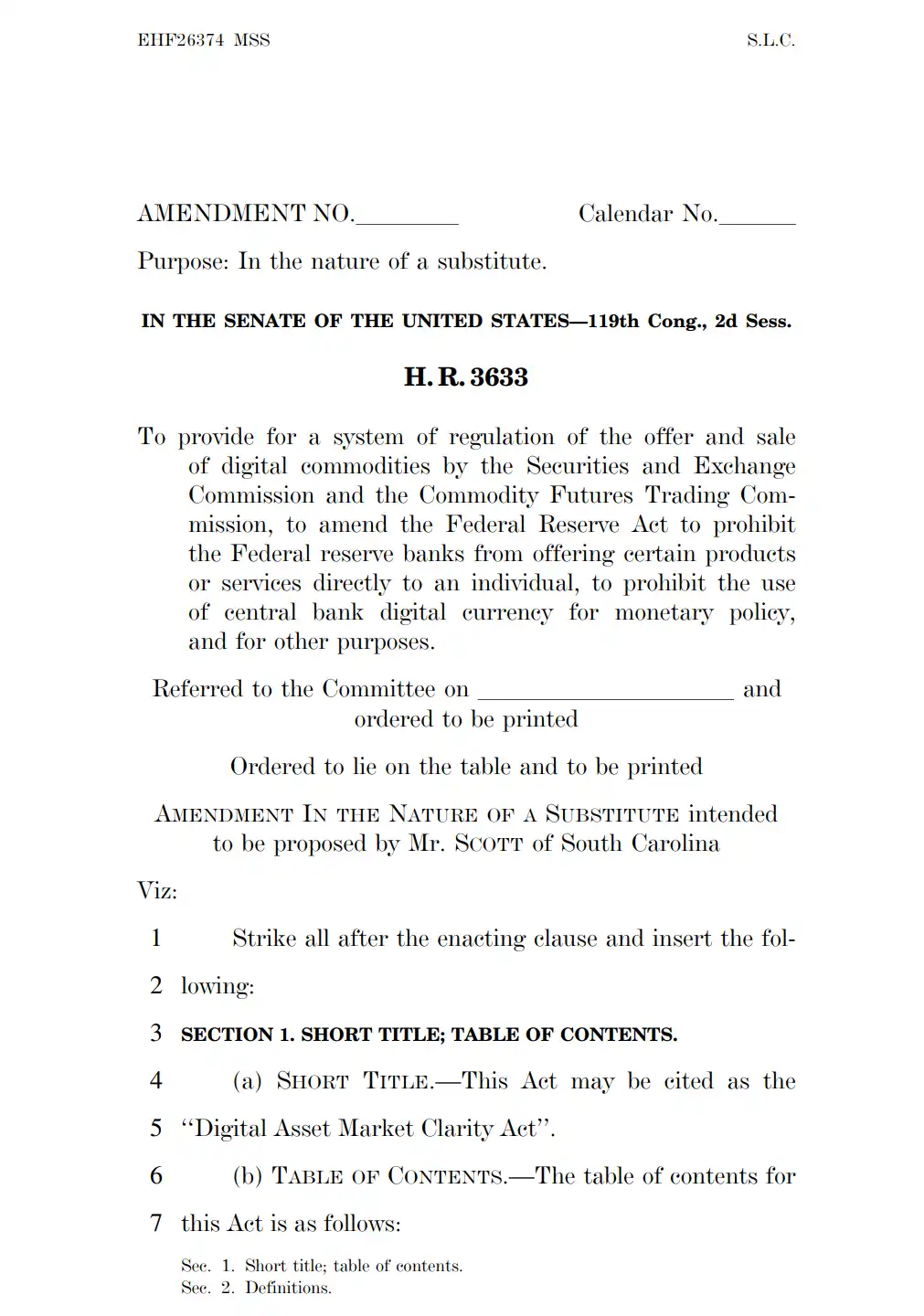
The draft, with a total of 309 pages, consists of nine parts, namely:
1. Securities innovation provides disclosure requirements and exemptions for transactions involving ancillary assets, defines the characteristics of "network tokens" and treats them as non-securities under certain conditions。
2. TO COMBAT ILLEGAL FINANCIAL TRANSACTIONS BY INCLUDING DIGITAL ASSETS IN THE SUPERVISION OF THE BANK SECRECY ACT (BSA) AND THE SANCTIONS ACT。
3. Regulation of the DeFi sector, which applies the existing securities intermediation and BSA requirements to decentralised financial agreements。
4. Banking and supervision, specifying the licensing of banks ' activities in digital assets. It is forbidden to pay interest or gain on the payment of a stable currency
5. CREATION OF A CFTC-SEC MICROINNOVATION SANDBOX, INTERNATIONAL COOPERATION, AUTOMATED COMPLIANCE STUDIES, SECURITIES MONETIZATION, VOLUNTARY ADOPTION OF POSTQUANT CODE STANDARDS, ETC。
6. Protection of software developers and customer property, protection of software developers, NFT safe harbours, non-homogenic token studies, block chain regulation certainty bill, Keep Your Coins Act (self-custodial protection)。
7. Protection of customer property
8. Client protection
Other matters, etc
AT THE HEART OF THE DRAFT IS THE SCOPE OF THE SEC AND CDTC REGULATORY BOUNDARIES, NON-SECURITIES TREATMENT OF TOKENS (COLLATERAL DISTRIBUTION, GOVERNANCE SYSTEM, ETC.)。
THE DRAFT BEGINS BY DEFINING THE BOUNDARIES BETWEEN "DIGITAL GOODS" AND "SECURITIES", THUS DIVIDING THE JURISDICTIONS OF THE SEC AND THE CFTC. ACCORDING TO THE MOST RECENT EXCERPT, THE CFTC WILL HAVE EXCLUSIVE JURISDICTION OVER “DIGITAL GOODS” — THE ORIGINAL TOKEN OF A MATURE NETWORK WHOSE VALUE IS MAINLY DERIVED FROM THE DECENTRALISED BLOCK CHAIN FUNCTION — WHILE THE SEC RETAINS JURISDICTION OVER “INVESTMENT CONTRACTS” AND ASSETS AT THE INITIAL DISTRIBUTION STAGE. THE DRAFT INTRODUCES "A MATURE BLOCK CHAIN TEST" , WHICH REQUIRES BLOCK CHAIN SYSTEMS TO MEET CONDITIONS SUCH AS NO SINGLE ENTITY CONTROL, DISTRIBUTED OWNERSHIP, OPEN SOURCE, SUCH AS BTC AND ETH。
ONCE CERTIFIED, THE RELEVANT TOKEN WILL AUTOMATICALLY BE CONVERTED TO A NON-SECURITIES, AND THE ISSUER MAY WAIVE PART OF THE SEC REGISTRATION REQUIREMENT, SUBJECT TO CONTINUOUS INITIAL AND SEMI-ANNUAL DISCLOSURE。
To put it simply, it went from "preliminary securities" to "general goods" when it matured, with much simpler regulation and more room for innovation。
In the case of intermediaries, digital commodity brokers, distributors and trading platforms must register with CFTC and fulfil customer asset segregation, risk disclosure, and anti-money laundering (BSA) obligations. In particular, the Bill incorporates provisions of the Zone Chain Regulatory Determination Act to provide clear exemptions for non-trustee DeFi agreements, nodal operators and open source developers - They do not need to be registered as money service providers or brokers, provided that the agreement is truly decentralised (decentralized governance does not in itself constitute “control”)。
THE CURRENCY STABILIZATION CLAUSE IS THE FOCUS OF THE LATEST COMPROMISE. THE BILL DEFINES IT AS A "LICENSED PAYMENT STABILITY CURRENCY" (I.E. A COMPLIANT PAYMENT STABILITY CURRENCY SUCH AS USDC) AND EXCLUDES IT FROM THE CATEGORY OF DIGITAL GOODS. THE NEW TEXT PROHIBITS DIGITAL ASSET SERVICE PROVIDERS COVERED FROM PAYING PASSIVE, SAVED INTEREST OR PROCEEDS TO UNITED STATES CUSTOMERS, BUT ALLOWS INCENTIVES BASED ON REAL ACTIVITIES OR TRANSACTIONS。
On 12 May, the new text included language on the restrictions associated with the Stabilisation Currency incentive, as well as the clause of the Blackchain Regulatory Certancy Act, making it clear that non-host developers were not financial transmitters. Coinbase, which had previously withdrawn its support because of a dispute over a stable currency incentive clause, has turned to support, but banking groups still consider the restrictions inadequate。
IN ADDITION, THE BILL EXPRESSLY PROHIBITS THE FEDERAL RESERVE FROM ISSUING OR DIRECTLY PROVIDING CBDC TO INDIVIDUALS AND REQUIRES FEDERAL AGENCIES NOT TO RESTRICT THE USE OF SELF-CUSTODY WALLETS, WHILE STRENGTHENING THE PROTECTION OF BANKRUPTCY ISOLATION AND TREATING DIGITAL GOODS AS “CLIENT PROPERTY”。
These provisions were the result of extensive consultations with regulators, law enforcement, financial institutions, innovators and consumer advocates. The Senate version was expanded to nine headings, with a greater focus on anti-illegal finance and consumer education than the Chamber of Deputies version。
The regulatory gap ends and institutional funds will flow back to the United States
Over the past decade, encryption in the United States has been in the "grey zone". SEC, known for its "law enforcement-type regulation", has brought long-term uncertainty to the industry in the litigation against platforms such as Coinbase and Ripple, leading to capital flight, project relocation to Singapore, Dubai, etc. The adoption of Clarity Act will provide, for the first time, a framework of certainty at the federal level。
FOR THE MARKET, THIS MEANS THAT INSTITUTIONAL INVESTORS AND TRADITIONAL FINANCE ARE MORE SECURE. THE EXPLICIT JURISDICTION OF THE CTC OVER SPOT DIGITAL COMMODITY MARKETS WILL FACILITATE MORE ETF PRODUCT EXPANSION, BANK HOSTING SERVICES AND PAYMENT INNOVATION. ACCORDING TO THE BILL ' S PROPONENTS, CLEAR RULES ARE EXPECTED TO ATTRACT INSTITUTIONAL FUNDS BACK TO THE UNITED STATES。
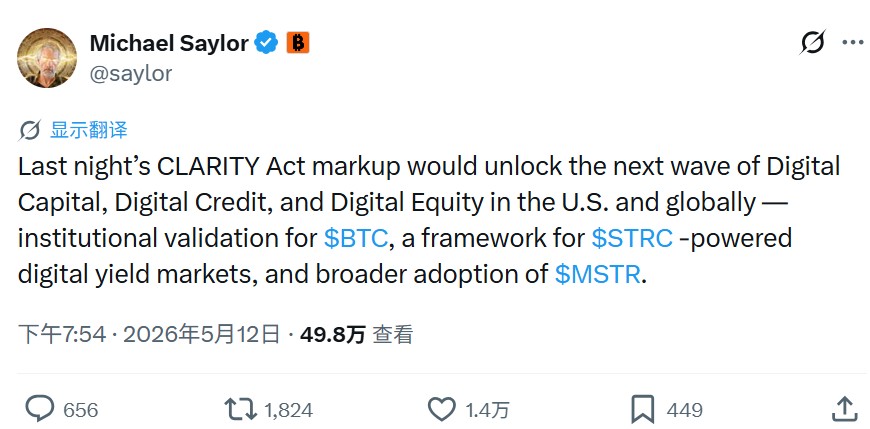
According to Michael Saylor, last night's CLARITY Act Review will release the next wave of digital capital, credit and digital interests in the United States and globally, providing institutional validation for the BTC。
a16z partner Chris Dixon and other encrypted leaders have long called for "a clear road to rules" that the bill would allow the United States to continue to lead innovation。
For users of the encryption industry and developers, DeFi developers receive "safe harbours", while ordinary users benefit from mandatory disclosure, asset segregation and anti-fraud clauses. The CTC will acquire new tools to combat market manipulation and illegal financial activities. At the same time, the Act retains jurisdiction over unfair fraud and requires the publication of educational material on digital asset fraud。
In terms of national competitiveness, Tim Scott, Chairman of the Senate Banking Commission, made it clear that the bill places consumers first, combats illegal finance, deters crime and foreign opponents, and leaves the financial future in the United States。
On 8 May, Paul Atkins, Chairman of the United States Securities and Exchange Commission (SEC), in a presentation on "Specially competitive research project at AI + Expo", stated that he supported a limited exemption for innovation and called on Congress to pass the CLARITY Act to provide long-term certainty in the form of legislation. Atkins warned that overregulation or uncertainty could push innovation overseas and that the United States should continue to lead global markets through understanding and adaptation。

There are, however, opposition voices. According to Bloomberg, the United States Confederation of Labour - Confederation of Industrial Trade Unions (AFL-CIO) issued a letter on Tuesday to the Senator against the CIAITY Act, which, according to the union, is deeply concerned that the bill will result in a massive influx of digital assets into pension schemes, retirement accounts and the wider financial system, putting working people at risk。
Disputes and differences: Bank lobbying, Democratic resistance and intra-industry games
Despite strong cross-party support, Clarity Act faces multiple resistance. The most controversial point is the stabilization of the gains clause。
HERE, THE CORE CONCEPT IS CLEAR: THE SO-CALLED "LICENSED PAYMENTS OF STABLE COINS" ARE THOSE THAT ANCHOR THE DOLLAR, SUCH AS THE ONE-TO-ONE, AND THAT ARE COMPLIANT AND STABLE (LIKE THE REGULATED USDC) THAT ARE MAINLY USED FOR DAILY PAYMENTS AND TRANSFERS。
The Act expressly prohibits such stable currency from paying any interest or “passive proceeds” of “deposit” to users, with the aim of preventing encrypted platforms from taking deposits from traditional banks. The core feature of any asset that has been characterized as “Payment Stablecoin” is that it does not generate interest, otherwise it would be subject to great compliance pressure。
TRADITIONAL BANKING HAS LONG BEEN A STRONG ALLY OF THE REPUBLICAN PARTY, BUT THE BILL IS SEEN AS A DIRECT ENGAGEMENT TO THEIR CORE INTERESTS. TRADITIONAL BANKING LOBBIES, SUCH AS THE AMERICAN BANKERS ASSOCIATION (ABA), ARE STRONGLY OPPOSED TO ANY FORM OF “PROCEEDS” ON DEPOSITS, WHICH WOULD ERODE THE BANK DEPOSIT BASE AND LEAD TO LARGE-SCALE OUTFLOWS。
At the beginning of this week, they sent an urgent letter to the National Bank of America CEO urging the complete closure of the encryption platform bypassing the GENIUS Act ban。
For its part, the encryption industry believes that overly restrictive incentives will severely stifle innovation and user incentives。
In January 2026, Coinbase CEO Brian Armstrong withdrew his support for a similar provision, which led to a one-time extension of the review; but only after the issuance of the latest compromise text at the beginning of May did he publicly reply to "Mark it up", indicating that the industry had accepted the compromise。
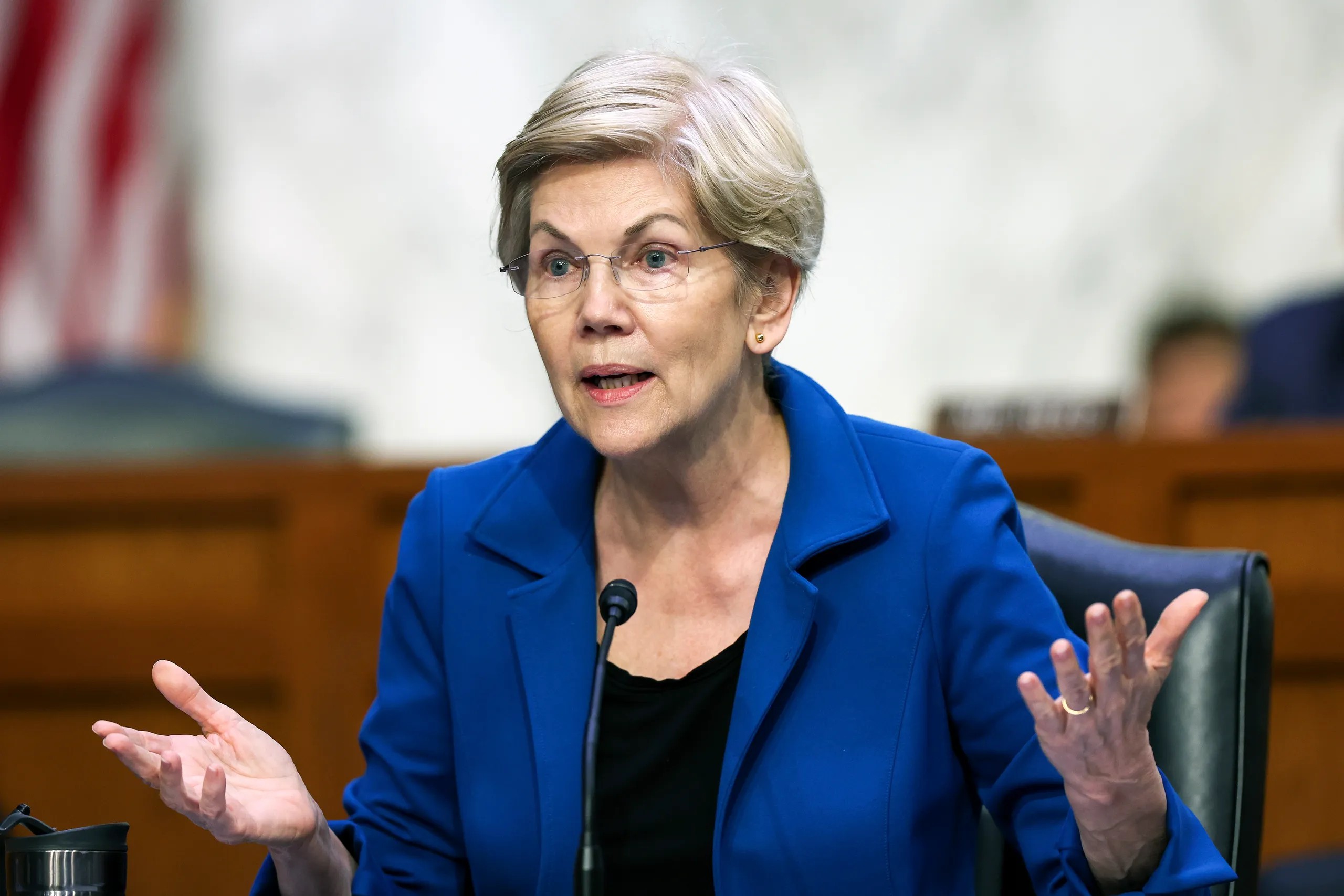
Elizabeth Warren
She has criticized the Bill for “depreciating the securities law” as a “green light for corruption in the Trump” and has promoted 38 amendments to strengthen AML requirements, official currency disclosure and prevent public officials and their families from profiting from encryption. Warren stated that the Trump family had earned at least hundreds of millions of dollars in its tenure through encrypted transactions, and that the bill would jeopardize investors and national security if it did not have enough firewalls。
The harsher political reality lies in the Senate voting threshold: the Republican party currently holds approximately 53 seats in the Senate, the Democratic Party 45, and the non-party 2 seats (usually in conjunction with the Democratic Party group). And to close the debate to the final ballot, 60 votes super-majority. This means that the bill must be supported by at least 5 Democrats。
It is precisely this critical point that the Bank Lobby has seized to create resistance through the coalition of some Democrat parliamentarians — the repeated saw-sawing to stabilize the interest-rate clause — that was the biggest variable advanced by the previous bill。
There have also been divisions within the industry. DeFi immunity is perceived by some as a risk of money-laundering, while the Bank vs encrypted lobbying war is more hot. Senator Thom Tillis admitted that after months of hard negotiations with stakeholders, it was a bipartisan compromise。
Following the passage of the Clarity Act Bill, the Committee will formally report to the Senate as a whole, entering the stage of debate and voting (60 votes to close the debate). After the vote was passed, the text had to be harmonized with the 2025 version of the House of Representatives, which once again voted unanimously and sent it to the President for signature. After the President's signature, the core regulatory framework will not be formally landed until the joint by-laws of the SEC and the CTC are completed within 360 days。
Original Link
