Ether's narrative is being rewritten: When L1 zkEVM becomes final, when will the next revolution come
IF 2021-2024 IS THE “L2 OUTSOURCING AGE”, THIS YEAR MARKS THE BEGINNING OF THE “SOVEREIGN RETURN” OF THE ETHER HOUSE。
Physically only, since 2025, the community of developers of the Taifung core has been extremely frequently updated。
From Fusaka to Glamsterdam to the next three years of long-term planning around issues such as kEVM, the antiquantified password system, and Gas Limited, the Taifung has published a series of road map documents covering three to five years in a few months。
This rhythm itself is a sign。
If you read the latest road map carefully, a clearer and more radical direction emerges:The Ether Workshop is transforming itself into a verifiable computer, the end of which is L1 zkEVM。
I. THREE DIRECTIONS IN THE ETAST
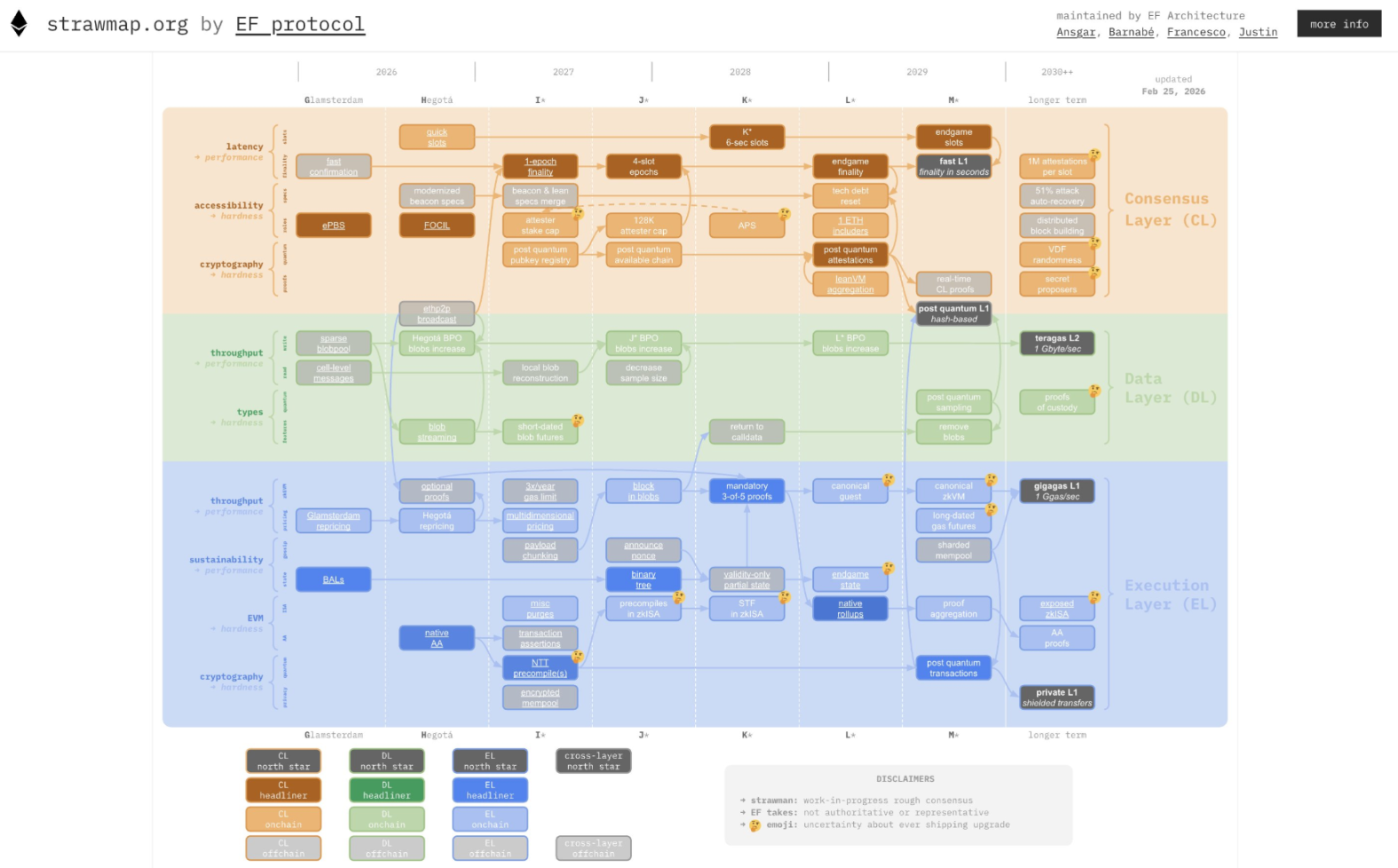
On 26 February, Justin Drake, a researcher of the Taifung Foundation, wrote on social platforms that the Taifung Foundation had presented a draft road map called Strawmap, outlining the course for the upgrading of the Taifung L1 agreement in the coming years。
The road map sets out five core objectives: faster L1 (second-level final confirmation), "Gigagas" L1 of 10,000 TPS through zkEVM, high-input L2 based on data availability (DAS), antiquity password system, primary privacy transfer function, while the road map plans to have seven protocol splits by 2029, on average, every six months。
We can say that:Over the past decade, the development of the Ether Mill has been accompanied by a continuous evolution of narrative and technical routes。
the first phase (2015-2020) is a programmable book.
This is the core of the Ether's original narrative, "Turing's complete smart contract." The greatest advantage is that it can do more than bitcoin. DeFi, NFT, DAO, for example, are the product of this narrative, with a large number of decentrized financial agreements starting to operate in chains, from borrowing, DEX, to stabilizing currency, and increasingly becoming the main clearing network for the encrypted economy。
THE SECOND STAGE (2021-2023) WAS L2 NARRATIVE。
Rollup began to become a major builder as the cost of the Taipei main chain Gas increased, making transaction costs difficult for ordinary users. The Taifeng has also gradually repositioned itself as a settlement layer, designed to provide a basic base for L2 security。
In simple terms, moving most of the calculations from the executive level to L2, expanding through Rollup, while L1 is only responsible for data availability and final settlement, the Merge, EIP-4844 are serving this narrative, aiming to make L2 use of the trust of the utensils cheaper and safer。
The third phase (2024-2025) focused on narratives and reflections。
It is well known that the prosperity of L2 has created an unexpected problem, namely, that the ETA L1 itself has become irrelevant, that users have begun to operate more on Arbitrum, Base, Optimism, with little direct contact with L1, and that this anxiety is confirmed by the price performance of ETH in the Taipo。
THIS HAS LED COMMUNITIES TO DEBATE WHERE L1 VALUES ARE CAPTURED IF L2 DIVIDES ALL USERS AND ACTIVITIES. UNTIL 2025, WHEN THE ETHER'S INTERNAL SHOCK, AND 2026, THE LATEST SERIES OF ROAD MAPS, THIS LOGIC IS UNDERGOING PROFOUND EVOLUTION。
In fact, combing the core technology directions since 2025, the re-emergence of Verkle Tree, Statue Client, EVM formalisation, ZK support, etc., point to the same thing: to make L1 the Taipei & L1 itself verifiable, it needs to be noted, not only that L2 certificates can be validated on L1, but that each L1 conversion can be compressed and validated through zero-knowledge certification。
That's exactly what L1 zkEVM is all about. Unlike L2, the zkEVM, L1 zkEVM (shell zkEVM) means that zero-knowledge proof technology is integrated directly into the ETA Consensus。
It is not a recapitulation of L2 zkEVM (e.g. zkSync, Starknet, Scroll), but instead transforms the Ether's executive layer itself into a ZK friendly system, so..If L2 zkEVM is building a ZK world on the Ether House, then L1 zkEVM is turning the Ether House itself into that ZK world。
ONCE THIS GOAL IS ACHIEVED, THE STORY OF THE TAIFUNG WILL BE UPGRADED FROM L2 SETTLEMENT LEVEL TO A "VERIFIABLE CALCULATION OF TRUST"。
That would be a qualitative change, not a quantitative change like that of the past few years。
II. WHAT'S REAL L1 ZKEVM
It's also an old saying that, in traditional models, a certifier needs to "re-execut" every transaction to verify a block, while in zkEVM, a certifier needs only to verify a ZK Proof, which allows the Taifu to raise Gas Limited to 100 million or more without increasing the node burden (extension readingZK ROUTE "DAWN TIME": THE ROAD MAP TO THE END OF THE TAIFUNG IS FULLY ACCELERATING)。
However, the transformation of the L1 into a zkEVM is not a single-point breakthrough, but a simultaneous push in eight directions, each of which is a multi-year project。
Workline I: EVM Formalization (EVM Force)
All ZK certificates are premised on a precise mathematical definition of the object, but today's EVM, whose behaviour is defined by the client (Geth, Nethermind, etc.) rather than by a strictly formalized norm, may not be the same for different clients in border situations, making it extremely difficult to prepare ZK circuits for EVM, after all, you cannot prove a vaguely defined system。
So the goal of this line of work is to write every EVM directive, every state conversion rule, into a formable norm that can be verified by a machine. This is the foundation of the entire L1 zkEVM project. Without it, everything after that is a tower built on sand。
WORKLINE II: ZK FRIENDLY HASH REPLACEMENT
The Ether is currently using Keccak-256 extensively as a Hash function. Keccak is extremely unfriendly to the ZK circuits and calculates the costs, which would significantly increase the time and cost of proof。
And the core task of this line of work is to gradually replace Kecak within the Taifung with the ZK friendly Hash function (e.g., Poseidon, Blake series), especially with the state tree and Merkle prove that this is a whole-body modification, because the Hash function penetrates every corner of the ETA。
Workline three: Verkle Tree Replace Merkle Patricia Tree
This is one of the most significant changes in the 2025-2027 road map. The current use of Merkle Patricia Tree (MPT) for global storage and the replacement of the Hashi link by Verkle Tree through Vector Committee can reduce the backlog by dozens of times。
For L1 zkEVM, this means that the amount of data required to prove that each block is significantly reduced, that the rate of generation has increased significantly, and that the introduction of Verkle Tree is a key infrastructure prerequisite for L1 zkEVM ' s viability。
Workline 4: Unstated Clients
a non-state client refers to a node validation block, which does not require a complete local storage database of the n.a. status, but only a witness data attached to the block itself。
This line of work is tied to the Verkle Tree depth, because only the wits are small enough to be viable for a non-state client, so the significance of a non-state client is twofold for L1 zkEVM: on the one hand, it significantly lowers the hardware threshold for running nodes and contributes to decentrization; on the other hand, it provides the ZK certificate with a clear input boundary, so that the proofer only has to process the data contained in wits, not the state of the world。
WORKLINE V: STANDARDIZATION AND INTEGRATION OF ZK CERTIFICATION SYSTEMS
L1 zkEVM requires a mature ZK certification system to produce proof for block execution, but the current technology pattern in the ZK field is highly dispersed and without the recognized best solution. The goal of this line of work is to define a standardized proof interface (proof interface) at the Taifaf protocol level, so that different certification systems can be accessed on a competitive basis rather than fix a family。
This has kept technology open and allowed room for the continuous evolution of the system, in which the PSE (Privacy and Scaling Operations) team has accumulated considerably ahead of schedule。
Workline VI: Decoupling between Executive and Consensus Levels (Engine API evolution)
Currently communicates via Engineering API via the Executive Level (EL) and the Consensus Level (CL). In the structure of L1 zkEVM, every state conversion in the executive layer requires the production of ZK certificates, which may be generated at a much longer time than a block break。
The core issue to be addressed in this line of work is how to generate decoupling and certification without undermining the consensus mechanism — implementation can be accomplished quickly, it can be proven that it can be produced late and then final confirmation by the certifying officer at the appropriate time. This involves deep modifications to the Finality model。
Workline VII: Recursive certificate and certificate aggregation
The ZK of a single block has proved to be costly to generate, but if the certificate of multiple blocks can be condensed into a single certificate, the cost of certification will be significantly reduced and the progress of this work line will determine directly how low the L1 zkEVM can run。
WORKLINE 8: DEVELOPER TOOL CHAIN AND EVM COMPATIBILITY SAFEGUARDS
All bottom-level technological adaptations must ultimately be transparent to the developers of smart contracts at the Ether House. Hundreds of thousands of existing contracts cannot be invalidated by the introduction of zkEVM, and developers ' tool chains cannot be forced to rewrite。
This line of work is the one that is most easily underestimated, but often the most time-consuming, with every EVM upgrade in history requiring extensive backward compatibility testing and tool chain adaptation, L1 zkEVM changes far more than upgrades, and the volume of tool chain and compatibility work being increased at the quantitative level。
III. Why is this the right time to understand this
Strawmap's release coincided with the market's doubts about ETH's price performanceFrom this perspective, the most important value of the road map is being redefined as “infrastructure”。
Strawmap provides directional certainty for Builder, which is represented by developers; for users, these technological upgrades will eventually translate into a perceived experience: transactions are finally identified within seconds, assets flow seamlessly between L1 and L2 and privacy protection becomes an built-in function rather than a plugin。
To be objective, of course, L1 zkEVM will not be a product that will land in the near future, and its completeness may take up to 2028-2029 or even later。
But at least it redefines the value proposition of the Taifung, which, if L1 zkEVM succeeds, will no longer be just a settlement layer for L2, but a verifiable trust base for the entire Web3 world, allowing any state of the chain to be traced mathematically to the ZK certification chain of the Taifeng, which is decisive for capture with its long-term value。
SECOND, IT AFFECTS THE LONG-TERM POSITIONING OF L2, WHICH, AFTER ALL, WILL CHANGE WHEN L1 HAS ITS OWN ZK CAPABILITY – FROM A “SAFE-ENHANCEMENT PROGRAM” TO A “DEDICATED IMPLEMENTATION ENVIRONMENT” – AND WHICH L2 CAN FIND ITS PLACE IN THIS NEW LANDSCAPE WILL BE THE MOST INTERESTING ECOLOGICAL EVOLUTION IN THE COMING YEARS。
The most important thing is that I thinkIt is also an excellent window for observing the culture of the developers of the Taifeng — one that can simultaneously advance eight interdependent technical lines of work, each of which is multi-year-scale work, and maintains a decentralized and coordinated approach, which is in itself the unique ability of the Taifeng as an agreement。
Understanding this would allow for a more accurate assessment of the true location of ETA in the various competition narratives。
On the whole, from 2020, when Rollup was at the centre, to 2026, when Strawmap reflected a clear trajectories that the expansion could not be based solely on L2, L1 and L2。
So the eight lines of L1 zkEVM, the technological map of this cognitive shift, collectively point to a goal of increasing the performance of the ETA without losing its focus, not as a denial of the L2 route, but as a refinement and supplement。
In the next three years, this Tseus ship will go through seven forks and replace countless boards, and when it arrives at the next stop in 2029, we may see a truly global settlement— Fast, secure, private and, as always, open。
We'll see。
